# Buildout Index
What it costs to open a small restaurant, line by line, from the filings.
## What it costs to open
Item 7 is the franchisor's guess at what it costs to open. The low end usually
assumes a finished room, a landlord cheque, or a smaller box. The high end
usually assumes a shell. There is no official middle figure.
The federal form asks for each expenditure, the amount, when it is paid, and
who gets it. The [FTC's Franchise Rule compliance
guide](https://www.ftc.gov/system/files/documents/plain-language/bus70-franchise-rule-compliance-guide.pdf)
also draws a line the brochure likes to ignore: Item 7 is an opening estimate,
not a forecast of rent, royalty and advertising for the life of the deal.
Two filings can put the same cost under different labels, or bury it inside a
wider row that cannot be split without inventing a number. Line items stay
when the filing has them, and stay absent when it does not.
Every brand below discloses an Item 7 total. Six also have worksheets. Döner
Haus's 2026 table is eighteen rows totalling $359,500–$586,000 for an
850–1,200 square-foot imbiss — the compact sandwich shop in this set. German
Doner Kebab, Shah's Halal Food, The Great Greek, Mad for Chicken and 375° Chicken
'n Fries are the other five. Doner Shack publishes
$498,000–$1,007,000 with no worksheet here. Wienerschnitzel has fees in the
companion directory and no Item 7 in this one.
## How to use the directory
Start with **format and filing year**, not rank. A 1,200-square-foot counter
shop and a 4,000-square-foot full restaurant are different projects even when
their totals overlap. Figures from different years also carry different labor,
material, and rent assumptions. Every row below keeps the disclosure year
beside the figure for that reason.
Döner Haus's 2026 table is a single unit in a typical retail space of
850–1,200 square feet at $359,500–$586,000 — the compact imbiss in this set,
and the one you can buy without a five-shop minimum. GDK's 2024 table is a
1,200–1,400 square-foot outlet inside a five-outlet minimum, at
$690,500–$1,123,000, from a US company with six loss years on file. Shah's 2024 table is a 1,200–2,000 square-foot
full-sized restaurant at $197,000–$405,000. Great Greek's 2023 table is an
1,800–2,000 square-foot in-line or end-cap at $582,014–$1,088,560. Mad for
Chicken's 2025 table is a 2,000–4,000 square-foot Full Restaurant at
$321,125–$691,700, with a separate Express Model disclosed at $243,500–$470,700
on 750–2,000 square feet and a Multi-Unit Development Agreement at
$263,500–$711,700 that is a commitment rather than a store. 375°'s 2024 table is an
800–1,500 square-foot outlet at $324,100–$521,500. Those six descriptions sit next to the six totals.
Next, open a line-item page where one is available. Read the original labels,
then the footnotes in the issued FDD. This index keeps the filing's numbers;
it does not turn “restaurant package” into a guessed equipment/construction
split. If a filing supplies only a total, the total remains listed and the
breakdown remains absent.
Then replace the filing's general assumptions with evidence for the actual
site: a contractor's site-specific scope; the lease, landlord work, and
tenant-improvement allowance; required equipment and utility connections; a
monthly cash model for the stated initial period and beyond; and recent
franchisees' actual opening costs.
The [FTC's review guide](https://www.ftc.gov/business-guidance/blog/2023/05/franchise-fundamentals-taking-deep-dive-franchise-disclosure-document)
specifically points readers to recent franchisees for opening-time and
total-investment evidence. Public state records provide another check on what
an Item 7 actually says: Minnesota's filed
[Shah's Halal disclosure](https://cards.web.commerce.state.mn.us/documents/%7B9078B29B-0000-C21E-982F-C2FDAFB07783%7D/download?contentSequence=0&documentClass=FRANCHISE_REGISTRATIONS)
separates construction from a fixture package, while a filed
[Great Greek disclosure](https://cards.web.commerce.state.mn.us/documents/%7B40DC349A-0000-CFD3-B1AA-6F584E40E621%7D/download?contentSequence=0&documentClass=FRANCHISE_REGISTRATIONS)
uses a combined equipment, furniture, supplies, and fixtures line. Those are
not interchangeable labels.
## Build and format
Construction is usually the widest row, and it is the row whose label changes
the most. GDK splits leasehold improvements, mechanical/electrical/plumbing,
fit-out, and architect fees; Shah's prints one build-out line; Great Greek
pairs a design fee with leasehold improvements that run $250,000–$650,000.
Start with [construction](/construction/), then [equipment](/equipment/),
[signage](/signage/), and [technology](/technology/). Great Greek's restaurant
package and Shah's fixture package are not equipment synonyms;
[restaurant package](/restaurant-package/) keeps those bundles whole.
Site condition explains more of the construction spread than contractor
uncertainty around one defined scope. [Second generation versus
shell](/second-generation-vs-shell/) is the delivered-condition test.
[Tenant-improvement allowance](/tenant-improvement-allowance/) is the cash-timing
test for landlord money. [Cost per square foot](/cost-per-square-foot/) shows
what you get when you divide an Item 7 range by a square-footage range, and
why the result is still not a bid.
## Soft costs and occupancy
The opening check that looks like rent is usually a deposit.
[Rent](/rent/) and [deposits and prepaid amounts](/deposits-and-prepaid/) share
the real-estate labels and then split the questions: what cash leaves before
opening, versus what occupancy costs each month after that. [Franchise
fee](/franchise-fee/) is the Item 5 amount that also appears as an Item 7 row;
Great Greek's low column uses a discounted fee for affiliated-brand owners, and
bluTaco discloses no initial fee. [Opening inventory](/opening-inventory/),
[professional fees](/professional-fees/), [grand opening](/grand-opening/),
[licenses and permits](/licenses-and-permits/), [insurance](/insurance/), and
[training costs](/training-costs/) are the other named soft-cost rows.
[Soft costs](/soft-costs/) groups professional, training, insurance, licenses,
and miscellaneous opening costs so they can be seen together without forcing
them into one invented line. [Working capital](/working-capital/) is the
additional-funds estimate for the stated initial period — three months in four
of the itemised filings, up to six in Great Greek — and is not a break-even
promise.
## How to read the table
[How to read Item 7](/how-to-read-item-7/) is the sequence: offering and date,
every column, footnotes, arithmetic, then Items 5, 6, 8, and 11, then a site
budget. [What the range hides](/what-the-range-hides/) is the companion:
format, bundled labels, discounts, zeros, filing year, and the Shah's
high-column sum of $410,000 against a printed $405,000. The [printable
worksheet](/item-7-worksheet/) is a blank table in that reading order, with no
calculator.
Three chapters handle tables that are not a single restaurant's cost.
[Reading a multi-unit Item 7](/reading-a-multi-unit-item-7/) covers the
development-agreement tables in Mad for Chicken's and Doner Shack's 2025
filings, both of which price the commitment plus one outlet rather than the
outlets they oblige. [What a revision tells you](/what-a-revision-tells-you/)
works the only valid year-over-year comparison here, where a single training
row accounts for the whole movement. And [the franchisor behind the
estimate](/the-franchisor-behind-the-estimate/) reads the Item 21 audited
statements bound into the same documents, on the same terms for every brand
here, Döner Haus included.
## What the totals table is
Each row below is an issued range, a format statement, and a disclosure year.
Sorting by high estimate answers a planning question — how much cash the
franchisor's own high column contemplated — and does not answer which brand is
cheaper to build. Shah's $405,000 high and GDK's $1,123,000 high are both 2024
restaurant tables; one is a 1,200–2,000 square-foot full-sized restaurant with
a fixture package, the other is a 1,200–1,400 square-foot outlet inside a
five-outlet minimum with split MEP and fit-out. Döner Haus's
$359,500–$586,000 is a 2026 imbiss range. Great Greek's $582,014–$1,088,560 is
a 2023 in-line or end-cap. Mad for Chicken's Express Model of
$243,500–$470,700 is a second offering in the same 12 March 2025 filing as the
$321,125–$691,700 Full Restaurant, and the third table in that document — a
Multi-Unit Development Agreement at $263,500–$711,700 — prices entry into a
three-outlet commitment plus the first outlet, so it is not a restaurant total
and does not belong in the ranking at all. [Reading a multi-unit Item
7](/reading-a-multi-unit-item-7/) is why.
Click through to a cost page when the filing itemises. The generated table
keeps original labels, prints the filing's total, and notes when the high
column does not add to that total. Shah's is the live example: fifteen lines
sum to $410,000 against a printed $405,000. The cost page also states the
working-capital period, which is three months for GDK, Shah's, Mad for
Chicken, 375° and Döner Haus, and zero to six months for Great Greek.
Brands that have a total and no worksheet stay on this page only. Do not
infer their construction or equipment from a neighbor. Do not infer Doner
Shack line items from its total. Do not infer Wienerschnitzel investment from
its fee and unit counts.
## A reading path
If the task is to understand one brand, open that brand's cost page first,
then [how to read Item 7](/how-to-read-item-7/), then the chapter for the
widest row in that table — construction for GDK and Great Greek, additional
funds for Mad for Chicken, the fixture-plus-build-out pair for Shah's. If the
task is to compare two brands, read [what the range hides](/what-the-range-hides/)
before subtracting one total from the other. If the task is a live site, print
the [worksheet](/item-7-worksheet/) and fill it from the FDD that was actually
delivered, using the totals below as a second check on labels.
The FTC's fourteen-day rule, described in its
[FDD walkthrough](https://consumer.ftc.gov/consumer-alerts/2023/05/franchise-fundamentals-taking-deep-dive-franchise-disclosure-document),
is the clock for that live document. A comparative table compiled from earlier
filings cannot replace it. Filing years below are there so a 2023 Great Greek
total is not ranked against a 2026 Döner Haus range as if they were the same
year's bids.
Companion reading for ongoing fees rather than buildout is the fee directory
at [qsrlandscape.com](https://qsrlandscape.com/). Item 6 stacks and Item 7
ranges answer different questions; this site is the second of those.
Use the chapters to decide which questions to carry into a current FDD, a
lease, and a contractor's scope. Use the table below for the issued totals
and filing years. Use a line-item cost page when the filing supplies one.
HTML: https://donerhandbook.com/
## Construction and leasehold improvements
Construction is usually the widest and least portable part of a restaurant
Item 7. “Leasehold improvements,” “build-out,” “fit out,” and “mechanical,
electrical and plumbing” may be separate rows, combined rows, or parts of a
larger package. The label tells you where the franchisor put the estimate; it
does not prove that two brands priced the same scope.
The comparison table injected below this chapter adds every construction-bucket
row inside a filing and shows that sum against the brand's own high total. Read
that table as a map of labels, not as proof that German Doner Kebab, Shah's
Halal Food, The Great Greek, Mad for Chicken, 375° Chicken 'n Fries and Döner
Haus bid the same contractor work.
## Begin with the delivered condition
A **cold shell** may have little beyond structure and utility service near the
premises. A **white box** may add walls, a ceiling, lighting, and basic
distribution but still lack restaurant infrastructure. A **second-generation
restaurant** may already have a hood path, grease handling, floor drains,
electrical capacity, gas service, restrooms, and usable HVAC. Each term is only
shorthand. The lease exhibit, landlord plans, field survey, and code review
decide what is actually present and who must make it work.
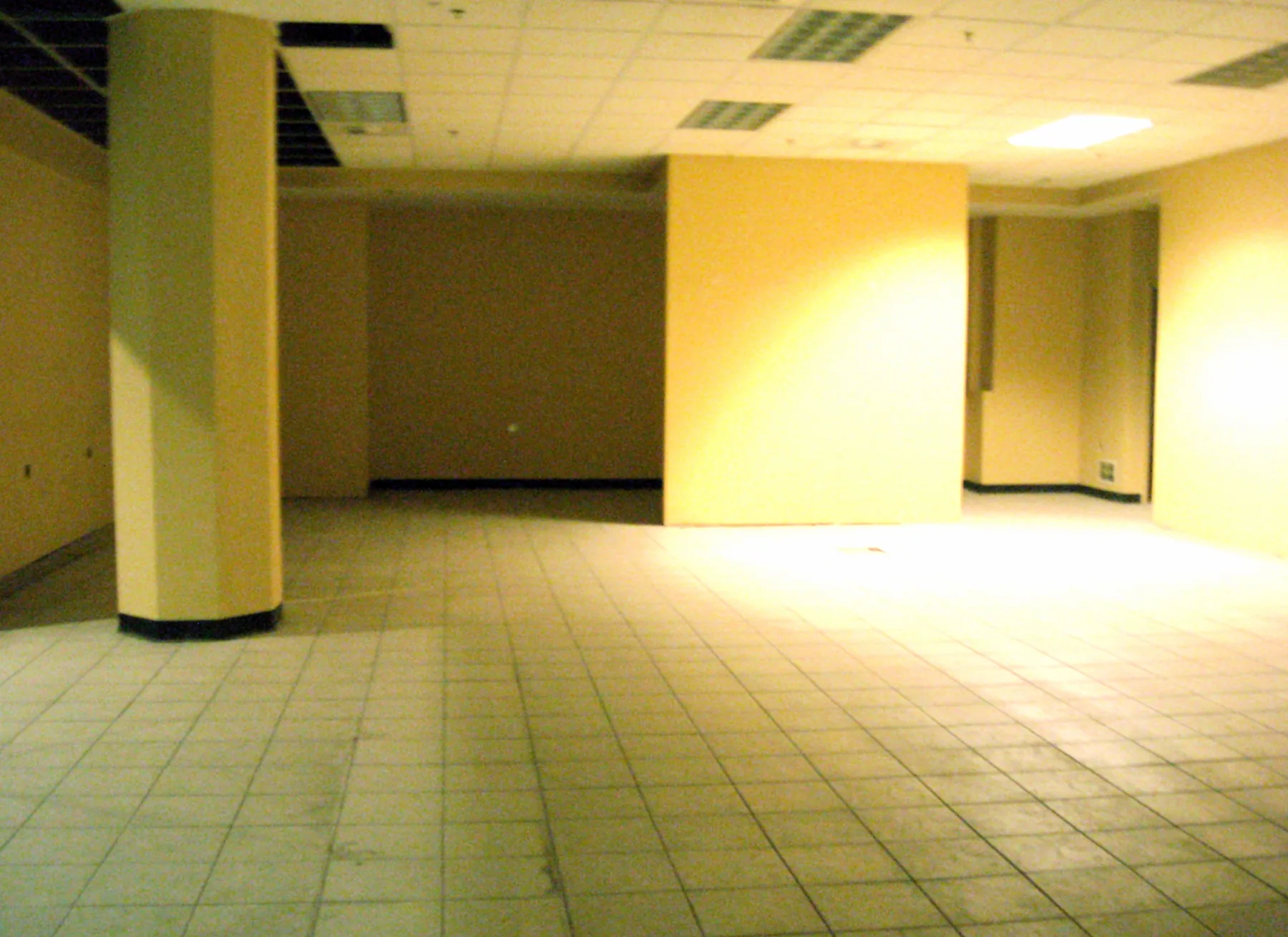
A vacant interior can look close to reusable while concealing the expensive questions: utility capacity, exhaust routing, drainage, fire protection, accessibility, and what the landlord will deliver. Photograph by chrstphre, CC BY 2.0.
Second generation is not automatically cheap. Existing equipment may be at the
end of its life; a hood may be the wrong type or length; the grease interceptor
may be undersized; rooftop penetrations may need remediation; and a prior
certificate of occupancy does not guarantee approval for a different menu or
layout. A contractor and the relevant design professionals need to test what
can remain before the lease makes that assumption expensive. The
[second-generation versus shell](/second-generation-vs-shell/) chapter walks
through those tests; this one stays with how filings disclose the work.
## Worked example: four ways to label the same problem
The six restaurant filings that itemise costs here do not use one
construction row. Adding the construction-bucket lines *inside* each filing —
without splitting any package — produces six different stories:
| Brand | Construction labels in the filing | Low | High |
| --- | --- | ---: | ---: |
| German Doner Kebab | Leasehold Improvements; Mechanical, Electrical and Plumbing; Fit Out Materials & Installation; Architects and Project Manager Fees | $355,000 | $680,000 |
| Shah's Halal Food | Build-Out/Construction | $80,000 | $160,000 |
| The Great Greek | Design and Project Management Fee; Leasehold Improvements | $260,000 | $660,000 |
| Mad for Chicken | Architectural Plans; Leasehold Improvements, Construction and/or Remodeling | $85,000 | $255,000 |
| 375° Chicken 'n Fries | Architectural Plans; Leasehold Improvements, Construction and/or Remodeling | $108,000 | $212,000 |
| Döner Haus | Construction, Leasehold Improvements | $131,000 | $266,000 |
Those sums are additions of rows the documents already printed. They are not
contractor bids, and they are not comparable scopes.
German Doner Kebab's 2024 table is the clearest warning against reading a single
cell. **Leasehold Improvements** run $0–$250,000. That zero is not a free
restaurant. **Mechanical, Electrical and Plumbing** still run $150,000–$175,000,
**Fit Out Materials & Installation** $175,000–$205,000, and **Architects and
Project Manager Fees** $30,000–$50,000. Even if leasehold improvements are
assumed unnecessary, the other three construction rows still total
$355,000–$430,000. The $0 low end describes a site assumption, not the absence
of construction.
Shah's Halal Food's 2024 table does the opposite: one **Build-Out/Construction**
line of $80,000–$160,000, with a separate **Fixture Package** of $30,000–$50,000.
Minnesota's public [Shah's Halal
filing](https://cards.web.commerce.state.mn.us/documents/%7B9078B29B-0000-C21E-982F-C2FDAFB07783%7D/download?contentSequence=0&documentClass=FRANCHISE_REGISTRATIONS)
keeps those two lines apart. A reader who compares only “construction” across
brands will understate Shah's hard costs relative to a brand that folded
fixtures into build-out, or overstate them relative to a brand that split MEP
and fit-out the way GDK did.
The Great Greek's 2023 table puts **Leasehold Improvements** at $250,000–$650,000
and a separate **Design and Project Management Fee** at $10,000. The restaurant
package of $225,964–$248,560 sits outside construction; the filing does not
say how much of that package is millwork, equipment, or furniture, so this
chapter does not guess. A filed [Great Greek
disclosure](https://cards.web.commerce.state.mn.us/documents/%7B40DC349A-0000-CFD3-B1AA-6F584E40E621%7D/download?contentSequence=0&documentClass=FRANCHISE_REGISTRATIONS)
is the place to read the original labels together.
Mad for Chicken and 375° Chicken 'n Fries use the same pair of labels —
**Architectural Plans** plus **Leasehold Improvements, Construction and/or
Remodeling** — at different amounts and different footprints. Mad for Chicken's
12 March 2025 table is for a full restaurant of 2,000–4,000 square feet, with
architectural plans of $10,000–$20,000 and leasehold work of $75,000–$235,000.
375°'s 2024 table is for an 800–1,500 square-foot outlet, with plans of
$8,000–$12,000 and leasehold work of $100,000–$200,000. Same row names, different
projects. The [cost per square foot](/cost-per-square-foot/) chapter shows why
dividing either range by area is still not a bid.
## The landlord contribution is not a deduction
A tenant-improvement allowance is a lease term, not free construction. The
[commercial real-estate explanation from Cushman &
Wakefield](https://www.cushmanwakefield.com/en/united-states/insights/tenant-improvement-allowance)
describes it as a pre-negotiated contribution, often stated per square foot.
The lease still determines eligible costs, documentation, disbursement timing,
unused balances, and whether the tenant must first pay the contractor and wait
for reimbursement.
An Item 7 footnote may say that a landlord contribution could reduce the
franchisee's cost without putting a guaranteed allowance in the low column.
Another estimate may be shown before any contribution. Neither treatment tells
you the economics of a specific lease. Model the gross construction contract,
the cash timing of every draw, the allowance actually available, and the rent
or term exchanged for it as separate lines. The
[tenant-improvement allowance](/tenant-improvement-allowance/) chapter is the
place to work that cash timing; here the point is narrower: do not subtract an
hoped-for allowance from the Item 7 construction high and call the remainder
the budget.
The City of Seattle's public [commercial lease
tool](https://www.seattle.gov/documents/departments/economicdevelopment/oisi/english%20final%20full%20lease%20tool.pdf)
is useful well beyond Seattle because it forces the questions Item 7 cannot:
when rent starts, who performs landlord work, which operating expenses pass
through, and how improvement obligations appear in the final lease.
## What sits next to construction without being construction
Design fees, project management, permits, and testing can live in construction,
in [professional fees](/professional-fees/), or in
[licenses and permits](/licenses-and-permits/). GDK puts architects and the
project manager in the construction group. Mad for Chicken and 375° put
architectural plans there and keep **Professional Fees** and **Business Licenses
and Permits** as their own rows. Great Greek's design fee is a construction row;
its **Utility Deposits/Licenses** row is not. Shah's puts **Licenses, Permits**
on a $1,000–$3,000 line and **Legal & Accounting** on another. Döner Haus keeps
**Professional Fees** at $12,000–$16,000 and **Licenses and Permits** at
$1,000–$3,500 outside its combined construction row, so whatever design work
that row contains is not separately visible.
Low-voltage, hoods, grease interceptors, and equipment connections create the
same boundary problem with [equipment](/equipment/). A hood hung by the general
contractor can sit in construction; a hood shipped with a kitchen package can
sit in equipment or in a restaurant package. The filing's label is the only
public evidence of where the franchisor put the estimate.
## What Item 7 cannot reveal
Even a careful estimate cannot show the condition behind the walls, the
authority having jurisdiction's interpretation, bid-market movement, long-lead
equipment coordination, utility-company timing, or change orders discovered
after demolition. Nor does the headline range show whether design,
project-management, low-voltage, permit, testing, and expediting costs sit
inside construction or in their own rows.
Filing year compounds the problem. GDK, Shah's and 375° are 2024 disclosures;
Great Greek is a 2023 disclosure; Mad for Chicken's is the FDD issued 12 March
2025 and Döner Haus's is 2026. Labor, materials, and
permit assumptions age. A 2023 leasehold range is evidence of what that
document disclosed, not a current contractor number.
Before treating the construction line as a budget, name the format printed
with the table (GDK: 1,200–1,400 sq ft inside a five-outlet minimum; Shah's:
1,200–2,000 sq ft full-sized restaurant; Great Greek: 1,800–2,000 sq ft
in-line or end-cap; Mad for Chicken: 2,000–4,000 sq ft full restaurant; 375°:
800–1,500 sq ft; Döner Haus: 850–1,200 sq ft). List every construction-bucket
label in *that* filing before comparing it with another brand. Read the $0 or
very low leasehold figure against the other construction rows, as in GDK's
MEP and fit-out lines. Architecture, project management, and permits may sit
inside construction or elsewhere. Obtain the landlord's delivered-condition
exhibit and a field survey before assuming second-generation savings. Price
landlord work, tenant work, and the tenant-improvement allowance as three
cash flows. Recent franchisees are the check on what the construction line
actually covered and what arrived as change orders.
Use Item 7 to identify the franchisor's disclosed scope and its range. Use a
site-specific pre-lease investigation to price the premises. The comparison
is most useful when it produces questions about what is included, what is
assumed reusable, who pays first, and what starts the rent clock.
HTML: https://donerhandbook.com/construction/
## Equipment, furniture, and packages
An equipment row is not one universal basket. One filing may disclose “furniture,
fixtures and equipment” as a single range. Another may separate restaurant
equipment, smallwares, furniture, technology, signage, and installation. A
third may use “restaurant package” for a mixture that cannot be reconstructed
from the public table. Comparing the row totals without comparing their scope
creates false precision.
The league table at the end of this chapter includes only rows coded here as
equipment. Great Greek's **Restaurant Package** is grouped as a package,
not as equipment, so it will not appear in that table. That is the correct
treatment: the filing did not say how to split it. The
[restaurant package](/restaurant-package/) chapter keeps that bundle intact.
## Trace the package boundary
Read the Item 7 label and its footnote together. The footnote is where the
estimate says whether it
includes cooking and holding equipment, refrigeration, warewashing, prep
tables, shelving, sinks, water treatment, beverage systems, millwork, customer
furniture, office equipment, utensils, freight, tax, installation, startup, and
warranty. Then identify which of those costs appear elsewhere in the same
table. A separate technology line may contain the POS hardware but not network
cabling. A construction line may include equipment connections but not the
equipment. “Small wares” may mean the opening utensil set, while replacement
smallwares become an operating expense.
Do not split a package just to make a chart look comparable. Minnesota's public
[Shah's Halal filing](https://cards.web.commerce.state.mn.us/documents/%7B9078B29B-0000-C21E-982F-C2FDAFB07783%7D/download?contentSequence=0&documentClass=FRANCHISE_REGISTRATIONS)
uses a fixture-package line, while the filed
[Great Greek table](https://cards.web.commerce.state.mn.us/documents/%7B40DC349A-0000-CFD3-B1AA-6F584E40E621%7D/download?contentSequence=0&documentClass=FRANCHISE_REGISTRATIONS)
combines equipment, furniture, supplies, and fixtures. The usable comparison is
that the bundles differ; a made-up allocation would not improve it.
A Union Station restaurant kitchen in 1943 makes the package boundary visible: work surface, storage, cookware, production positions, and service flow operate as one line even when a filing prices them separately. Photograph by Jack Delano, Farm Security Administration/Library of Congress; public domain.
## Worked example: five labels for kitchen hardware
The equipment-adjacent rows look like this when left
under the filing's own names:
| Brand | Filing label | Low | High |
| --- | --- | ---: | ---: |
| German Doner Kebab | Restaurant Equipment | $140,000 | $175,000 |
| German Doner Kebab | Furniture & Fixtures | $15,500 | $20,000 |
| German Doner Kebab | Small Wares | $11,000 | $15,000 |
| Shah's Halal Food | Fixture Package | $30,000 | $50,000 |
| The Great Greek | Restaurant Package | $225,964 | $248,560 |
| Mad for Chicken | Furniture, Fixtures and Equipment | $85,000 | $110,000 |
| 375° Chicken 'n Fries | Furniture, Fixtures and Equipment | $100,000 | $120,000 |
| Döner Haus | Equipment | $78,000 | $85,000 |
| Döner Haus | Furniture & Fixtures | $6,000 | $12,000 |
| Döner Haus | Opening Smallwares | $7,000 | $15,000 |
GDK's three equipment-bucket rows add to $166,500–$210,000. That addition is
allowed because the filing already split them. Adding GDK's equipment rows to
Shah's fixture package, or subtracting an invented equipment slice from Great
Greek's restaurant package, is not.
GDK also discloses **Fit Out Materials & Installation** at $175,000–$205,000
in construction. Some of that work will look like “kitchen” on a job site —
stainless, millwork, connections — and none of it is in the equipment rows.
Shah's **Build-Out/Construction** of $80,000–$160,000 sits beside the fixture
package; the document does not say whether hoods, sinks, or walk-in boxes live
in one line or the other.
Great Greek's restaurant package is the tightest range in the table
($225,964–$248,560) sitting next to the widest construction range
($250,000–$650,000 leasehold improvements). That pattern is consistent with a
specified kit of furniture, equipment, and supplies whose price is more stable
than the premises work. It is not evidence that the package contains only
equipment. The 2023 Great Greek note that grand-opening marketing is included
in the restaurant package is a further reason not to treat the package as a
pure FF&E number.
Mad for Chicken and 375° use the same **Furniture, Fixtures and Equipment**
label. Mad for Chicken discloses $85,000–$110,000 for a 2,000–4,000 square-foot
full restaurant; 375° discloses $100,000–$120,000 for an 800–1,500 square-foot
outlet. The smaller shop has the higher equipment low end. Footprint does not
rank equipment cost by itself, and neither row discloses whether freight,
tax, or installation are inside the figure.
## Purchase price is not installed cost
A quoted appliance can require freight, rigging, assembly, curb or stand
hardware, electrical disconnects, plumbing, gas regulation, ventilation,
commissioning, and inspection. Those costs may land in construction, equipment,
or both depending on the filing. Delivery timing also matters: a low equipment
quote is not useful if a long-lead item delays opening and extends pre-opening
rent and payroll.
[Technology](/technology/) and [signage](/signage/) are the two most common
neighbors that readers accidentally roll into equipment. GDK's **Hardware and
Software** line is $27,500–$30,000; Shah's **Computer Hardware, Software, and
POS System** is $4,000–$6,000; Mad for Chicken's **POS System** is
$3,000–$15,000; 375° splits **POS System** ($4,000–$6,000) from **Computer
Systems** ($500–$1,500). Great Greek has no separate technology row in Item 7.
Signage is its own row in five of the six itemised filings and is absent as a
named line in Great Greek. Those absences are silences, not zeroes.
Utility consumption belongs in the decision even though it is not part of the
purchase price. The U.S. Environmental Protection Agency's
[ENERGY STAR commercial food-service directory](https://www.energystar.gov/products/commercial_food_service_equipment)
covers categories including refrigeration, ice machines, dishwashers, ovens,
griddles, fryers, holding cabinets, and cooktops. It also offers product and
rebate tools. Certification does not answer capacity, menu, ventilation, or
service-network questions, but it makes lifetime energy and water cost visible
next to the acquisition cost.
## Mandatory sources and substitutions
Item 7 says how much. Item 8 says from whom. Equipment that must be bought from
the franchisor or a designated supplier is a different cash event from
equipment that may be bid. The FTC's [Franchise Rule compliance
guide](https://www.ftc.gov/system/files/documents/plain-language/bus70-franchise-rule-compliance-guide.pdf)
requires the disclosure of required purchases; it does not convert an Item 7
range into a shoppable bill of materials.
Confirm whether the package is mandatory, whether used equipment is permitted,
who approves substitutions, who owns leased systems, and what happens when a
model is discontinued. A used-equipment low end in a footnote can explain part
of a wide range; it does not authorize a substitution the operations manual
will reject after the lease is signed.
Recent franchisees are the check on what they actually paid for freight,
installation, and opening replacements. The FTC's
[FDD review guidance](https://www.ftc.gov/business-guidance/blog/2023/05/franchise-fundamentals-taking-deep-dive-franchise-disclosure-document)
specifically recommends discussing total investment and required purchases
with current operators.
Copy the filing's equipment, fixture, smallwares, and package labels onto a
blank sheet before adding any quote. Mark each required function (cook, hold,
refrigerate, wash, prep, serve, seat, store) and note which Item 7 row is
supposed to cover it. Flag functions that might live in construction,
technology, or signage instead. Leave Great Greek's restaurant package as one
line until the franchisor or a franchisee documents its contents. Add freight,
tax, installation, startup, and first-year maintenance as separate columns
even if the filing bundled them. Record lead times next to amounts: a cheap
item that arrives after rent starts is not cheap. Check the matrix against
Item 8 restricted sources before treating a third-party quote as a
substitute.
## Smallwares, furniture, and the opening-week replacements
GDK is the only itemised filing that isolates **Small Wares** at
$11,000–$15,000 and **Furniture & Fixtures** at $15,500–$20,000 beside
restaurant equipment. That split is useful on a job site: pans, ladles, and
opening utensils wear out in the first month, while booths and millwork do
not. Replacement smallwares then become an operating expense that
[working capital](/working-capital/) has to fund. Shah's fixture package and
the two chicken concepts' FF&E lines do not say whether the first set of
tongs is inside the cell. Great Greek's restaurant package is silent in the
same way, and there is no invented smallwares slice to fill the silence.
Freight damage and short shipments are opening-week equipment costs that no
Item 7 row is named for. They show up as change orders, rush re-orders, or
missing menu items. A buyer who treats the high column as a cap has no line
for them. Put a short-shipment allowance on the project budget even when the
filing did not.
## Where this sits in the cash calendar
Equipment deposits are often due when the order is placed, weeks before
delivery and months before sales. GDK's restaurant-equipment high of $175,000
can require a deposit that dwarfs the $25,000–$30,000 lease-deposit row. Great
Greek's package of up to $248,560 is the same kind of early check, paid to
whomever Item 7 names. Those deposits are not construction draws and are not
additional funds. They belong on the pre-opening calendar next to the
[franchise fee](/franchise-fee/) and [deposits](/deposits-and-prepaid/).
Item 7 provides the disclosed opening estimate. A project budget needs a
location-specific equipment matrix that matches each required function to
its quote, installation scope, utility demand, lead time, and first-year
maintenance burden—without assuming that another filing's package contains the
same things.
HTML: https://donerhandbook.com/equipment/
## Working capital and the initial period
Item 7 usually ends with “additional funds,” “working capital,” or “operating
expenses” for a stated initial period. That line is not a promise that the
restaurant will break even before the period ends. It is the franchisor's
estimate of additional cash needed during the period named in the filing.
The period is part of the number. Four of the line-item filings use
three months and one uses up to six months. A six-month reserve cannot be
ranked against a three-month reserve as if it were merely a larger quote for
the same thing. The FTC's [Franchise Rule compliance
guide](https://www.ftc.gov/system/files/documents/plain-language/bus70-franchise-rule-compliance-guide.pdf)
describes initial investment as costs paid through opening plus additional
expenses through the initial period; future rent, royalty, and advertising
obligations over the life of the agreement remain outside that definition.
## The five disclosed reserves
| Brand | Filing label | Period | Low | High |
| --- | --- | --- | ---: | ---: |
| German Doner Kebab | Additional Funds (Approx. 3 months) | 3 months | $15,000 | $20,000 |
| Shah's Halal Food | Additional Funds - 3 Months | 3 months | $10,000 | $30,000 |
| The Great Greek | Additional funds (for 0 - 6 months) | 0–6 months | $35,000 | $75,000 |
| Mad for Chicken | Operating Expenses / Additional Funds - 3 months | 3 months | $51,375 | $162,000 |
| 375° Chicken 'n Fries | Operating Expenses / Additional Funds - 3 months | 3 months | $30,000 | $60,000 |
| Döner Haus | Additional Funds – 3 months | 3 months | $20,000 | $35,000 |
Those figures are not ranked by generosity. They are ranked, if at all, by
whether the footnote, the format, and the rest of Item 7 make the same
assumptions you will actually live through.
GDK's $15,000–$20,000 for three months sits inside a $690,500–$1,123,000
outlet estimate for 1,200–1,400 square feet. The reserve is 2 percent of the
high total. Mad for Chicken's $51,375–$162,000 for three months sits inside a
$321,125–$691,700 estimate for a 2,000–4,000 square-foot full restaurant. The
reserve is 23 percent of that high total. Both filings use a three-month
label. They are not describing the same cash problem. Döner Haus's
$20,000–$35,000, also for three months, is 6 percent of its $586,000 high on
an 850–1,200 square-foot imbiss.
Great Greek's $35,000–$75,000 is the only itemised reserve that can run as long
as six months, and the label itself says “0 - 6 months.” A buyer who annualizes
that high end ($75,000 ÷ 6 × 12 = $150,000) and then compares it with Mad for
Chicken's high end ($162,000 for three months, which would be $648,000 if
someone naively annualized it) is inventing a run-rate neither filing stated.
Keep the period attached to the number.
Shah's $10,000–$30,000 for three months is the lowest high end in the table
except GDK's. Shah's printed Item 7 total is $197,000–$405,000; the high column
of the fifteen lines adds to $410,000, a $5,000 gap the generated cost page
reports rather than repairs. The working-capital line is not the source of that
gap, and stretching the reserve to “fix” the total would be the wrong response.
375°'s $30,000–$60,000 for three months sits between Shah's and Mad for Chicken
on a smaller footprint (800–1,500 square feet). The label matches Mad for
Chicken's wording — **Operating Expenses / Additional Funds - 3 months** —
which is a reminder that identical labels do not mean identical contents.
## What the reserve assumes
The Item 7 footnote should identify the initial period and the basis for the
estimate. Look for whether it includes payroll, utilities, occupancy, insurance,
inventory replenishment, local marketing, technology fees, royalties, repairs,
debt service, and cash timing between sales and card settlement. Then compare
that list with the monthly model. A cost that is absent from the footnote does
not become zero.
Several neighboring rows can look like working capital and are not. GDK's
**Opening Inventory** is $15,000–$20,000 and **Pre-Launch, Soft Launch and Grand
Opening Marketing** is $10,000–$15,000. Shah's **Initial Inventory** is
$10,000–$30,000 and **Grand Opening Campaign** is $1,000–$5,000. Mad for
Chicken's **Initial Inventory** is $14,250–$28,200 and **Grand Opening
Advertising** is $15,000. Those amounts are spent to open, or to open the
doors with product and a campaign; they are not the three-month operating
reserve. Adding them into additional funds double-counts if the footnote
already assumed replenishment, and omitting them from the cash plan undercounts
if they are due before the first sale.
Opening day is not steady state. Training labor can be high while throughput is
low. Waste, rework, and overtime can rise as the team learns. A launch can
produce an early sales spike that settles before repeat demand is established.
Seasonality can make three calendar months unusually strong or weak. Build the
reserve from a month-by-month cash forecast rather than dividing an annual
profit-and-loss statement by twelve.
The U.S. Small Business Administration's [startup-cost
worksheet](https://www.sba.gov/business-guide/plan-your-business/calculate-your-startup-costs)
separates one-time expenses from monthly expenses and recommends counting at
least one year of monthly costs, with five years as ideal. That is a different
exercise from reproducing Item 7: it converts the disclosed opening estimate
into a cash plan with timing.
## Owner pay and personal liquidity
An “additional funds” line may cover store payroll without including a salary
or draw for the owner. It also does not necessarily include the owner's rent,
health insurance, taxes, or household obligations while the business ramps.
The [FTC's consumer guide](https://search.ftc.gov/system/files/documents/plain-language/591a_buying_a_franchise_sept_2020.pdf)
advises estimating first-year operating expenses and personal living expenses
for up to two years because break-even may take much longer than opening.
Keep business working capital and personal liquidity as separate schedules.
That prevents an owner draw from disappearing inside “payroll” and makes it
clear which cash is available to the company. Financing also changes the
schedule: loan proceeds may fund eligible startup costs, but principal,
interest, fees, and required equity affect cash after opening.
Royalty, brand-fund, and required local advertising are Item 6 costs. They
belong in the monthly model from the first dollar of sales. They do not belong
in Item 7 as a capitalized life-of-agreement total. GDK's 2024 filing discloses
a 6 percent royalty, 3 percent brand fund, and 2 percent local advertising
(waived if the store joins a cooperative that can itself levy up to 2 percent).
Shah's discloses 5 percent, 1 percent, and 1 percent. Great Greek discloses
6 percent, 3 percent with a right to raise to 4 percent, and 1 percent. Those
rates are for the operating model, not extra rows to add into the additional-funds
cell.
## Stress the timing, not only the total
Run at least three monthly cases: slower sales ramp, delayed opening, and a
cost overrun that consumes part of the reserve before the first transaction.
Include the payment dates for deposits, inventory, payroll, and card receipts.
Recent franchisees are the check on how long they took to stabilize and which
opening costs the filing's reserve did not capture.
A delayed opening is a working-capital event even when construction stays
inside its Item 7 range. [Rent](/rent/) can start on delivery or on a fixed
date; [deposits and prepaid amounts](/deposits-and-prepaid/) are already gone;
payroll for training may already be committed. GDK's three-month additional-funds
line will not absorb an extra two months of occupancy caused by a hood delay.
Mad for Chicken's wider three-month range might, or it might already assume a
fully open restaurant. The footnote, not the width of the band, answers that.
Copy the filing's period (3 months, or 0–6 months) onto the cash-flow header
before entering any dollar amount. List every monthly cash out: occupancy,
labor, goods, royalties and funds, insurance, technology, marketing, debt
service, and owner draw. List every monthly cash in: card receipts net of
holdbacks, catering deposits, and any landlord reimbursement still
outstanding. Keep opening inventory and grand-opening spend on the
pre-opening schedule unless the footnote says they are inside additional
funds. Build a slow-ramp case and a delayed-opening case, each for the full
stated period plus the delay. Compare the result with recent franchisees, as
the FTC's
[FDD walkthrough](https://www.ftc.gov/business-guidance/blog/2023/05/franchise-fundamentals-taking-deep-dive-franchise-disclosure-document)
recommends, rather than with another brand's additional-funds cell.
Card-processing holds and aggregator payouts are timing problems inside an
otherwise ordinary month. A week of sales that sits in a processor's reserve
is not working capital the operator can spend. The Item 7 additional-funds
footnote may assume cash sales; the actual store may not. Put settlement
delay on the monthly calendar as a separate line, even when the filing did
not name it.
The Item 7 working-capital figure should remain exactly what the filing states.
The planning reserve should be independently rebuilt for the lease, opening
date, financing, season, owner needs, and downside case. Those two numbers
serve different purposes, and treating them as identical is the risk.
HTML: https://donerhandbook.com/working-capital/
## How to read Item 7
Item 7 looks like a spreadsheet. Start with the format — square feet, seating,
shell vs second-generation — then the footnotes, then add the columns
yourself. Shah's high column does not add. That is in the document.
The [FTC Franchise Rule compliance
guide](https://www.ftc.gov/system/files/documents/plain-language/bus70-franchise-rule-compliance-guide.pdf)
says the table has to name each expenditure, the amount, how you pay, when it
is due, and who gets the money. Copy only the low and high totals into a
spreadsheet and you throw half of that away.
## Start with the format
Read the cover page and Item 1 before the total. Is this one outlet, a
development agreement, an express shop, a full restaurant, or a food court?
What square footage does it assume? Which year is the filing? Last year's range
is last year's guess, not this year's bid.
These format lines are not interchangeable:
| Brand | Format statement printed with Item 7 | Disclosure year |
| --- | --- | --- |
| German Doner Kebab | Single outlet of 1,200–1,400 sq ft, inside a five-outlet minimum | 2024 |
| Shah's Halal Food | Full-sized restaurant, 1,200–2,000 sq ft | 2024 |
| The Great Greek | Single in-line or end-cap restaurant, 1,800–2,000 sq ft | 2023 |
| Mad for Chicken | Full restaurant, 2,000–4,000 sq ft | 2025 |
| 375° Chicken 'n Fries | Single outlet, 800–1,500 sq ft | 2024 |
| Döner Haus | Single unit, typical retail space of 850–1,200 sq ft | 2026 |
GDK's table is per outlet inside a five-outlet minimum. A standalone
single-store purchase is not what that range describes. Mad for Chicken's
worksheet here is the Full Restaurant. The FDD issued 12 March 2025 also has
an Express Model at $243,500–$470,700 on 750–2,000 square feet, and a
Multi-Unit Development Agreement at $263,500–$711,700 that covers the
commitment plus the first outlet — three tables, only two of them restaurants.
Format comes before the total for that reason. Döner Haus's eighteen rows
total $359,500–$586,000. Wienerschnitzel shows up in the fee directory with
unit counts and has no Item 7 here at all.
The FTC says you must get the FDD at least fourteen days before you sign or
pay the franchisor or an affiliate. Its [plain-language FDD
walkthrough](https://consumer.ftc.gov/consumer-alerts/2023/05/franchise-fundamentals-taking-deep-dive-franchise-disclosure-document)
also says to check whether the document and the attached agreements have been
updated before you sign.
If last year's filing is sitting next to this year's, [what changes between two
filings](/what-changes-between-two-filings/) walks the one pair on this site,
and [diffing the same offering](/diffing-the-same-offering/) is the check
before you subtract anything. If the brand has never filed before,
[a first Item 7](/a-first-item-7/) is the reading.
## Read across, not down
Do not stop at amount. “Method of payment,” “when due,” and “to whom paid”
tell you when cash leaves and who it concentrates on. A package paid to an
affiliate is a different cash path from a range paid to independent
contractors. A landlord allowance you have to front does not help the month
you pay the contractor.
Keep the filing's names. Shah's Halal uses “Fixture Package.” The Great Greek
uses “Restaurant Package.” German Doner Kebab splits restaurant equipment from
fit-out materials and installation. Two chicken concepts use “Furniture,
Fixtures and Equipment.” Those are not the same basket.
Copy the generated [cost page](/costs/german-doner-kebab/) onto the
[worksheet](/item-7-worksheet/) and put quotes in a later column. Leave the
labels alone.
## The footnotes are the table
Footnotes carry the format, size, lease, landlord money, new-versus-used
equipment, training, refunds, and how many months of working capital. A zero
low can mean the landlord might pay, or that this site might not need the
work. It does not mean the work is free.
GDK's **Leasehold Improvements** low of $0 and **Property Agent** of $0–$0 are
disclosed zeros. Great Greek's **Real Estate Service Charge** of $0–$3,500 is
a real range that starts at nothing. Those are different statements.
Minnesota's public [Shah's Halal
filing](https://cards.web.commerce.state.mn.us/documents/%7B9078B29B-0000-C21E-982F-C2FDAFB07783%7D/download?contentSequence=0&documentClass=FRANCHISE_REGISTRATIONS)
shows how the table and the numbered notes work together: used equipment,
landlord contributions, and training travel usually live in the notes.
Great Greek's low **Initial franchise fee** of $35,550 is another footnote
fact. The first-time fee in that filing is $39,500; the low column uses a
discount for owners of affiliated brands. Reading $35,550 as the price of
entry for a new buyer is a footnote error, not a math error. The
[franchise fee](/franchise-fee/) chapter comes back to that row.
## Add the columns. Do not fix them.
Add the low column and the high column. If the lines do not equal the printed
total, write down both results. Do not shove the difference into one row to
make the table tidy.
Shah's Halal is the live example. The fifteen line items' high column sums to
$410,000. The filing prints $405,000, and the cover page repeats $405,000.
The $5,000 gap is in the document. The generated [Shah's cost
page](/costs/shahs-halal/) reports both. Quietly changing grand opening,
miscellaneous costs, or additional funds would make the table prettier and
the source worse.
A $0 is a disclosure. No line-item table at all is silence. Keep those
separate. Mad for Chicken's **Grand Opening Advertising** of $15,000–$15,000
and **Insurance** of $2,500–$2,500 are fixed amounts. 375°'s **Grand Opening
Advertising** of $10,000–$10,000 is the same kind of number, as are Döner
Haus's **Utility Deposits** of $3,000–$3,000 and its **Pre-opening Travel
Expense** low of $0 — a disclosed zero, not a blank.
## Then check Items 5, 6, 8, and 11
Item 5 is the initial fee. Item 6 is the ongoing fees. Item 8 is who you have
to buy from. Item 11 is training and systems. They change what an Item 7 row
actually means. Equipment may have to come through an affiliate. Travel may
sit outside the training fee. Software may keep billing after you buy the
terminals. The FTC's [compliance
guide](https://www.ftc.gov/system/files/documents/plain-language/bus70-franchise-rule-compliance-guide.pdf)
requires fees paid to the franchisor to match across those items. You still
have to follow the cash.
For the brands that itemise here:
- GDK's **Initial Franchise Fee** of $30,000 matches Item 5 in the 2024
filing. **Initial Training** of $5,000–$10,000 is a separate Item 7 row from
the 40 classroom and 120 on-the-job hours in Item 11.
- Shah's **Travel Expenses to Attend Training** of $2,000–$20,000 is the
Item 7 training row. Classroom and on-the-job hours live in Item 11 (19 and
85).
- Great Greek's training row is **Travel and Living Expenses (while attending
training)** at $10,000–$20,000 against 60.25 classroom hours and 180
on-the-job hours — the longest classroom block among these itemised filings.
- 375°'s **Your Training Expenses** low of $100 against a $5,000 high is a
reminder that the row may be travel and living, not tuition.
None of those hours belong in the Item 7 total as a capitalized wage. They
belong in the opening schedule that feeds [working capital](/working-capital/).
## Then price the actual room
Three columns: filing amount, site quote, why they differ. Attach the lease
exhibit, contractor scope, equipment quote, permit estimate, opening schedule,
and monthly cash forecast. Talk to recent franchisees about what they actually
spent and how long it took, as the [FTC
recommends](https://www.ftc.gov/business-guidance/blog/2023/05/franchise-fundamentals-taking-deep-dive-franchise-disclosure-document).
The [printable worksheet](/item-7-worksheet/) is that sheet with the reading
order printed on it. What you get is a project budget sitting next to the
issued disclosure, so you can see what the franchisor guessed, what this site
needs, and why the two numbers differ.
Minnesota's Shah's and Great Greek PDFs, and the generated cost pages here,
are practice on documents that already exist. For a live deal, use the FDD
the franchisor delivers, keep the receipt, and have counsel confirm the
attached agreements match the version you read.
[What the range hides](/what-the-range-hides/), [construction](/construction/),
and [equipment](/equipment/) are the usual next stops. Those are the places a
clean-looking table most often conceals a different project.
HTML: https://donerhandbook.com/how-to-read-item-7/
## What the range hides
An Item 7 range is a pair of endpoints. The midpoint is a quoted “typical”
project only if the filing says so, and the low end is the price a qualified
buyer should expect only under the assumptions that produced it. The endpoints
combine assumptions about format, site, market, payment timing, and operating
period that can move together.
## How wide the issued totals actually are
Dividing the high total by the low total shows the spread without pretending
the midpoint is a bid:
| Brand | Item 7 low | Item 7 high | High ÷ low | Format |
| --- | ---: | ---: | ---: | --- |
| German Doner Kebab | $690,500 | $1,123,000 | 1.63 | 1,200–1,400 sq ft, five-outlet minimum |
| Shah's Halal Food | $197,000 | $405,000 | 2.06 | 1,200–2,000 sq ft full-sized restaurant |
| The Great Greek | $582,014 | $1,088,560 | 1.87 | 1,800–2,000 sq ft in-line or end-cap |
| Mad for Chicken | $321,125 | $691,700 | 2.15 | 2,000–4,000 sq ft full restaurant |
| 375° Chicken 'n Fries | $324,100 | $521,500 | 1.61 | 800–1,500 sq ft outlet |
| Döner Haus | $359,500 | $586,000 | 1.63 | 850–1,200 sq ft imbiss |
Shah's and Mad for Chicken more than double from low to high. GDK, 375°, and
Döner Haus cluster around 1.6 times. Those ratios are descriptions of the
disclosed bands, not rankings of risk. A narrow band can still omit a cost
that a wide band included under another label.
Mad for Chicken's FDD issued 12 March 2025 also discloses an Express Model at
$243,500–$470,700 on 750–2,000 square feet, and a Multi-Unit Development
Agreement at $263,500–$711,700 that is not a store format at all: it covers
entering a three-outlet development agreement and opening the first outlet.
Neither band is in the table above, because the line-item worksheet here is
the full restaurant. Mixing an Express Model low with the
full-restaurant high would manufacture a spread the franchisor did not print,
and putting the development range in a column of single-restaurant ratios would
be worse than that. [Reading a multi-unit Item
7](/reading-a-multi-unit-item-7/) is where that third table belongs.
## Different spaces produce different scopes
Construction is the obvious source of spread. A compliant second-generation
restaurant may preserve infrastructure that a shell needs from scratch.
Landlord work and a tenant-improvement allowance can change who writes the
check and when. Local labor, permit, utility, and accessibility requirements
can move the project outside a generic estimate. A wide construction range may
therefore describe several site conditions, not contractor uncertainty around
one defined scope.
The construction-bucket sums inside the itemised filings show where the
total's width often lives:
| Brand | Construction-bucket low | Construction-bucket high | Share of that brand's high total |
| --- | ---: | ---: | ---: |
| German Doner Kebab | $355,000 | $680,000 | 61% |
| Shah's Halal Food | $80,000 | $160,000 | 40% |
| The Great Greek | $260,000 | $660,000 | 61% |
| Mad for Chicken | $85,000 | $255,000 | 37% |
| 375° Chicken 'n Fries | $108,000 | $212,000 | 41% |
| Döner Haus | $131,000 | $266,000 | 45% |
GDK's construction high is $325,000 above its construction low. The brand's
total high is $432,500 above its total low. Construction accounts for most of
that movement, and even then the $0 leasehold-improvements low is a site
assumption sitting next to $150,000–$175,000 of mechanical, electrical, and
plumbing that does not go to zero with it. Great Greek's leasehold-improvements
line alone is $250,000–$650,000; that $400,000 swing is within $5,000 of Shah's
entire printed high total of $405,000.
Footprint compounds the difference. The 800–1,500-square-foot outlet in 375°'s
filing and the 2,000–4,000-square-foot full restaurant in Mad for Chicken's do
not need the same seating, finishes, HVAC, refrigeration, or working inventory.
Comparison starts with the format statement printed above the line items. The
[cost per square foot](/cost-per-square-foot/) arithmetic is a way to see that
mismatch, not a way to erase it.
## Labels bundle unlike costs
The public filings show the problem directly. Minnesota's filed
[Shah's Halal Item 7](https://cards.web.commerce.state.mn.us/documents/%7B9078B29B-0000-C21E-982F-C2FDAFB07783%7D/download?contentSequence=0&documentClass=FRANCHISE_REGISTRATIONS)
uses a fixture package alongside a separate build-out line. A filed
[Great Greek disclosure](https://cards.web.commerce.state.mn.us/documents/%7B40DC349A-0000-CFD3-B1AA-6F584E40E621%7D/download?contentSequence=0&documentClass=FRANCHISE_REGISTRATIONS)
puts equipment, furniture, supplies, and fixtures together. Here,
German Doner Kebab separately discloses restaurant equipment, fit-out materials
and installation, smallwares, furniture and fixtures, and mechanical,
electrical, and plumbing.
Those tables may all be internally valid. They are not row-for-row substitutes.
Adding every relevant row within one filing is safer than comparing a single
“equipment” label across filings. When a package cannot be unpacked from public
data, the package stays intact.
Working-capital period is another hidden axis. GDK, Shah's, Mad for Chicken,
375° and Döner Haus estimate additional funds for three months. Great Greek estimates
$35,000–$75,000 for zero to six months. A reader who treats Great Greek's
higher reserve as “more conservative” without noticing the longer window is
comparing unlike periods. The [working capital](/working-capital/) chapter
keeps the period attached to the dollars.
## Discounts and zeroes need context
A low total can include a fee discount available only to a defined class of
buyer. Great Greek's Item 7 low uses a $35,550 franchise fee; a first-time
buyer pays $39,500. The $3,950 difference is small next to a $1,088,560 high
total, but it is a qualitative error: the low column is not the price of
admission for the reader who is not already inside that affiliated-brand class.
A $0 low value can mean the cost is not expected in a qualifying site, could
be covered by another party, or is estimated as no additional payment under
the stated assumption. GDK's leasehold-improvements low of $0 and property-agent
row of $0–$0 are disclosed zeros. Great Greek's real-estate service charge of
$0–$3,500 is a range that starts at zero. It is a disclosed zero, not a blank.
Conversely, a brand with a published total but no line-item source here
remains total-only; no rows are reverse-engineered from the difference.
Arithmetic deserves the same restraint. If a filing's line items do not add to
its printed total, report the printed total and the sum. Shah's high column
adds to $410,000 against a printed $405,000. The generated page reports that
difference. Quietly changing one of the values would make the table cleaner
and the source record less accurate.
## Time changes the comparison
Filing years matter because labor, equipment, freight, insurance, and rent
assumptions age. Great Greek's table is a 2023 disclosure; GDK, Shah's and
375° are 2024; Mad for Chicken's is the filing issued 12 March 2025; Döner
Haus is 2026. A 2023 leasehold high sitting next to a 2026 imbiss total looks
like a ranking. It is two different years.
Payment timing matters because a project can exhaust cash before every
reimbursement or loan draw arrives even when the final total fits the estimate.
A tenant-improvement allowance collected after opening does not fund the
contractor during month two of the build. The
[tenant-improvement allowance](/tenant-improvement-allowance/) chapter treats
that as a cash-flow problem, which is what the range conceals when it nets
the allowance into a low construction figure.
The FTC's [consumer guide to buying a
franchise](https://search.ftc.gov/system/files/documents/plain-language/591a_buying_a_franchise_sept_2020.pdf)
recommends comparing the filing with what franchisees in the system and
competing systems actually paid. Use the range as a starting hypothesis and
test it against recent openings, site quotes, and a dated cash-flow model.
Halal Guys, Dog Haus, Crave Hot Dogs and BBQ, Pepper Lunch, and Capriotti's
appear in the totals directory with Item 7 ranges and without line-item
worksheets here. Their highs and lows can be compared as issued
totals, with filing year attached, and cannot be compared row-for-row with
GDK's MEP line or Great Greek's restaurant package. A wide total without rows
shows the spread and hides the causes.
bluTaco discloses no initial fee and has no Item 7 here. Wienerschnitzel has
no Item 7 here. Those are absences of a table, not low-end openings. Ranking
them against Shah's $197,000 low would mix unlike things, the same way ranking
a three-month reserve against a six-month reserve would.
Read the high end as exposure under the franchisor's assumptions. Read the low
end as a conditional endpoint. Then write down which conditions the real
project satisfies: filing year, format, and which wide rows produced most of
the spread.
HTML: https://donerhandbook.com/what-the-range-hides/
## Rent, deposits, and occupancy cost
Item 7 often contains a real-estate line, but that does not mean the total
contains the lease obligation. The row may cover a security deposit, utility
deposits, a short period of prepaid rent, a brokerage charge, or some
combination. Recurring rent over the lease term remains an operating cost.
The distinction follows the purpose of Item 7. The FTC's [Franchise Rule
compliance guide](https://www.ftc.gov/system/files/documents/plain-language/bus70-franchise-rule-compliance-guide.pdf)
defines initial investment around opening and the initial operating period; it
expressly distinguishes future rent over the life of the agreement. A small
deposit line can therefore sit inside a large long-term occupancy commitment
without contradiction.
The league table at the end of this chapter sums every real-estate-bucket row
in a filing. [Deposits and prepaid amounts](/deposits-and-prepaid/) uses the
same bucket to separate security deposits from prepaid rent and from the
monthly occupancy model. The two chapters share the injected comparison on
purpose: the labels are the same, the questions are not.
## What the filings actually named
| Brand | Filing labels | Low | High |
| --- | --- | ---: | ---: |
| German Doner Kebab | Lease, Utility & Security Deposits; Property Agent | $25,000 | $30,000 |
| Shah's Halal Food | Real Property | $3,000 | $10,000 |
| The Great Greek | Real Estate Lease Deposits; Real Estate Service Charge | $5,000 | $19,500 |
| Mad for Chicken | Lease & Utilities deposits | $15,500 | $37,500 |
| 375° Chicken 'n Fries | Lease & Utilities deposits | $10,000 | $30,000 |
| Döner Haus | Rent Deposits; Utility Deposits | $18,000 | $40,000 |
GDK's property-agent row is $0–$0. The $25,000–$30,000 range is entirely the
deposit line. Great Greek's service charge is $0–$3,500; the deposits are
$5,000–$16,000. Adding those two Great Greek rows is fair because the filing
split them. Renaming Shah's **Real Property** as “deposits” is not: the label
is broader, the amount is smaller, and the footnote in the issued FDD is the
only public explanation of what $3,000–$10,000 covers.
None of these rows is monthly rent. GDK's high deposit of $30,000 against a
$1,123,000 high total is 3 percent of the opening estimate and says nothing
about whether the lease is $4,000 or $14,000 a month. Mad for Chicken's
$15,500–$37,500 is the widest deposit band among the itemised filings and still is
not an occupancy model for a 2,000–4,000 square-foot restaurant.
Great Greek also folds **Utility Deposits/Licenses** into a $1,000–$3,000
licenses-bucket row. Utility deposits can therefore appear in real estate (GDK,
Mad for Chicken, 375°) or in licenses (Great Greek). The [licenses and
permits](/licenses-and-permits/) chapter keeps Great Greek's combined label
intact rather than guessing a split.
## Separate the first checks
Build a schedule for each amount due before and around opening:
- security deposit held under the lease;
- first month's or prepaid rent;
- utility deposits;
- key money or acquisition payment, if any;
- legal, brokerage, and guaranty costs;
- rent during design, permitting, and construction;
- common-area, tax, insurance, or other pass-through estimates; and
- storage or temporary-space costs created by delays.
Some amounts may be refundable, some credited, and some earned immediately.
The Item 7 amount column alone does not answer which. Read “when due,” “to whom
paid,” and the footnote, then match each item to the lease.
GDK's deposit line is the closest to that checklist in wording — lease, utility,
and security deposits in one label. Shah's **Real Property** is the furthest.
A buyer who treats Shah's $3,000 low as “cheap rent” has misread both Item 7
and the lease. Minnesota's public [Shah's Halal
filing](https://cards.web.commerce.state.mn.us/documents/%7B9078B29B-0000-C21E-982F-C2FDAFB07783%7D/download?contentSequence=0&documentClass=FRANCHISE_REGISTRATIONS)
is the document that shows how that row sits next to an $80,000–$160,000
build-out line: the premises cost is in construction, not in real property.
## Model total occupancy cost
Base rent is only the beginning. Depending on the lease structure, the tenant
may also pay a share of common-area maintenance, property tax, building
insurance, utilities, waste, security, repairs, management charges, and
percentage rent. The City of Seattle's public [commercial lease
tool](https://www.seattle.gov/documents/departments/economicdevelopment/oisi/english%20final%20full%20lease%20tool.pdf)
explains minimum rent, percentage rent, and operating-expense pass-throughs and
provides questions for reviewing how they are calculated.
Convert every recurring component into a monthly cash schedule. Keep base rent,
estimated pass-throughs, utilities, and percentage rent separate so escalation
and sensitivity are visible. A per-square-foot quote is not comparable until
the rentable area, expense basis, annual increases, free-rent period, and
percentage-rent definition are known.
That monthly schedule is what [working capital](/working-capital/) has to fund
during the initial period. GDK's additional-funds line is $15,000–$20,000 for
three months. If occupancy alone is $8,000 a month, three months of rent
already exceeds the high reserve before labor, goods, or royalties. The
Item 7 real-estate row did not hide that; the additional-funds footnote either
assumed a different occupancy cost or assumed the reserve was never meant to
cover it. Either way, the lease — not the deposit cell — is the input.
## Construction time is occupancy time
The lease should identify what starts rent: execution, delivery, possession,
permit issuance, completion of landlord work, or opening. A delay can consume
free rent and working capital before revenue begins. Tenant-improvement
reimbursement can arrive only after lien waivers, inspections, and proof of
payment, leaving the operator to fund both construction and occupancy in the
meantime.
Second-generation premises can reduce construction while carrying higher rent,
an acquisition payment, or inherited repair obligations. A shell may offer a
larger allowance but require a longer build. Item 7 cannot decide which lease
has the better economics because it does not model the full term. The
[second-generation versus shell](/second-generation-vs-shell/) and
[tenant-improvement allowance](/tenant-improvement-allowance/) chapters take
those tradeoffs in order; this chapter only insists that the occupancy clock
and the construction clock be drawn on the same calendar.
## Use the filing without overreading it
On generated cost pages, the original real-estate labels remain unchanged:
“Lease & Utilities deposits,” “Real Property,” and “Real Estate Lease Deposits”
are shown as the filings state them. They should not be renamed “rent” simply
to make the rows line up.
Guaranties and letters of credit sit next to deposits and are often larger.
A personal guaranty is not a cash outlay until it is called, but a letter of
credit is cash collateral the bank will hold. Item 7 real-estate rows in this
dataset do not name letters of credit. If the landlord requires one in place
of a cash deposit, the opening cash need can exceed GDK's $25,000–$30,000
deposit line or Mad for Chicken's $15,500–$37,500 without contradicting the
filing — the filing estimated a deposit, and the lease demanded collateral
instead.
Percentage rent, when the lease has it, is the occupancy cost Item 7 is
least able to see. It is a function of sales after opening. It belongs in the
monthly model as soon as the ramp is projected, and it does not belong as a
plug in the deposit cell. The Seattle lease tool's questions about how
percentage rent is calculated — what is included in gross sales, whether
delivery commissions are deducted, whether there is a natural breakpoint —
are the questions. GDK's additional-funds high of $20,000 will not absorb an
unmodeled percentage-rent month.
Treat the Item 7 real-estate figure as the disclosed opening cash estimate.
Treat the signed lease as the source for deposit conditions, commencement,
escalations, pass-throughs, guaranties, improvement funding, and the long-term
occupancy obligation. Both belong in the file, but they answer different
questions.
Copy the filing's real-estate labels and amounts onto the worksheet without
renaming them. List every pre-opening occupancy check from the lease,
including prepaid rent and deposits that Item 7 may have combined. Write down
what starts rent, what the free-rent period covers, and whether construction
days count. Convert base rent, estimated pass-throughs, utilities, and
percentage rent into a monthly schedule for the Item 7 initial period *and*
for the first full year. Compare that monthly total with the additional-funds
line for the same period. Recent franchisees are the check on what they paid
to occupy the space before the first week of sales, as the FTC's
[FDD walkthrough](https://www.ftc.gov/business-guidance/blog/2023/05/franchise-fundamentals-taking-deep-dive-franchise-disclosure-document)
recommends.
A personal guaranty next to a small deposit row is still a full occupancy
obligation. Item 7 counted the check; the lease counted the term. Percentage
rent, pass-throughs, and the commencement date remain lease facts.
The injected comparison below sorts brands by the high real-estate estimate.
Use it to see the labels. Use the lease to see the rent.
HTML: https://donerhandbook.com/rent/
## Signage
Signage is one of the few Item 7 rows that sounds like a single object — a
blade, a channel letter, a window vinyl — and still fails as a cross-brand
comparison. The estimate may cover only the primary identity sign, or it may
include interior graphics, menu boards, drive-through signs, monument signs,
permits, engineering, installation, and electrical. A filing that omits the
row has not disclosed $0 of signage; it has put those costs inside another
line or left them unnamed.
The league table at the end of this chapter includes only the brands that
printed a signage-bucket row. Great Greek has no such row. Its restaurant
package of $225,964–$248,560 is the place a reader might look next, and the
filing does not say whether signs live there.
## The five disclosed signage lines
| Brand | Filing label | Low | High | Share of that brand's high total |
| --- | --- | ---: | ---: | ---: |
| German Doner Kebab | Signage | $20,000 | $35,000 | 3% |
| Shah's Halal Food | Signage | $10,000 | $28,000 | 7% |
| Mad for Chicken | Signage | $5,500 | $9,500 | 1% |
| 375° Chicken 'n Fries | Signage | $10,000 | $12,000 | 2% |
| Döner Haus | Signage (interior and exterior) | $13,000 | $17,500 | 3% |
GDK's $20,000–$35,000 is the highest band and still a small slice of a
$690,500–$1,123,000 outlet. Shah's $10,000–$28,000 is the widest relative
spread: the high is 2.8 times the low. That width is the story. A second-generation
space with an existing raceway and landlord-approved blade can sit near the
low end; a mall pylon, a monument on a pad, or a landlord that requires
all-new storefront letters can sit near the high end. The Item 7 cell does not
say which of those projects it priced.
Mad for Chicken's $5,500–$9,500 is the lowest band among the itemised filings, on the
largest footprint (2,000–4,000 square feet). 375°'s $10,000–$12,000 is a tight
band on an 800–1,500 square-foot outlet. Döner Haus's $13,000–$17,500 is the
only label that says what it covers — interior and exterior — on the smallest
footprint in the set, which is the clearest evidence available here that
signage follows frontage and brand standard rather than floor area. Neither figure includes the
information a sign contractor actually bids: square footage of letters,
illumination, structural engineering, city sign code, landlord criteria, and
whether the electrical feed already exists at the fascia.
## What usually sits next to the signage row
GDK separates **Furniture & Fixtures** ($15,500–$20,000) from signage.
Interior brand graphics can land in either row depending on how the franchisor
wrote the footnote. Shah's **Marketing Supplies** line of $2,000–$7,000 is
grouped with miscellaneous costs, not signage; window clings and opening posters may live there,
on the signage line, or on **Grand Opening Campaign** ($1,000–$5,000). This
chapter does not split those labels either.
[Technology](/technology/) can overlap when menu boards are digital. GDK's
**Hardware and Software** is $27,500–$30,000; Shah's POS and computer line is
$4,000–$6,000; Mad for Chicken's POS is $3,000–$15,000. A digital menu board
purchased with the POS will not appear in signage. A static menu board
purchased with the identity package will. The footnote, then the vendor list
in Item 8, is where that split lives.
[Construction](/construction/) overlaps when the storefront itself is the
sign: new glazing, a bulkhead, a raceway, or a landlord-required façade
upgrade. GDK's **Fit Out Materials & Installation** of $175,000–$205,000 and
Shah's **Build-Out/Construction** of $80,000–$160,000 are the rows where that
work can hide. Adding a signage cell to a construction cell double-counts if
the fascia work is already in build-out; omitting both undercounts if the
landlord criteria arrived after the Item 7 estimate was written.
## Permits, landlords, and the unused raceway
A city sign permit is often a separate cash event from the sign itself.
[Licenses and permits](/licenses-and-permits/) may already include it. GDK's
**Business Licenses** are $1,000–$5,000; Shah's **Licenses, Permits** are
$1,000–$3,000; Mad for Chicken's **Business Licenses and Permits** are
$2,500–$5,000; 375°'s are $2,000–$5,000. Great Greek's **Utility
Deposits/Licenses** of $1,000–$3,000 combines two unlike things. None of those
rows is a sign-permit quote, and a monument sign on a state highway can exceed
the entire licenses high end by itself.
Landlord criteria can exceed city code. A shopping center may require
illuminated channel letters in a specified typeface, forbid a blade, or
require the tenant to join a pylon that has no remaining panels. A
second-generation restaurant may have a raceway that cannot accept the new
brand's letter height. Those constraints are lease and criteria-book facts.
They are not visible in the four numbers in the table above.
The [second-generation versus shell](/second-generation-vs-shell/) chapter
covers the broader delivered-condition test. For signage the short version is:
photograph the fascia, the pylon, the interior glass, and the electrical feed
before treating the Item 7 low as the bid.
## Worked example: do not annualize a sign
Shah's high signage figure of $28,000 against a $405,000 printed total is
7 percent of opening investment. GDK's high of $35,000 against $1,123,000 is
3 percent. Ranking those percentages as “Shah's spends more on brand identity”
confuses a one-time installed-cost estimate with a marketing program. Shah's
grand-opening campaign is a separate $1,000–$5,000. GDK's pre-launch and grand
opening marketing is a separate $10,000–$15,000. Mad for Chicken's grand
opening advertising is a fixed $15,000. Those are campaigns. Signage is
hardware and installation, unless the footnote says otherwise.
Minnesota's public [Shah's Halal
filing](https://cards.web.commerce.state.mn.us/documents/%7B9078B29B-0000-C21E-982F-C2FDAFB07783%7D/download?contentSequence=0&documentClass=FRANCHISE_REGISTRATIONS)
is the place to read the Shah's signage footnote next to the fixture package
and the build-out line. A filed [Great Greek
disclosure](https://cards.web.commerce.state.mn.us/documents/%7B40DC349A-0000-CFD3-B1AA-6F584E40E621%7D/download?contentSequence=0&documentClass=FRANCHISE_REGISTRATIONS)
is the place to confirm that no signage row appears in that Item 7 at all.
Copy the filing's signage label, or note that the filing has none. List
every required identity element from the brand book: primary sign, blade,
window vinyl, interior graphics, menu boards, directional signs,
drive-through, monument, pylon panel. Mark which Item 7 row is supposed to
pay for each element — signage, fixtures, technology, construction, grand
opening, or unnamed. Price permits, engineering, installation, and electrical
as separate lines if the quote does not already include them. Read the
landlord's sign criteria before using the Item 7 low. Recent franchisees are
the check on what the installed sign package actually cost, including change
orders after landlord review, as the FTC's
[FDD walkthrough](https://www.ftc.gov/business-guidance/blog/2023/05/franchise-fundamentals-taking-deep-dive-franchise-disclosure-document)
recommends for opening costs generally.
## Code, landmarks, and interior graphics
A historic-district or landmark façade can forbid the channel letters the
brand book assumes. That fight is a sign-variance fee, an architect's time,
and sometimes a different identity package. It will not show up as a fourth
column in GDK's $20,000–$35,000 **Signage** row. Put it on the worksheet as
a site quote against signage or against [professional fees](/professional-fees/).
Interior graphics — wall murals, menu boards that are not digital, window
hours, directional signs to restrooms — are the items most often left off a
storefront bid and then rushed in the last week. Shah's **Marketing Supplies**
of $2,000–$7,000 may cover some of that. GDK's furniture-and-fixtures row of
$15,500–$20,000 may cover millwork that has the logo in it. Great Greek's
restaurant package may cover it and may not. Walk the brand book against the
Item 7 labels before treating the signage high as the identity budget.
Illumination and night-time photographs are a landlord-criteria issue as much
as a city-code issue. A shopping center that requires internally illuminated
letters, a raceway painted to match, and a photocell will price differently
from a second-generation box that will accept a non-illuminated blade. Mad
for Chicken's $5,500–$9,500 is the band that most needs that distinction
written down, because it is the lowest disclosed signage range on the largest
footprint.
The injected comparison below sorts the four disclosed signage rows by high
estimate. Great Greek will not be in it. That absence is the fifth data point.
HTML: https://donerhandbook.com/signage/
## Technology
A technology row in Item 7 is an opening purchase estimate. It is not the
lifetime cost of software, processing, online ordering, or required upgrades.
It may cover a POS terminal and a back-office PC, or it may cover kitchen
display screens, kiosks, networking, cameras, music, and the first term of a
software subscription. Two filings can use similar labels and still be pricing
different stacks.
The league table at the end of this chapter includes only technology-bucket
rows. Great Greek has none. GDK has one. 375° has two. Adding those rows
inside a filing is fair; inventing a Great Greek technology line by subtracting
something from the restaurant package is not.
## The disclosed technology lines
| Brand | Filing label | Low | High |
| --- | --- | ---: | ---: |
| German Doner Kebab | Hardware and Software | $27,500 | $30,000 |
| Shah's Halal Food | Computer Hardware, Software, and POS System | $4,000 | $6,000 |
| Mad for Chicken | POS System | $3,000 | $15,000 |
| 375° Chicken 'n Fries | POS System | $4,000 | $6,000 |
| 375° Chicken 'n Fries | Computer Systems | $500 | $1,500 |
| Döner Haus | Computer, Software, and Point of Sale Systems | $11,000 | $15,000 |
375°'s two rows add to $4,500–$7,500. That addition is in the filing. GDK's
single $27,500–$30,000 line is both the highest low end and the tightest band.
Shah's $4,000–$6,000 matches 375°'s POS row and does not match GDK's hardware
and software row in magnitude. Mad for Chicken's $3,000–$15,000 is the widest
technology band in the set: the high is five times the low.
Those gaps are the comparison. GDK is describing a 1,200–1,400 square-foot
outlet inside a five-outlet minimum, with a 2024 table that also carries
**Restaurant Equipment** of $140,000–$175,000. Shah's is describing a
1,200–2,000 square-foot restaurant whose fixture package is $30,000–$50,000.
If GDK's hardware line includes kitchen display, networking, and opening
software that Shah's put in the fixture package or omitted, the $27,500 versus
$4,000 contrast is a labeling difference, not a finding that one brand is
six times more computerized.
## Recurring fees are Item 6, opening purchases are Item 7
The FTC's [Franchise Rule compliance
guide](https://www.ftc.gov/system/files/documents/plain-language/bus70-franchise-rule-compliance-guide.pdf)
puts continuing fees in Item 6 and the opening investment in Item 7. A POS
subscription that begins at opening can appear in both: first-term software in
Item 7, the ongoing rate in Item 6. Adding the Item 6 annual technology fee
into the Item 7 cell double-counts the first year if the opening purchase
already included it, and undercounts later years if it did not.
Capriotti's, in the companion fee directory, discloses a technology fee of
0.65 percent of gross sales on top of royalty and funds. Dog Haus discloses a
technology development fee of $5,000 a year. Those are 2024 comparative-study
figures for brands that do not have line-item worksheets in this Item 7
dataset. They belong in the monthly operating model, not in a reconstructed
GDK or Shah's technology row.
Inside the itemised filings, the opening technology purchase still has to be
checked against Item 11 (computer systems) and Item 8 (required suppliers). The
franchisor can require a specific POS, a specific online-ordering vendor, and
a specific camera system. Substituting a cheaper terminal because Shah's
disclosed $4,000–$6,000 does not help if Item 8 names a different vendor for
the brand actually being bought.
## What the row often does not include
Network cabling, conduit, and a dedicated data closet often sit in
[construction](/construction/). GDK's **Mechanical, Electrical and Plumbing**
of $150,000–$175,000 and **Fit Out Materials & Installation** of
$175,000–$205,000 are large enough to absorb low-voltage work; the labels do
not say whether they do. Shah's **Build-Out/Construction** of $80,000–$160,000
is the same kind of neighbor.
Kiosks, customer-facing screens, and digital menu boards can sit in technology,
in [equipment](/equipment/), or in [signage](/signage/). GDK's signage is
$20,000–$35,000; Shah's is $10,000–$28,000; Mad for Chicken's is $5,500–$9,500;
375°'s is $10,000–$12,000. Great Greek has neither a technology row nor a
signage row. The [restaurant package](/restaurant-package/) of
$225,964–$248,560 is silent on both.
Payment processing equipment may be “free” from a processor in exchange for
a rate. That arrangement can make the Item 7 technology low look like a
bargain while raising the cost of goods sold for the life of the agreement.
The opening table will not show the rate. The merchant agreement will.
Cameras, music licensing hardware, time clocks, and back-office printers are
easy to leave off a three-terminal POS quote. Mad for Chicken's $3,000 low is
the figure that most needs a footnote: it can be a single terminal in a
conversion, or it can be an incomplete list. The $15,000 high is still below
GDK's low. Either Mad for Chicken is pricing a thinner stack, or GDK is
pricing a thicker one. The public tables do not say which.
## Worked example: add inside a filing, not across filings
375° is the only itemised brand that split POS from other computers:
- POS System: $4,000–$6,000
- Computer Systems: $500–$1,500
- Combined: $4,500–$7,500
That combined range still sits next to **Furniture, Fixtures and Equipment**
of $100,000–$120,000 and **Leasehold Improvements, Construction and/or
Remodeling** of $100,000–$200,000. Technology is 1 percent of 375°'s $521,500
high total. GDK's $30,000 high is 3 percent of $1,123,000. Ranking those
percentages without reading Item 11 is how a directory turns into a false
precision about “who is more digital.”
Great Greek's silence is the other worked example. The 2023 filing discloses
60.25 classroom hours and 180 on-the-job hours, a 35-year term, and a
restaurant package. It does not disclose a POS line in Item 7. A buyer still
needs terminals, connectivity, and software. The cost is somewhere — in the
package, in additional funds of $35,000–$75,000 for up to six months, or
outside the table. The [Great Greek cost page](/costs/great-greek/) leaves that
as a silence. So does this chapter.
Copy every technology-bucket label in the filing, including 375°'s second
computer-systems row. List the required stack from Item 11: POS, KDS, kiosks,
back office, cameras, online ordering, accounting, music, timekeeping. Mark
each item as opening purchase (Item 7), recurring fee (Item 6), required
supplier (Item 8), or unnamed. Add cabling, racks, and electrical to the
construction quote if the technology quote is terminals-only. Put processing
rates and software subscriptions on the monthly cash calendar that feeds
[working capital](/working-capital/). Recent franchisees are the check on
what they actually paid to open the system and what they pay now, following
the FTC's
[FDD walkthrough](https://www.ftc.gov/business-guidance/blog/2023/05/franchise-fundamentals-taking-deep-dive-franchise-disclosure-document).
## Kiosks, cameras, and the store that opens without them
Customer-facing kiosks, if the brand requires them, are large, long-lead, and
easy to leave off a POS quote. GDK's $27,500–$30,000 hardware-and-software
line is the cell most likely to include a thicker stack; Shah's $4,000–$6,000
is the cell most likely not to. Neither label says “kiosk.” Item 11's computer
systems section does. Read that section before treating Mad for Chicken's
$3,000 low as a complete opening technology budget for a 2,000–4,000
square-foot restaurant.
Cameras are a landlord, insurer, and franchisor requirement that can arrive
as a separate vendor. They need power, network, and a retention policy.
Cabling may already be in GDK's MEP or fit-out rows. The recorder may belong
in technology. The monthly cloud fee belongs in Item 6 or in the operating
model. Splitting those three without a footnote is guesswork; leaving cameras
out of the cash plan because Item 7 said “POS System” is how opening week
starts with a compliance gap.
Music, time clocks, and back-office accounting software are the same pattern:
small opening invoices, recurring fees, required vendors. 375°'s **Computer
Systems** of $500–$1,500 is the row that looks like it was meant for that
remainder. It may be. Confirm in the FDD rather than assigning leftover
gadgets to it because the label is leftover-shaped.
The injected comparison below sorts disclosed technology rows by high
estimate. Use it to see who printed a line. Use Items 6, 8, and 11 to see what
the line has to buy.
HTML: https://donerhandbook.com/technology/
## Second-generation space versus a shell
Item 7 construction ranges are wide because the premises are not one product.
A second-generation restaurant may already have a hood path, grease handling,
floor drains, electrical capacity, and restrooms. A cold shell may have
structure and a utility stub. A white box sits between them. The filing's low
construction figure often describes one of those conditions; the high figure
describes another. Neither figure is a survey of the space under lease.
An empty retail interior can photograph like a short conversion while still lacking restaurant exhaust, grease waste, electrical capacity, and a landlord scope that matches the brand's drawings. Photograph by chrstphre, CC BY 2.0.
The [construction](/construction/) chapter is about how filings label the work.
This chapter is about the physical assumption behind the low end.
## What the construction lows are assuming
| Brand | Construction-related labels | Low | High |
| --- | --- | ---: | ---: |
| German Doner Kebab | Leasehold Improvements; MEP; Fit Out Materials & Installation; Architects and Project Manager Fees | $355,000 | $680,000 |
| Shah's Halal Food | Build-Out/Construction | $80,000 | $160,000 |
| The Great Greek | Design and Project Management Fee; Leasehold Improvements | $260,000 | $660,000 |
| Mad for Chicken | Architectural Plans; Leasehold Improvements, Construction and/or Remodeling | $85,000 | $255,000 |
| 375° Chicken 'n Fries | Architectural Plans; Leasehold Improvements, Construction and/or Remodeling | $108,000 | $212,000 |
GDK's **Leasehold Improvements** low of $0 is the starkest second-generation
assumption here. It does not travel with the other construction rows:
mechanical, electrical, and plumbing remain $150,000–$175,000, fit-out remains
$175,000–$205,000, and architects remain $30,000–$50,000. A “free” conversion
in that table is still a $355,000–$430,000 construction project if those three
rows stay at their lows. The $0 is a statement about one label, not about the
job.
Shah's **Build-Out/Construction** of $80,000–$160,000 is the lowest
construction band, on a 1,200–2,000 square-foot full-sized restaurant. That
low is only plausible if a large share of restaurant infrastructure is already
in the room. The same filing's **Fixture Package** of $30,000–$50,000 does not
buy a hood and a walk-in. Minnesota's public [Shah's Halal
filing](https://cards.web.commerce.state.mn.us/documents/%7B9078B29B-0000-C21E-982F-C2FDAFB07783%7D/download?contentSequence=0&documentClass=FRANCHISE_REGISTRATIONS)
is where the footnotes either confirm a conversion assumption or leave it
unspoken.
Great Greek's leasehold-improvements line of $250,000–$650,000 is the widest
single construction cell. The low end is already higher than Shah's high end.
An 1,800–2,000 square-foot in-line or end-cap that still needs $250,000 of
tenant work is not a light refresh, and the $650,000 high is the shell-shaped
number here. A filed [Great Greek
disclosure](https://cards.web.commerce.state.mn.us/documents/%7B40DC349A-0000-CFD3-B1AA-6F584E40E621%7D/download?contentSequence=0&documentClass=FRANCHISE_REGISTRATIONS)
keeps that line next to a restaurant package that does not move much
($225,964–$248,560). The premises change; the kit does not.
Mad for Chicken's remodeling-inclusive label — **Leasehold Improvements,
Construction and/or Remodeling** at $75,000–$235,000 — names the conversion
explicitly. 375° uses the same words at $100,000–$200,000 on a smaller
footprint. “Remodeling” in the label is a hint, not a survey.
## Tests that a photograph cannot pass
A prior restaurant is a starting inventory, not a certificate that the next
concept can occupy it. Walk the following before treating the Item 7 low as
the project:
1. **Exhaust.** Hood type, length, makeup-air, rooftop fan, shaft, and
fire-suppression coverage. A pizza hood is not a fryer hood. A shaft that
served a prior tenant may be in the wrong place for the brand's line.
2. **Grease waste.** Interceptor size, location, and remaining capacity. An
undersized interceptor is a health-department and plumbing-code problem,
not a fixture-package problem.
3. **Floor drains and slope.** Warewash, prep, and restrooms. A flat slab
from a prior retail use is a shell problem wearing second-generation
clothes.
4. **Electrical service.** Amperage, panel location, and whether the load
calculation for the required equipment still fits. GDK's restaurant
equipment of $140,000–$175,000 and 375°'s FF&E of $100,000–$120,000 imply
different loads; neither number is the service-upgrade quote.
5. **Gas, water, and HVAC.** Capacity, meter location, and whether the
rooftop units can accept kitchen exhaust and dining-room loads together.
6. **Accessibility and restrooms.** A prior certificate of occupancy does not
freeze the code. A change of use or a substantial alteration can reopen
the restroom and path-of-travel requirements.
7. **Grease on the roof and in the walls.** Remediation of a prior tenant's
neglect can erase the conversion savings before demolition finishes.
The City of Seattle's public [commercial lease
tool](https://www.seattle.gov/documents/departments/economicdevelopment/oisi/english%20final%20full%20lease%20tool.pdf)
is useful here because it forces a written landlord-work exhibit: what is
delivered, by when, and who pays if the delivered condition is not the
condition assumed in Item 7.
## Rent, time, and the false bargain
Second generation can reduce construction and raise occupancy. A space that
already has a hood may also have a rent the prior operator could barely carry,
an acquisition payment for remaining furniture, or a shorter remaining term.
A shell may offer a larger [tenant-improvement
allowance](/tenant-improvement-allowance/) and a longer free-rent period that
is consumed by the build.
Item 7 will not score that trade. GDK's real-estate row is $25,000–$30,000 of
deposits. Shah's is $3,000–$10,000 of **Real Property**. Great Greek's deposits
and service charge add to $5,000–$19,500. Those are opening cash, not rent.
The [rent](/rent/) chapter is the occupancy model; this chapter only insists
that construction savings and rent increases be put on the same page.
Time is the other half. A conversion that needs a new shaft can take as long
as a shell. During that time, [working capital](/working-capital/) is not yet
doing the work the footnote described, because the restaurant is not open.
GDK's additional funds of $15,000–$20,000 for three months will not cover an
extra quarter of rent on a “cheap” second-generation box.
## Worked example: do not mix format with condition
Mad for Chicken's full restaurant is 2,000–4,000 square feet at
$321,125–$691,700, with construction-bucket rows of $85,000–$255,000. 375° is
800–1,500 square feet at $324,100–$521,500, with construction-bucket rows of
$108,000–$212,000. The smaller shop's construction low ($108,000) is higher
than Mad for Chicken's construction low ($85,000). That is not evidence that
375° is worse at conversions. It is evidence that footprint, menu, and assumed
delivered condition are different variables. Dividing either construction
range by square footage, as the [cost per square
foot](/cost-per-square-foot/) chapter does, still will not tell you whether
the room has a hood.
Döner Haus's 850–1,200 square-foot imbiss puts construction and leasehold
improvements on one row at $131,000–$266,000 inside a $359,500–$586,000 total.
A single combined row cannot be read as a second-generation low against a
shell high: the filing does not say which delivered condition sits at either
end of it, and that is the question a lease answers.
Obtain the landlord's delivered-condition plans and a recent as-built, not
a listing photograph. Walk exhaust, grease, drains, electrical, gas, HVAC,
and accessibility with a contractor who has built this brand or this use.
Write down which Item 7 construction rows were estimated on a conversion
assumption (GDK's $0 leasehold low is the obvious one). Price landlord work,
tenant work, and remediation as three numbers. Put rent commencement on the
same calendar as the construction schedule. Recent franchisees are the check
on how many of their openings were true conversions and what still had to be
ripped out, following the FTC's
[guidance on talking to franchisees](https://www.ftc.gov/business-guidance/blog/2023/05/franchise-fundamentals-taking-deep-dive-franchise-disclosure-document).
The Item 7 low is a disclosed assumption about a class of sites. The lease is
a specific room. Only the second of those can be built.
HTML: https://donerhandbook.com/second-generation-vs-shell/
## Tenant-improvement allowance
A tenant-improvement allowance is money the landlord agrees to put toward the
tenant's work, usually stated per square foot and always defined by the lease.
Item 7 does not print it as a discount. Some footnotes mention that a landlord
contribution *could* reduce the franchisee's cost. Few Item 7 tables put a
guaranteed allowance in the low column. Subtracting a hoped-for TI from the
construction high and calling the remainder the budget is how projects run
out of cash during the build.
The [commercial real-estate explanation from Cushman &
Wakefield](https://www.cushmanwakefield.com/en/united-states/insights/tenant-improvement-allowance)
describes the allowance as a pre-negotiated contribution. Eligible costs,
disbursement timing, unused balances, and whether the tenant pays first are
lease terms. Item 7 cannot see them.
## Construction cash is still due
The construction-bucket rows here are the amounts a buyer has to
place next to any allowance, not net of one:
| Brand | Construction-related labels | Low | High |
| --- | --- | ---: | ---: |
| German Doner Kebab | Leasehold Improvements; MEP; Fit Out; Architects and Project Manager Fees | $355,000 | $680,000 |
| Shah's Halal Food | Build-Out/Construction | $80,000 | $160,000 |
| The Great Greek | Design and Project Management Fee; Leasehold Improvements | $260,000 | $660,000 |
| Mad for Chicken | Architectural Plans; Leasehold Improvements, Construction and/or Remodeling | $85,000 | $255,000 |
| 375° Chicken 'n Fries | Architectural Plans; Leasehold Improvements, Construction and/or Remodeling | $108,000 | $212,000 |
GDK's leasehold-improvements low of $0 is the closest the public tables come
to “someone else paid for the room.” Even then, MEP of $150,000–$175,000 and
fit-out of $175,000–$205,000 remain. An allowance that covers only landlord-defined
base building work would not touch those rows. An allowance that reimburses
tenant finish might. The lease, not the $0 cell, decides.
Great Greek's leasehold high of $650,000 is the figure that most tempts a
back-of-envelope TI. On a 1,800–2,000 square-foot shop, a $150 per square foot
allowance would be $270,000–$300,000 — a real number, and one these pages
does not attribute to Great Greek, because the filing does not state it. If a
specific lease actually offered that, the cash-flow question would still be:
does the landlord pay the contractor, or reimburse the tenant after lien
waivers, inspections, and proof of payment?
Shah's construction high of $160,000 is small enough that a modest allowance
could appear to “cover” it. That appearance is dangerous if the fixture
package ($30,000–$50,000), deposits ($3,000–$10,000 of **Real Property**), and
additional funds ($10,000–$30,000) are still due in the same months, and if
the allowance arrives after opening. Minnesota's public [Shah's Halal
filing](https://cards.web.commerce.state.mn.us/documents/%7B9078B29B-0000-C21E-982F-C2FDAFB07783%7D/download?contentSequence=0&documentClass=FRANCHISE_REGISTRATIONS)
is the document that shows those rows as separate opening costs.
## Four cash-flow structures, one Item 7 cell
Treat the allowance as one of four structures, written into the lease:
1. **Landlord performs.** The landlord's contractor delivers a defined
condition. The tenant's Item 7 construction rows cover only tenant extra
work. GDK's $0 leasehold low is the shape of this assumption; it is not
proof that a given landlord will perform.
2. **Landlord pays the tenant's contractor directly.** Draws go to the
general contractor against inspected work. The tenant still needs a
contract, insurance, and often a completion guaranty.
3. **Reimbursement after the tenant pays.** The tenant funds the job, then
invoices the landlord. This is the structure that Item 7 most often fails
to fund, because the construction high and the deposit line are both due
before the reimbursement check.
4. **Rent credit.** The “allowance” is a period of free or reduced rent, not
a construction check. It does not pay the contractor. It may or may not
overlap the build.
The City of Seattle's public [commercial lease
tool](https://www.seattle.gov/documents/departments/economicdevelopment/oisi/english%20final%20full%20lease%20tool.pdf)
asks when rent starts, who performs landlord work, and how improvement
obligations appear in the final lease. Those three questions are the TI
analysis. Item 7 answers none of them.
## What the allowance usually will not pay
Allowances are often limited to hard construction in the premises. They
commonly exclude:
- furniture, fixtures, and equipment (GDK restaurant equipment
$140,000–$175,000; Shah's fixture package $30,000–$50,000; Mad for Chicken
FF&E $85,000–$110,000; 375° FF&E $100,000–$120,000);
- Great Greek's restaurant package of $225,964–$248,560, unless the lease
says otherwise;
- signage (GDK $20,000–$35,000; Shah's $10,000–$28,000);
- professional fees outside the landlord's architect;
- opening inventory and grand-opening advertising;
- the franchise fee.
A lease that reimburses “all tenant improvements” still needs a definition.
Millwork that looks like construction to the operator can look like furniture
to the landlord's lender. The [equipment](/equipment/) and
[restaurant package](/restaurant-package/) chapters are where those boundary
fights belong; here the point is that an allowance is not a second Item 7.
Unused allowance is another trap. Some leases let the tenant take unused TI
as a rent credit; some forfeit it; some require it to be spent on landlord-approved
items by a date that sits before the restaurant can open. A footnote that
says “landlord contributions may reduce your cost” does not say what happens
to the unused balance.
## Worked example: do not net the high end
Take Great Greek's construction-bucket high of $660,000 and its total high of
$1,088,560. Suppose a lease offered $200,000 of TI on reimbursement. The
opening cash need is still the contractor's draws plus deposits of
$5,000–$16,000 plus the restaurant package of up to $248,560 plus additional
funds of up to $75,000, until the landlord pays. If reimbursement lags ninety
days after each draw, the buyer is financing the allowance. Item 7's printed
total does not include that financing.
GDK's total high of $1,123,000 already includes construction up to $680,000.
Netting a speculative $100,000 allowance would produce a $1,023,000 “adjusted
Item 7” that no filing issued. These pages do not print that number. A
project budget can, if the lease is signed and the disbursement mechanics are
written down.
Döner Haus's **Construction, Leasehold Improvements** row of $131,000–$266,000
sits inside a $359,500–$586,000 total and carries no allowance of its own. The
lease decides whether any of that $266,000 high comes back, and on what
schedule.
Read the Item 7 construction footnotes for any mention of landlord
contribution. Treat a mention as a possibility, not as a cell in the table.
Obtain the lease's TI exhibit: amount, eligible costs, unused balance,
disbursement, and whether the tenant pays first. Build a monthly cash
calendar with contractor draws, retainage, and expected reimbursement dates.
Keep FF&E, packages, signage, deposits, and the franchise fee outside the
allowance unless the lease names them. Align rent commencement with the
build, so free rent is not consumed while waiting for a reimbursement.
Recent franchisees are the check on how much TI they actually collected and
when, as the FTC's
[FDD walkthrough](https://www.ftc.gov/business-guidance/blog/2023/05/franchise-fundamentals-taking-deep-dive-franchise-disclosure-document)
recommends for opening-cost evidence.
## Allowance versus landlord work versus free rent
Landlord work is not TI. If the landlord delivers a shaft, a restroom core,
and HVAC, that is a delivered condition, and GDK's $0 leasehold low is the
Item 7 shape of that assumption. If the landlord instead writes a check, that
is TI. If the landlord offers three months of free rent, that is occupancy
timing. A listing that says “generous TI” may mean any of the three. The
[second-generation versus shell](/second-generation-vs-shell/) chapter tests
the room; this chapter tests the check; [rent](/rent/) tests the clock.
Free rent that runs during the build can fund occupancy but not the
contractor. TI that reimburses after opening can fund the contractor later
and not occupancy now. A buyer who nets both against Great Greek's $650,000
leasehold high will count the same relief twice if the lease actually offers
only one of them. Write landlord work, TI amount, TI mechanics, and free rent
as four lines on the worksheet.
Personal guaranties sometimes expand when TI is large, because the landlord
is advancing construction capital. That liability sits next to GDK's $30,000
fee and Mad for Chicken's $35,000 fee. Counsel
who read the franchise agreement should also read the guaranty that arrived
with the TI exhibit.
The [second-generation versus shell](/second-generation-vs-shell/) chapter
decides what work exists. This chapter decides who funds it, and when the
money arrives. Item 7 states the franchisor's construction estimate. The lease
states the allowance. They are not the same document.
HTML: https://donerhandbook.com/tenant-improvement-allowance/
## Cost per square foot
Dividing an Item 7 total by square footage is a way to see that two ranges
describe different projects. It is not a way to bid a restaurant. The
numerator is a low-to-high opening-investment estimate that includes fees,
deposits, equipment, inventory, and working capital. The denominator is a
low-to-high footprint. Four combinations are possible, and none of them is
the contractor's number for the room under lease.
Brands without both an Item 7 range and a square-footage range do not appear
below. Wienerschnitzel has neither. The Halal Guys, Dog Haus, Crave Hot Dogs
and BBQ, Pepper Lunch, and Capriotti's have Item 7 totals in the directory
and no square-footage field on the brand record.
## Four combinations, not a unit rate
For each brand, four implied dollars-per-square-foot figures exist:
- low total ÷ large footprint (the smallest implied $/sq ft)
- low total ÷ small footprint
- high total ÷ large footprint
- high total ÷ small footprint (the largest implied $/sq ft)
| Brand | Sq ft | Item 7 | Low ÷ large | Low ÷ small | High ÷ large | High ÷ small |
| --- | --- | --- | ---: | ---: | ---: | ---: |
| German Doner Kebab | 1,200–1,400 | $690,500–$1,123,000 | $493 | $575 | $802 | $936 |
| Shah's Halal Food | 1,200–2,000 | $197,000–$405,000 | $99 | $164 | $203 | $338 |
| The Great Greek | 1,800–2,000 | $582,014–$1,088,560 | $291 | $323 | $544 | $605 |
| Mad for Chicken | 2,000–4,000 | $321,125–$691,700 | $80 | $161 | $173 | $346 |
| 375° Chicken 'n Fries | 800–1,500 | $324,100–$521,500 | $216 | $405 | $348 | $652 |
| Döner Haus | 850–1,200 | $359,500–$586,000 | $300 | $423 | $488 | $689 |
| Doner Shack | 1,200–1,800 | $498,000–$1,007,000 | $277 | $415 | $559 | $839 |
| Atomic Wings | 1,200–1,800 | $222,220–$860,773 | $123 | $185 | $478 | $717 |
The dollars are rounded to the nearest dollar after dividing the filing's
totals by the endpoints of the published footprint. GDK's $690,500 ÷ 1,400 =
$493.21, shown as $493. Döner Haus's $359,500 ÷ 1,200 = $299.58, shown as
$300.
The last two rows are the closest like-for-like here, and they are worth
sitting with. Doner Shack's FDD issued 29 April 2025 and Atomic Wings' issued
29 April 2025 publish the *same* footprint band, 1,200 to 1,800 square feet,
so for once the denominator is not doing the work. The numerators are
$498,000–$1,007,000 against $222,220–$860,773. At the low end that is $277
per square foot against $123, a difference of more than two to one for a room
the two filings describe in identical terms.
Even here the comparison does not survive contact with the documents. Doner
Shack's low includes a $40,000 franchise fee against Atomic Wings' $25,000,
and Atomic Wings' band is nearly four to one from end to end where Doner
Shack's is roughly two to one, which says the two franchisors made different
judgements about how much of the uncertainty to put in the range rather than
that one builds more cheaply. What the pair does establish is that when two
filings genuinely agree on the footprint, the spread that remains is a spread
in what each chose to estimate.
Mad for Chicken's $80 (low total on 4,000 square feet) and GDK's $936 (high
total on 1,200 square feet) are both “Item 7 per square foot.” They are not
two bids for comparable rooms. Mad for Chicken's table in the FDD issued 12
March 2025 is a 2,000–4,000 square-foot full restaurant at
$321,125–$691,700. GDK's 2024 table is a 1,200–1,400 square-foot outlet
inside a five-outlet minimum at $690,500–$1,123,000. The formats, filing
years, and included rows differ before anyone divides.
## Why the numerator is the wrong kind of cost
Item 7 is an opening-investment estimate. The FTC's [Franchise Rule compliance
guide](https://www.ftc.gov/system/files/documents/plain-language/bus70-franchise-rule-compliance-guide.pdf)
includes amounts paid to establish the business and additional expenses
through the initial period. A contractor bids work in the premises. Those are
different objects.
GDK's $1,123,000 high includes a $30,000 franchise fee, $25,000–$30,000 of
deposits, $15,000–$20,000 of additional funds, $15,000–$20,000 of opening
inventory, and $10,000–$15,000 of pre-launch marketing. None of that is
flooring. Dividing the whole high by 1,200 square feet and calling the result
a construction unit cost attributes fees and working capital to the slab.
Construction-only division is still not a bid, but it is a less mixed
numerator for the brands that itemise it:
| Brand | Construction-bucket range | Construction ÷ large sq ft (low–high) | Construction ÷ small sq ft (low–high) |
| --- | --- | --- | --- |
| German Doner Kebab | $355,000–$680,000 | $254–$486 | $296–$567 |
| Shah's Halal Food | $80,000–$160,000 | $40–$80 | $67–$133 |
| The Great Greek | $260,000–$660,000 | $130–$330 | $144–$367 |
| Mad for Chicken | $85,000–$255,000 | $21–$64 | $43–$128 |
| 375° Chicken 'n Fries | $108,000–$212,000 | $72–$141 | $135–$265 |
| Döner Haus | $131,000–$266,000 | $109–$222 | $154–$313 |
Shah's $40–$80 of construction per large-footprint square foot is the
conversion-shaped band. Great Greek's $130–$367 spans a design fee plus
leasehold improvements of $250,000–$650,000. GDK's construction unit costs
stay high even at the low end because mechanical, electrical, and plumbing
($150,000–$175,000) and fit-out ($175,000–$205,000) do not go to zero when
leasehold improvements do. Döner Haus's band comes from a single row —
construction and leasehold improvements together — where GDK's comes from
four, so its width is the filing's own uncertainty rather than a sum of
separately estimated trades. Doner Shack discloses a total and a footprint
but no line items here, so it cannot appear in this second table.
A contractor will still bid from drawings, existing conditions, and the
authority having jurisdiction — not from $254 per square foot derived from a
2024 FDD.
## Footprint endpoints are not the room
Square-footage ranges in these filings are typical-outlet statements, not
measured areas of a leased premises. GDK's 1,200–1,400, Shah's 1,200–2,000,
Great Greek's 1,800–2,000, Mad for Chicken's 2,000–4,000, 375°'s 800–1,500,
Döner Haus's 850–1,200 and Doner Shack's 1,200–1,800 are format descriptions.
Rentable area, usable area, and kitchen area are different measurements. A
1,350 square-foot GDK-shaped shop with a 400 square-foot back of house is not
“the midpoint.”
Mad for Chicken's Express Model at $243,500–$470,700 is a second Item 7 with
its own footprint of 750–2,000 square feet, not a second square-footage field
on the brand record. Dividing it by the full-restaurant 2,000–4,000 square
feet would mix two offerings, and this page does not.
The same filing's Multi-Unit Development Agreement at $263,500–$711,700 has
no place in this arithmetic at all, in either direction. It prices entry into
a three-outlet development agreement plus the first outlet, so it has no
footprint of its own — its own footnote says the low end assumes the first
outlet is an Express Model and the high end assumes a Full Restaurant. There
is no denominator that turns it into a rate. [Reading a multi-unit Item
7](/reading-a-multi-unit-item-7/) sets out what can be done with it instead.
## Worked example: 375° versus GDK
375°'s high total of $521,500 on 800 square feet implies $652 per square
foot. GDK's low total of $690,500 on 1,400 square feet implies $493 per
square foot. A ranking that says “375° is more expensive per foot” has
compared a small outlet's high end on its small footprint with a larger
outlet's low end on its large footprint, across two 2024 filings with
different row structures. 375° itemises FF&E at $100,000–$120,000 and
construction-bucket costs at $108,000–$212,000. GDK itemises restaurant
equipment at $140,000–$175,000 and construction-bucket costs at
$355,000–$680,000. The unit-cost ranking hid that.
Döner Haus's $300–$689 band overlaps several of the others because an
850–1,200 square-foot imbiss total of $359,500–$586,000 can be divided four
ways. The line items behind it do explain some of the spread: $45,000 of
fees and training sits in every one of those four figures whatever the room
turns out to cost, and construction moves by $135,000 across the range while
the footprint moves by 350 square feet. They remain a way to see the issued
range against the issued footprint, and not a unit rate for a build.
Write down all four combinations, as in the first table, so the midpoint
does not masquerade as a typical cost. Keep filing year and format on the
same line as the unit cost. If you need a construction unit cost, divide
only construction-bucket rows that the filing already separated — never a
guessed slice of a restaurant package. Compare the result with a
contractor's schematic estimate for the actual room, not with another
brand's implied $/sq ft. Put landlord TI, stated as dollars per square foot
in the lease, on a separate line from Item 7 per square foot. They look
similar and fund different things. See [tenant-improvement
allowance](/tenant-improvement-allowance/).
A per-square-foot rent quote and an Item 7-per-square-foot figure will look
alike on a spreadsheet and fund different things. Rent is occupancy for a
term. Item 7 is opening cash, including fees and reserves. Landlord TI is a
third dollars-per-foot number, defined by the lease. Keep all three labeled.
Mixing them is how a $50 TI looks like it “covers” Shah's $80,000–$160,000
build-out until the reimbursement date arrives.
[What the range hides](/what-the-range-hides/) is the qualitative version of
this arithmetic. [Construction](/construction/) is the row-by-row version.
This page exists so that a divided range is shown as a divided range, and
then left behind when the drawings come in.
HTML: https://donerhandbook.com/cost-per-square-foot/
## The low column and the high column
Two columns sit side by side in Item 7, and they are not two versions of the
same project. The high column is an estimate of exposure under the
franchisor's stated assumptions. The low column is a stack of individually
favourable endpoints, each resting on an assumption the filing may or may not
name, added together into a figure that no single restaurant necessarily
matches. The columns look symmetrical on the page and are asymmetrical in what
they claim.
The practical consequence is that the low total is the harder of the two to
use. A buyer can at least ask whether the high column contemplated the site in
question. Asking the same of the low column means asking twenty separate
questions, one per row, because the low figure was assembled row by row.
## The low column is added, not observed
German Doner Kebab's 2024 low of $690,500 is the sum of twenty low cells. One
of those cells, **Leasehold Improvements**, is $0. Three others in the same
construction group are not: **Mechanical, Electrical and Plumbing** is
$150,000–$175,000, **Fit Out Materials & Installation** is $175,000–$205,000,
and **Architects and Project Manager Fees** are $30,000–$50,000. A premises
that genuinely required no leasehold improvements would be a very particular
kind of room, and nothing in the table says that same room also produces the
low end of mechanical, electrical, and plumbing work. The
[second-generation versus shell](/second-generation-vs-shell/) chapter tests
that assumption physically. The point here is arithmetical: the low total
assumes every favourable condition holds at once.
That is why the low column so rarely describes anything a contractor would
recognise. It is a column of best cases, not a bid on a cheap version of the
restaurant. The [construction](/construction/) chapter shows the same
structure in five different label schemes.
## Four kinds of cell, only one of which is a range
Reading a column means reading what each cell is doing. Four patterns appear in
the itemised filings here, and they carry different information.
| Pattern | Example from the filings | What it states |
| --- | --- | --- |
| A true range | Shah's Halal Food, Build-Out/Construction, $80,000–$160,000 (2024) | The cost varies with the site and the franchisor has bracketed it |
| A fixed amount | Mad for Chicken, Grand Opening Advertising, $15,000–$15,000 (2025) | One figure, disclosed twice |
| A zero low on a substantial row | German Doner Kebab, Leasehold Improvements, $0–$250,000 (2024) | Under some site assumption the cost does not arise |
| A zero at both ends | German Doner Kebab, Property Agent, $0–$0 (2024) | The franchisor expects no payment on this row |
Great Greek's 2023 **Real Estate Service Charge** of $0–$3,500 is the third
pattern at a small scale: a genuine range whose floor happens to be nothing, as
is Döner Haus's 2026 **Pre-opening Travel Expense** of $0–$3,000. Neither is the
fourth pattern, and the difference matters when a reader is deciding
which rows to carry onto a project budget. A row that can be zero has to be
priced anyway. A row that is zero at both ends has been disclosed as not
applicable under the franchisor's assumptions, which is still worth a question
about whose service the row would have paid for.
None of these is the same as a row that is absent. Great Greek's 2023 table has
no signage row and no technology row; Mad for Chicken's 2025 table and 375°'s
2024 table have no miscellaneous row. Silence is not a zero, and the
[what the range hides](/what-the-range-hides/) chapter treats that distinction
as the central discipline of the whole exercise.
## A fixed amount usually means the franchisor set the price
Look at which rows collapse to a single figure. Every itemised filing here
fixes its initial franchise fee: $30,000 at German Doner Kebab and Shah's,
$35,000 at Mad for Chicken and Döner Haus, $40,000 at 375°. Great Greek's fee is
the exception at $35,550–$39,500, and the [franchise fee](/franchise-fee/) chapter explains
why — the low end is a discount available to owners of affiliated brands, so
that band describes two classes of buyer rather than two prices for the same
buyer.
Mad for Chicken fixes **Grand Opening Advertising** at $15,000 and 375° fixes
it at $10,000, both amounts a franchisor can specify because a launch programme
is a defined deliverable. Great Greek fixes its **Design and Project Management
Fee** at $10,000 for the same reason, while leaving leasehold improvements to
run $250,000–$650,000. The pattern is not a rule, though. Mad for Chicken's
2024 **Insurance** row is fixed at $2,500, and insurance is a third-party
premium that varies with carrier, jurisdiction, coverage limits, and the
landlord's requirements. A single figure there is an estimate presented without
a band, which the [insurance](/insurance/) chapter treats as the reason not to
read $2,500 as a quote.
## Width is not risk, and the widest cells are not the largest
The widest single cell here is Great Greek's 2023 **Leasehold
Improvements** at $250,000–$650,000, a disclosed swing of $400,000 — within
$5,000 of Shah's entire 2024 printed high total of $405,000. German Doner Kebab's
leasehold row swings $250,000 from a zero floor. Mad for Chicken's **Leasehold
Improvements, Construction and/or Remodeling** swings $160,000.
Proportionally the picture inverts. 375°'s 2024 **Your Training Expenses** runs
$100–$5,000, a fifty-fold band, and it is one of the smallest rows in the
table. Shah's **Travel Expenses to Attend Training** runs $2,000–$20,000. Wide
bands on small rows usually mean the franchisor cannot know something about the
buyer — where they live, how many people travel, how long they stay — rather
than that the cost is volatile. The [training costs](/training-costs/) chapter
reads those rows as travel, not tuition.
Meanwhile German Doner Kebab's **Hardware and Software** at $27,500–$30,000 is
a narrow band on a substantial row, which is what a specified package looks
like when the franchisor controls the specification. Narrow is not safe and
wide is not dangerous. Both describe how much the franchisor knows.
## Check the columns separately
Add the low column. Add the high column. Compare each with the printed total
before comparing anything with another filing. The columns can fail
independently: Shah's fifteen 2024 low cells sum to $197,000, which is the
printed low, while the same fifteen high cells sum to $410,000 against a
printed high of $405,000. One column adds and one does not, and the
generated [Shah's cost page](/costs/shahs-halal/) reports both figures rather
than adjusting a row to close the gap. That $5,000 is a fact about the
document.
A column-level check also catches the more common reader error, which is
building a "likely case" by taking some rows at their low and others at their
high. There is nothing wrong with doing that on a project budget — it is what a
project budget is — but the result is not an Item 7 figure and should not be
presented as one, and it should not be compared with another brand's printed
total.
Write the format statement and filing year above both columns. For each low
cell, note the assumption that produces it: a reusable premises, a discount,
a shorter travel, a landlord contribution, a franchisor-specified package.
Mark every fixed cell and who set the price. Mark every zero and classify
it: zero floor on a real range, zero at both ends, or an absent row. Sum
each column and write the printed total beside it. If they disagree, keep
both. Carry the high column into the cash plan and the assumptions into the
open questions, then replace both with quotes as [from Item 7 to a site
budget](/from-item-7-to-a-site-budget/) describes. A midpoint is not a
typical project, and averaging the two totals does not produce one.
The [how to read Item 7](/how-to-read-item-7/) sequence puts this step fourth,
after the labels and the footnotes, because a column cannot be interpreted
before the rows are understood. The low column is the franchisor's most
optimistic reading of its own assumptions. The high column is the number to
plan against. Neither is a budget, and the space between them is not a
probability.
HTML: https://donerhandbook.com/low-column-and-high-column/
## Format drives the total
Sort these brands by the small end of the disclosed footprint and the totals
refuse to follow. The order that comes out is not close to the order of the
money, it is not even roughly monotonic, and the two filings whose footprints
begin at exactly the same number sit at opposite ends of the whole table. That
is the most useful thing square footage can tell you about an Item 7 total:
not much, and never on its own.
Format does the work instead. Format is what kind of restaurant the table
describes — seated or standing, in-line or end-cap, full or express, one outlet
or a development commitment — and it moves the total in ways area cannot
predict, because it decides which rows exist at all.
## Footprint order is not total order
Every brand here that discloses both a footprint and an Item 7 range, ordered
by the low end of the footprint:
| Brand | Disclosed footprint | Item 7 | Filing year |
| --- | --- | --- | --- |
| 375° Chicken 'n Fries | 800–1,500 sq ft | $324,100–$521,500 | 2024 |
| Döner Haus | 850–1,200 sq ft | $359,500–$586,000 | 2026 |
| German Doner Kebab | 1,200–1,400 sq ft | $690,500–$1,123,000 | 2024 |
| Doner Shack | 1,200–1,800 sq ft | $498,000–$1,007,000 | 2025 |
| Shah's Halal Food | 1,200–2,000 sq ft | $197,000–$405,000 | 2024 |
| The Great Greek | 1,800–2,000 sq ft | $582,014–$1,088,560 | 2023 |
| Mad for Chicken | 2,000–4,000 sq ft | $321,125–$691,700 | 2025 |
The rows in the middle do most of the damage to the intuition. German Doner
Kebab's 2024 table, Doner Shack's 2025 table and Shah's 2024 table all start
at 1,200 square feet. One has the highest high estimate in the group at
$1,123,000; another has the lowest at $405,000. Same footprint floor, and a
gap of $718,000 between those two high columns.
The ends of the table are no better behaved. The largest footprint here,
Mad for Chicken's 2,000–4,000 square-foot full restaurant, carries a high total
below both German Doner Kebab's 1,200–1,400 square-foot outlet and Great
Greek's 1,800–2,000 square-foot in-line or end-cap. At the other end, the two
formats with the smallest ceilings — Döner Haus at 1,200 square feet and 375° at
1,500 — both carry a high total above Shah's 1,200–2,000 square-foot restaurant.
If area drove cost, none of that would be possible.
Dividing the total by the area does not repair the ordering; it only expresses
it as a unit cost, which the [cost per square
foot](/cost-per-square-foot/) chapter works through in four combinations per
brand. The arithmetic there is a way of seeing the mismatch. It is not a way of
removing it.
## The one format comparison held inside a single filing
Across brands, format and footprint and filing year all move at once, so
nothing is isolated. There is exactly one place here where a format change is
observable with everything else held still. Mad for Chicken's FDD
issued 12 March 2025 discloses a Full Restaurant at $321,125–$691,700 on
2,000–4,000 square feet and an Express Model at $243,500–$470,700 on 750–2,000
square feet. One franchisor, one document, one year, one system's
specifications, and two formats. Moving from the 2,000–4,000 square-foot
restaurant to the 750–2,000 square-foot one takes $77,625 off the low estimate
and $221,000 off the high.
That is the cleanest evidence available here that format, not square footage,
is what the total responds to. It comes with two limits worth stating. The
line-item worksheet here is the full restaurant, so dividing the Express Model
total by the full-restaurant footprint would mix two offerings,
and taking the Express Model's low against the full restaurant's high would
manufacture a spread the filing never printed.
The same document's third Item 7 table, a Multi-Unit Development Agreement at
$263,500–$711,700, is not a third format and does not belong in this
comparison. It prices entry into a three-outlet development agreement plus the
first outlet, and its own footnote says the low end assumes that first outlet is
an Express Model while the high end assumes it is a Full Restaurant — so it is
built out of the two formats above rather than describing a third one.
[Reading a multi-unit Item 7](/reading-a-multi-unit-item-7/) takes it in full.
## The format statement says more than an area
The line printed above Item 7 usually contains a fact that changes the reading
of every row beneath it, and square footage is rarely the most important part
of it.
German Doner Kebab's 2024 range is per outlet inside a five-outlet minimum
commitment. A reader treating $690,500–$1,123,000 as the price of opening one
restaurant has misread the offering, not the arithmetic. Great Greek's 2023
table specifies an in-line or end-cap restaurant, which is a statement about
frontage, party walls, and what a landlord delivers as much as about area.
Shah's 2024 table says full-sized restaurant, and the same filing excludes
non-traditional sites from the territory. Döner Haus's 2026 table describes a
single unit in a typical retail space, and the brand is a standing-service imbiss
rather than a seated restaurant, which is why its footprint band is among the
smallest here — the format explains the area, not the reverse.
Those descriptions decide which rows a table needs. A standing-service counter
does not need the seating a full restaurant needs. An in-line unit inherits a
different delivered condition from an end-cap with two exposed elevations. An
outlet inside a five-store commitment is priced with a development schedule
behind it.
## Which rows actually move, and which move the other way
Take four buckets across the itemised filings and check them against footprint.
None behaves as area alone would predict.
Construction inverts most sharply. German Doner Kebab's construction-bucket
rows run $355,000–$680,000 on 1,200–1,400 square feet, while Mad for Chicken's
run $85,000–$255,000 on 2,000–4,000 square feet, and Döner Haus's single
combined row runs $131,000–$266,000 on 850–1,200. German Doner Kebab's
construction low is more than four times Mad for Chicken's, on a floor a
third the size, because
mechanical, electrical, and plumbing at $150,000–$175,000 and fit-out at
$175,000–$205,000 are specification decisions rather than area calculations.
Equipment inverts too. 375°'s 800–1,500 square-foot outlet discloses furniture,
fixtures and equipment at $100,000–$120,000; Mad for Chicken's 2,000–4,000
square-foot restaurant discloses the same label at $85,000–$110,000. The
smaller format's equipment estimate is higher at both ends. The
[equipment](/equipment/) chapter reads that as menu and production line, not
floor plan.
Signage follows frontage and local rules, not interior area. German Doner
Kebab's 2024 signage row is $20,000–$35,000 on 1,200–1,400 square feet; Mad for
Chicken's is $5,500–$9,500 on 2,000–4,000. The [signage](/signage/) chapter is
where that boundary sits.
Opening inventory follows menu and turn. German Doner Kebab's 1,200–1,400
square-foot outlet discloses $15,000–$20,000, and Great Greek's larger
1,800–2,000 square-foot restaurant discloses $7,000–$15,000 — a lower estimate
at both ends on a bigger floor. 375° discloses $5,000–$10,000 and Shah's
$10,000–$30,000. The [opening inventory](/opening-inventory/) chapter treats
those as product decisions.
## Five totals with no footprint at all
Five brands here disclose an Item 7 range and no square footage: The
Halal Guys at $461,400–$1,333,500, Dog Haus at $357,437–$625,800, Crave Hot
Dogs and BBQ at $301,500–$1,192,500, Pepper Lunch at $609,200–$1,471,500, and
Capriotti's at $417,100–$748,500, all from a May 2024 comparative study of
published FDDs. Pepper Lunch's high is the largest figure on these pages
and cannot be placed on the table above, because there is nothing to place it
against.
That is a reminder about what the footprint field is for. It is not a
normaliser. It is one clause of a format statement, and where it is missing the
total simply stays a total — as it does for Wienerschnitzel and bluTaco, which
have fees and unit counts here and no Item 7 at all.
Before comparing two totals, copy the whole format line, not the square
footage: seated or standing, in-line or end-cap, express or full, one outlet
or a commitment. Note the filing year beside each total. Great Greek's is
2023, GDK's, Shah's and 375°'s are 2024, Mad for Chicken's and Doner Shack's
are 2025, and Döner Haus's is 2026. Check whether the same filing discloses a
second format, as Mad for Chicken's does, and keep the tables apart. The
Multi-Unit Development Agreement is a commitment, not a third box. An absent
seating or signage row is a format consequence, not a saving. Read
[comparing two Item 7 tables](/comparing-two-item-7-tables/) before putting
two brands side by side, and [what the range hides](/what-the-range-hides/)
before treating either endpoint as a plan.
The footprint is a useful sanity check on whether two tables describe similar
buildings. It is not a scaling factor, it does not order the totals, and in the
one case here where a format changes inside a single filing, the total moves
without a footprint being restated at all.
HTML: https://donerhandbook.com/format-drives-the-total/
## Franchise fee
The initial franchise fee is the one Item 7 row that should match Item 5. It
is paid to the franchisor for the right to open, not for construction,
equipment, or inventory. A low column that is smaller than the stated first-time
fee is usually a discount for a defined class of buyer, not a negotiation
target printed for everyone.
The FTC's [Franchise Rule compliance
guide](https://www.ftc.gov/system/files/documents/plain-language/bus70-franchise-rule-compliance-guide.pdf)
requires fees paid to the franchisor to match across the disclosure items.
The buyer's job is to notice when the Item 7 low is not the fee the reader
will pay.
## Itemised franchise-fee rows
| Brand | Filing label | Low | High | First-time fee on the brand record |
| --- | --- | ---: | ---: | ---: |
| German Doner Kebab | Initial Franchise Fee | $30,000 | $30,000 | $30,000 |
| Shah's Halal Food | Initial Franchise Fee | $30,000 | $30,000 | $30,000 |
| The Great Greek | Initial franchise fee | $35,550 | $39,500 | $39,500 |
| Mad for Chicken | Initial Franchise Fee | $35,000 | $35,000 | $35,000 |
| Döner Haus | Initial Franchise Fee | $35,000 | $35,000 | $35,000 |
| 375° Chicken 'n Fries | Initial Franchise Fee | $40,000 | $40,000 | $40,000 |
Great Greek is the worked example. The 2023 filing's Item 7 low uses $35,550.
The first-time fee is $39,500. The $3,950 difference is a discount available
to owners of affiliated brands. A reader who is not in that class should carry
$39,500 into the opening budget and should not treat $582,014 — the printed
Item 7 low — as available either, because that total is built on the
discounted fee. Adding $3,950 to $582,014 gives $585,964 as the low-end total
a first-time buyer would reconstruct from the same rows. That reconstruction
is arithmetic on disclosed numbers; it is not a new filing.
GDK, Shah's, Mad for Chicken, Döner Haus and 375° print the same number in
both columns. Those are fixed fees in Item 7, not ranges. They can still
change in a later FDD, and they can still be reduced by a negotiated incentive
that is not in the table. The disclosed figure is the starting point.
Döner Haus is the case where the Item 5 reconciliation needs a second line.
Its $35,000 **Initial Franchise Fee** sits above a separate $10,000 **Initial
Training Fee**, and both are payments to the franchisor before opening. A
reader comparing entry costs across this table is comparing $35,000 with
$35,000 and missing $10,000 of the same kind of money.
## When the fee is disclosed as none
bluTaco's 2024 comparative-study record lists the initial fee as none. There
is no Item 7 worksheet for bluTaco here, so there is no franchise-fee
row to put in the league table. “None” is a disclosure about Item 5, not a
$0 construction project. The same record notes that no royalty rate is
disclosed and that the agreement runs until either party terminates it. A
buyer who treats a missing initial fee as a cheap opening has skipped Items 6
and 7.
Other first-time fees in the broader brand set, for context around the
itemised rows above, are The Halal Guys at $60,000, Pepper Lunch at $50,000,
Crave Hot Dogs and BBQ at $45,000, Dog Haus and Capriotti's at $40,000,
Wienerschnitzel at $32,000, and Doner Shack at $40,000.
Those figures are from the brand records and their stated sources; they are
not Item 7 line items here.
## What the fee does not buy
The franchise fee is not training travel, not opening inventory, and not the
grand-opening campaign. GDK lists **Initial Training** at $5,000–$10,000 and
**Opening Inventory** at $15,000–$20,000 as separate rows. Shah's lists
**Travel Expenses to Attend Training** at $2,000–$20,000. Great Greek lists
**Travel and Living Expenses (while attending training)** at $10,000–$20,000.
375° lists **Your Training Expenses** at $100–$5,000. Döner Haus lists a
$10,000 **Initial Training Fee** covering two people, with **Pre-opening
Travel Expense** of $0–$3,000 beside it. Folding those into “the fee” makes
Item 7 look simpler and the cash plan worse.
Refundability is a footnote question. Some fees are earned on signing, some
are refundable if a site is not approved, some are credited against a
development schedule. GDK's table is per outlet inside a five-outlet minimum;
the $30,000 cell is the per-outlet fee in that structure, not a standalone
single-store offering. Item 5 and the development agreement, not the Item 7
cell alone, state how many fees are due and when.
Transfer and renewal fees are later events. GDK discloses a transfer fee of
5 percent of the sale price and a renewal fee of 50 percent of the then-current
franchise fee. Great Greek's transfer fee is the greater of $29,500 or 10
percent of the sale price, capped at the then-current franchise fee, with a
$2,500 renewal fee on a 35-year term. Those amounts do not belong in the
opening Item 7 total. They belong in the exit and renewal model.
## Worked example: fee share of the high total
| Brand | Fee (high column) | Item 7 high | Fee as share of high |
| --- | ---: | ---: | ---: |
| German Doner Kebab | $30,000 | $1,123,000 | 3% |
| Shah's Halal Food | $30,000 | $405,000 | 7% |
| The Great Greek | $39,500 | $1,088,560 | 4% |
| Mad for Chicken | $35,000 | $691,700 | 5% |
| Döner Haus | $35,000 | $586,000 | 6% |
| 375° Chicken 'n Fries | $40,000 | $521,500 | 8% |
Shah's and 375° show the largest fee shares because their totals are smaller,
not because the fee is unusually high. GDK's $30,000 is the same dollar amount
as Shah's and a smaller share of a larger build. Ranking brands by fee share
without looking at construction is how a $10,000 difference in Item 5 crowds
out a $400,000 difference in leasehold improvements.
Read Item 5 and the Item 7 fee row together: they should name the same
amount for a first-time buyer. If the Item 7 low is lower, as with Great
Greek's $35,550, write down who qualifies for the discount. Separate training
travel, inventory, and grand opening from the fee. Check refundability,
development-schedule multipliers, and when the fee is due. Leave transfer and
renewal fees off the opening worksheet. For offerings with no Item 7 rows,
keep the Item 5 fee as a fee rather than inventing the rest of the table
around it.
## Multi-unit schedules and the fee that is due more than once
GDK's Item 7 is per outlet inside a five-outlet minimum. Five times $30,000
is $150,000 of fees if each outlet pays the disclosed amount, before any
development-schedule incentive the FDD may describe in Item 5. These pages
do not print a five-store total, because the table is an outlet table.
A buyer signing that development schedule still has to multiply the fee,
and then decide whether construction, equipment, and additional funds
multiply the same way — they will not, site by site.
Resale of an existing outlet substitutes a transfer fee for some or all of
the initial fee, and substitutes a going-concern price for some construction.
GDK's transfer fee is 5 percent of the sale price; Great Greek's is the
greater of $29,500 or 10 percent, capped at the then-current franchise fee;
Shah's is 50 percent of the then-current franchise fee. Those are not Item 7
opening rows for a new build. A buyer of a resale should not use this
chapter's league table as the price of the store.
The injected comparison below sorts the itemised franchise-fee rows by high
estimate. bluTaco will not be in it. Great Greek's row will show the filing's
$35,550–$39,500 band; a first-time buyer still pays the high end of that band.
HTML: https://donerhandbook.com/franchise-fee/
## Opening inventory
Opening inventory is the product, paper, and supplies needed to start selling.
It is not the three-month operating reserve, and it is not the grand-opening
campaign. Filings put it on its own row because it is due before the first
week of sales, often to a required supplier, and because replenishment after
that week belongs in additional funds or in the monthly model.
The league table at the end of this chapter sums inventory-bucket rows. Every
itemised filing here has one.
## The six disclosed inventory lines
| Brand | Filing label | Low | High | Format |
| --- | --- | ---: | ---: | --- |
| German Doner Kebab | Opening Inventory | $15,000 | $20,000 | 1,200–1,400 sq ft |
| Shah's Halal Food | Initial Inventory | $10,000 | $30,000 | 1,200–2,000 sq ft |
| The Great Greek | Opening Inventory | $7,000 | $15,000 | 1,800–2,000 sq ft |
| Mad for Chicken | Initial Inventory | $14,250 | $28,200 | 2,000–4,000 sq ft |
| 375° Chicken 'n Fries | Initial Inventory | $5,000 | $10,000 | 800–1,500 sq ft |
| Döner Haus | Opening Inventory | $10,000 | $17,000 | 850–1,200 sq ft |
Great Greek's $7,000–$15,000 is the lowest band on one of the larger
footprints. 375°'s $5,000–$10,000 is the lowest band on the smallest
footprint. Shah's $10,000–$30,000 is the widest inventory range, and its high
end equals GDK's entire additional-funds high of $20,000. Those comparisons
are interesting only after the footnote says what is in the box: protein,
produce, bread, packaging, cleaning chemicals, uniforms, or some mixture.
GDK also discloses **Small Wares** at $11,000–$15,000 in the equipment bucket
and **Office Supplies & Misc.** at $1,500–$5,000 in other. Smallwares are
utensils and opening tools; they are not food. Treating them as inventory
double-counts if the operations list already packed them into opening
inventory, and undercounts if a buyer skipped the smallwares row because
“inventory” sounded like the whole kitchen.
Shah's **Marketing Supplies** of $2,000–$7,000 is other, not inventory.
Napkins with a logo can live in either row. Minnesota's public [Shah's Halal
filing](https://cards.web.commerce.state.mn.us/documents/%7B9078B29B-0000-C21E-982F-C2FDAFB07783%7D/download?contentSequence=0&documentClass=FRANCHISE_REGISTRATIONS)
is the place to read the inventory footnote next to marketing supplies and
the fixture package.
## Inventory is not working capital
Additional-funds rows in the same filings:
| Brand | Additional funds | Period |
| --- | --- | --- |
| German Doner Kebab | $15,000–$20,000 | 3 months |
| Shah's Halal Food | $10,000–$30,000 | 3 months |
| The Great Greek | $35,000–$75,000 | 0–6 months |
| Mad for Chicken | $51,375–$162,000 | 3 months |
| 375° Chicken 'n Fries | $30,000–$60,000 | 3 months |
| Döner Haus | $20,000–$35,000 | 3 months |
GDK's opening inventory high ($20,000) equals its additional-funds high
($20,000). That coincidence is not a reason to merge the rows. Inventory is
product on the shelf at opening. Additional funds are cash to operate after
opening. If the additional-funds footnote already assumes replenishment, the
opening-inventory row is still the first fill. If it does not, the monthly
model has to buy food again in week two.
Great Greek's inventory high of $15,000 against additional funds of up to
$75,000 for as long as six months is the opposite shape: a modest first fill
and a longer operating reserve. Mad for Chicken's inventory of $14,250–$28,200
against additional funds of $51,375–$162,000 is closer to that shape on a
larger restaurant. 375°'s inventory of $5,000–$10,000 against $30,000–$60,000
of additional funds is a small first fill on a small outlet. None of those
patterns discloses days-of-supply.
## Required suppliers and spoilage
Item 8 restricted sources matter more for inventory than for almost any other
Item 7 row except equipment. Proprietary protein, bread, or sauce cannot be
bid out because Shah's disclosed a $10,000 low. The opening order may have a
minimum, a freight add-on, and a delivery window that does not match the
health-department opening date. Spoilage between delivery and the first busy
weekend is an opening cost that Item 7 may have assumed away.
Halal supply, where it is required, is a specification, not an Item 7 line.
The inventory cell does not say whether the first fill meets the brand's
standard; the operations manual and the supplier list do. This chapter does
not invent a premium for that specification.
Packaging for delivery and pickup can dwarf protein in a small footprint.
375°'s $5,000 low on 800–1,500 square feet will not last if the opening week
is aggregator-heavy and the row was estimated on dine-in paper. The footnote,
then a recent franchisee, as the FTC's
[FDD walkthrough](https://www.ftc.gov/business-guidance/blog/2023/05/franchise-fundamentals-taking-deep-dive-franchise-disclosure-document)
recommends for opening costs.
## Worked example: do not scale inventory by square footage
Great Greek's inventory high of $15,000 on up to 2,000 square feet is $7.50
per square foot if someone divides it that way. GDK's $20,000 on 1,200 square
feet is $16.67. Mad for Chicken's $28,200 on 2,000 square feet is $14.10, or
$7.05 on 4,000 square feet. Those unit costs are artifacts. Inventory scales
with menu, throughput, delivery mix, and supplier minimums, not with dining-room
area. The [cost per square foot](/cost-per-square-foot/) chapter exists to
show that kind of division and then put it down. Inventory is one of the
rows that makes the division misleading.
Copy the filing's inventory label and range without renaming it “food.”
List protein, produce, dry goods, beverages, packaging, chemicals, and
uniforms, and mark which of those the footnote includes. Keep smallwares,
marketing supplies, and grand-opening materials on their own rows where the
filing split them. Confirm Item 8 sources, minimum orders, freight, and lead
time. Put replenishment on the [working capital](/working-capital/) calendar,
not back into the opening-inventory cell. Count spoilage and a second
delivery before the first weekend as explicit lines if the franchisor's
first fill is a one-time truck.
## First fill versus par, and the delivery calendar
Opening inventory is a first fill. Par is the on-hand level the store is
supposed to hold once it is busy. If the first truck is a first fill and the
second truck is delayed, the store either 86s items or buys retail. GDK's
$15,000–$20,000 and 375°'s $5,000–$10,000 are the cells that most need a
dated delivery calendar, because they are small relative to a busy weekend
on a small footprint. Mad for Chicken's $14,250–$28,200 on 2,000–4,000 square
feet looks larger and still fails if the protein lead time is ten days and
the health department opens on day eight.
Frozen versus fresh changes the cash, the equipment, and the permit. A first
fill that is mostly frozen needs freezer capacity that lives in
[equipment](/equipment/) or in a package. A first fill that is mostly fresh
needs more frequent trucks and more spoilage reserve. Item 7 inventory rows
do not say which. The operations manual and the supplier list do.
A first fill that arrives before the walk-in is running is spoilage, not
inventory savings.
Uniforms and smallwares are the usual double-count. GDK split smallwares.
Shah's and the chicken concepts did not. Count uniforms as inventory only if
the footnote put them there; otherwise they are other, professional, or a
site quote with no home in the filing.
The injected comparison below sorts inventory rows by high estimate. Use it
to see the labels. Use a supplier quote dated to the opening week to see the
order.
HTML: https://donerhandbook.com/opening-inventory/
## Professional fees
Professional fees are the lawyers, accountants, and sometimes the consultants
paid to form the entity, read the FDD, close the lease, and set up the books.
Architecture and project management can sit in this bucket or in construction,
depending on the filing. Comparing only the rows labelled “professional” will
miss the design fees that another brand put next to leasehold improvements.
The league table at the end of this chapter includes only professional-bucket
rows. Great Greek will not be in it. GDK, Shah's, Mad for Chicken, 375° and
Döner Haus will.
## The disclosed professional-fee rows
| Brand | Filing label | Low | High |
| --- | --- | ---: | ---: |
| German Doner Kebab | Professional Fees | $10,000 | $15,000 |
| Shah's Halal Food | Legal & Accounting | $3,000 | $6,000 |
| Mad for Chicken | Professional Fees | $2,500 | $7,000 |
| 375° Chicken 'n Fries | Professional Fees | $2,000 | $5,000 |
| Döner Haus | Professional Fees | $12,000 | $16,000 |
Döner Haus's $12,000–$16,000 professional-fees row is the largest dollar
band in this table, on the compact Item 7. GDK's $10,000–$15,000 is next. Shah's names the professions:
legal and accounting, $3,000–$6,000. Mad for Chicken and 375° use the generic
label at different amounts. None of these rows is the architect.
## Design fees live next door
Architecture and project management in the same filings:
| Brand | Filing label | Bucket | Low | High |
| --- | --- | --- | ---: | ---: |
| German Doner Kebab | Architects and Project Manager Fees | construction | $30,000 | $50,000 |
| The Great Greek | Design and Project Management Fee | construction | $10,000 | $10,000 |
| Mad for Chicken | Architectural Plans | construction | $10,000 | $20,000 |
| 375° Chicken 'n Fries | Architectural Plans | construction | $8,000 | $12,000 |
Adding GDK's professional fees to its architect row produces
$40,000–$65,000 of named professional-looking costs. That addition is fair
inside the filing because both rows exist. Calling the sum “professional fees”
for comparison with Shah's $3,000–$6,000 is not: Shah's build-out of
$80,000–$160,000 may include design, or design may be extra. Minnesota's
public [Shah's Halal
filing](https://cards.web.commerce.state.mn.us/documents/%7B9078B29B-0000-C21E-982F-C2FDAFB07783%7D/download?contentSequence=0&documentClass=FRANCHISE_REGISTRATIONS)
is the document that either says so in a footnote or does not.
Great Greek's design fee is a flat $10,000 in construction. There is no
separate legal-and-accounting line. Entity formation, FDD review, and lease
negotiation are still cash events. They may sit in **Opening Assistance**
($500–$2,000), in additional funds ($35,000–$75,000), or outside the table.
A filed [Great Greek
disclosure](https://cards.web.commerce.state.mn.us/documents/%7B40DC349A-0000-CFD3-B1AA-6F584E40E621%7D/download?contentSequence=0&documentClass=FRANCHISE_REGISTRATIONS)
does not invent a $6,000 legal row to match Shah's label.
## What the row has to cover in a real closing
A usable professional-fee budget is a list of engagements, not a single cell:
1. Franchise counsel to review the FDD and the franchise agreement, including
development-schedule terms. GDK's table is per outlet inside a five-outlet
minimum; that structure is a legal-review item, not an Item 7 curiosity.
2. Entity formation and, where relevant, a review of the franchisor's required
entity structure.
3. Lease counsel, which is a different job from franchise counsel. The City of
Seattle's [commercial lease
tool](https://www.seattle.gov/documents/departments/economicdevelopment/oisi/english%20final%20full%20lease%20tool.pdf)
is a question list, not a substitute for that engagement.
4. Accountant for entity elections, sales-tax registration, and the chart of
accounts the franchisor's reporting will require.
5. Architect and, if required, a branded design firm — already a separate
construction row in four of the six itemised filings.
6. Consultants the buyer actually hires (site, immigration, liquor, if any)
that Item 7 did not name.
Shah's $3,000 low will not pay for franchise counsel, lease counsel, and an
accountant in most markets if all three are used. The $6,000 high may not
either. That is not a finding that Shah's under-discloses; it is a finding
that the row is an estimate of a class of cost, and the buyer's engagement
letters are the bid. The FTC's [consumer
guide](https://search.ftc.gov/system/files/documents/plain-language/591a_buying_a_franchise_sept_2020.pdf)
treats independent professional advice as part of buying a franchise, not as
optional garnish on Item 7.
## Worked example: do not treat the fee as optional because it is small
375°'s professional fees of $2,000–$5,000 are 1 percent of a $521,500 high
total. GDK's $15,000 high is 1 percent of $1,123,000. The shares match; the
dollars do not, and neither share measures the cost of a bad lease. A
[tenant-improvement allowance](/tenant-improvement-allowance/) clause that
reimburses after opening, or a rent-commencement date that starts on delivery
of a shell, will move more money than any professional-fee row in this
dataset. Paying counsel to read those clauses is the point of the row.
Mad for Chicken's professional fees of $2,500–$7,000 sit next to architectural
plans of $10,000–$20,000 and additional funds of $51,375–$162,000. The wide
operating reserve is not a substitute for a lease review completed before the
reserve is needed.
Copy the professional-bucket label, and separately copy any architect or
design row from construction. List franchise counsel, lease counsel,
accountant, and architect as four engagements. For Great Greek, note the
$10,000 design fee and the absence of a legal row, then budget counsel
anyway. Keep [licenses and permits](/licenses-and-permits/) on their own
line; expediters are not always inside professional fees. Put the engagement
letters next to the Item 7 range and explain the difference, as the
[worksheet](/item-7-worksheet/) requires for every other row.
## Formation, tax elections, and the franchisor's reporting pack
Entity formation is cheap relative to GDK's $10,000–$15,000 professional-fee
band and expensive relative to 375°'s $2,000 low if it includes an operating
agreement, an EIN, state foreign qualification, and a registered-agent year.
S-corporation or partnership elections, where they are used, have deadlines
that do not care about the construction schedule. The franchisor's required
chart of accounts and royalty-reporting pack may need a bookkeeper from
month one, which is an operating cost that Item 7 professional fees only
sometimes include.
Sales-tax registration, employer accounts, and — where relevant — local
business-tax accounts are licenses as well as professional work. The
[licenses and permits](/licenses-and-permits/) row may already estimate the
filing fees. The accountant's time to complete them is this row. Shah's
**Legal & Accounting** of $3,000–$6,000 is the only itemised label that names
both professions. Budget both anyway.
Site-selection or broker work is easy to park here and often belongs in real
estate. GDK's **Property Agent** row is $0–$0. Great Greek's **Real Estate
Service Charge** is $0–$3,500. Those are the filings that already made a
place for brokerage. Putting a $15,000 tenant-rep fee into professional fees
because GDK's property-agent cell is zero would misread a disclosed zero.
Immigration, liquor, and environmental consultants are project-specific.
None of the six itemised tables names them. If the site needs a Phase I or
a traffic study, that invoice is extra. It is not Shah's miscellaneous
opening costs unless the footnote says so.
A franchise agreement that requires mediation or a designated venue is a
counsel question before travel budgets are set, not after. That review is
this row, even when 375° printed $2,000 as the low. Entity-formation invoices
and lease-counsel retainers are usually due before the franchise fee itself,
not after possession.
The injected comparison below sorts professional-bucket rows by high estimate.
It will not include Great Greek's design fee. That fee is in
[construction](/construction/), where the filing put it.
HTML: https://donerhandbook.com/professional-fees/
## Deposits and prepaid amounts
Item 7 real-estate lines are opening cash, not rent. They usually mix a
security deposit the landlord will hold, utility deposits the providers will
hold, and sometimes a short period of prepaid rent the landlord will apply.
Recurring occupancy — base rent, pass-throughs, percentage rent, utilities —
belongs on a monthly calendar. The [rent](/rent/) chapter is that calendar.
This chapter is the first checks.
Both chapters use the real-estate bucket, so the injected comparison table
will look the same. Read it here for what is refundable, credited, or earned
on payment; read it there for what the lease costs each month after opening.
## The labels as filed
| Brand | Filing labels | Low | High |
| --- | --- | ---: | ---: |
| German Doner Kebab | Lease, Utility & Security Deposits; Property Agent | $25,000 | $30,000 |
| Shah's Halal Food | Real Property | $3,000 | $10,000 |
| The Great Greek | Real Estate Lease Deposits; Real Estate Service Charge | $5,000 | $19,500 |
| Mad for Chicken | Lease & Utilities deposits | $15,500 | $37,500 |
| 375° Chicken 'n Fries | Lease & Utilities deposits | $10,000 | $30,000 |
| Döner Haus | Rent Deposits; Utility Deposits | $18,000 | $40,000 |
GDK's wording is the most specific: lease, utility, and security deposits in
one $25,000–$30,000 line, plus a property-agent row of $0–$0. Mad for Chicken
and 375° say **Lease & Utilities deposits** at different amounts. Great Greek
splits **Real Estate Lease Deposits** ($5,000–$16,000) from **Real Estate
Service Charge** ($0–$3,500). Shah's **Real Property** of $3,000–$10,000 is
the broadest label and the smallest band.
Great Greek also prints **Utility Deposits/Licenses** at $1,000–$3,000 in the
licenses bucket. Utility deposits therefore appear in real estate for GDK, Mad
for Chicken, and 375°, and in licenses for Great Greek. Adding Great Greek's
licenses row into the table above would mix buckets; leaving utilities out of
a Great Greek deposit schedule would understate opening cash. Put
$1,000–$3,000 on the deposit worksheet and leave the Item 7 licenses label
intact. The [licenses and permits](/licenses-and-permits/) chapter keeps that
combined row visible.
## Three kinds of money that look alike in one cell
**Security deposits** are held. They may be refundable at the end of the term,
applied to the last month, or drawn by the landlord against unpaid rent or
damage. Item 7's amount column does not say which. The lease does. A $25,000
GDK-shaped deposit that is refundable in year ten is still $25,000 of opening
cash that is not working capital.
**Utility deposits** are held by the electric, gas, water, or communications
provider. They can be waived for a buyer with credit, or they can exceed the
Item 7 line when each provider wants two months of estimated service. GDK
bundled them with the lease deposit. Great Greek bundled them with licenses.
Shah's may have put them in **Real Property** or in **Miscellaneous Opening
Costs** of $5,000–$15,000. The public table does not split Shah's miscellaneous
row, so this chapter does not either.
**Prepaid rent** is earned by the landlord as rent, usually for the first
month or for a defined period. It is not a deposit. If Item 7's real-estate
line includes first month's rent, the monthly occupancy model must not count
that month again. If it does not, the first month is an extra check. GDK's
label says deposits, not prepaid rent. That is a hint, not a closing statement.
The City of Seattle's [commercial lease
tool](https://www.seattle.gov/documents/departments/economicdevelopment/oisi/english%20final%20full%20lease%20tool.pdf)
separates security deposits, prepaid rent, and the rent-commencement date for
exactly this reason.
## Worked example: deposits versus three months of occupancy
Mad for Chicken's deposit high of $37,500 is the largest real-estate cell in
the itemised filings. Its additional-funds high is $162,000 for three months. If
occupancy were $12,000 a month, three months would be $36,000 — almost the
entire deposit high — and that $36,000 would still not be the deposit. The
deposit is held; the rent is spent. A buyer who funds only the Item 7
real-estate row has funded the hold, not the three months.
GDK's deposit high of $30,000 against additional funds of $15,000–$20,000 for
three months is the tighter case. If occupancy is $8,000 a month, three months
of rent already exceed the additional-funds high before labor and goods. The
deposit row did not hide that. The [working capital](/working-capital/)
footnote either assumed cheaper occupancy or assumed the reserve was never
meant to cover it.
Shah's **Real Property** high of $10,000 against a printed total of $405,000
is 2 percent of opening investment. Treating that as “cheap rent in this
system” misreads the row. Construction is $80,000–$160,000; the premises cost
is there. Minnesota's public [Shah's Halal
filing](https://cards.web.commerce.state.mn.us/documents/%7B9078B29B-0000-C21E-982F-C2FDAFB07783%7D/download?contentSequence=0&documentClass=FRANCHISE_REGISTRATIONS)
shows the two lines apart.
## Prepaid construction-period rent
Rent during design, permitting, and construction is the deposit-adjacent cost
Item 7 most often understates, because it is occupancy before opening and
therefore easy to leave out of both the real-estate row and the additional-funds
row. A free-rent period that starts on opening does not cover the build. A
free-rent period that starts on delivery might. The lease's commencement
clause, not the Item 7 label, decides.
[Second-generation versus shell](/second-generation-vs-shell/) changes the
length of that period. [Tenant-improvement allowance](/tenant-improvement-allowance/)
changes whether the tenant is also funding contractor draws at the same time.
A reimbursement TI plus prepaid construction-period rent is two cash demands
in the same months. GDK's $25,000–$30,000 deposit line will not pay both.
Great Greek's real-estate service charge of $0–$3,500 is a brokerage or
administrative amount, not rent. It is due, or it is not, according to the
footnote. It should sit on the pre-opening checklist next to deposits, not
inside monthly occupancy.
Copy the filing's real-estate labels without renaming them “rent.” Split
the lease into security deposit, prepaid rent, and first month, even if
Item 7 combined them. List every utility deposit separately, including Great
Greek's licenses-bucket combined row. Write down whether each amount is
refundable, credited, or earned. Add construction-period rent from the
commencement clause. Keep the monthly occupancy model on the [rent](/rent/)
page, fed by the lease, not by the deposit cell.
## Refunds, last-month rent, and the end of the term
A security deposit that is applied to last month's rent is not refundable
cash at exit; it is prepaid occupancy with a long delay. A deposit that is
refundable only after a condition survey can be held through a dispute about
the hood or the slab. Item 7 does not model year ten. The lease does. Write
the refund conditions on the deposit worksheet so they are not later
mistaken for working capital.
Utility deposits are often refunded after a year of on-time payment, or
applied to the last bill. That refund is not opening cash coming back in
month two. Do not put it in GDK's $15,000–$20,000 additional-funds line as
an inflow during the initial period unless the provider's letter says the
refund lands then.
Key money and going-concern payments for a second-generation restaurant are
not deposits. They are purchase prices for someone else's remaining term,
furniture, or liquor position. None of the six itemised real-estate labels
uses those words. If a listing demands key money, it is a site quote against
Shah's **Real Property** or against a new worksheet line with no Item 7 home.
The [second-generation versus shell](/second-generation-vs-shell/) chapter is
where that bargain is tested.
The injected comparison below sorts real-estate highs. Use it to see who
printed a deposit-shaped row. Use the lease to see what happens to the money.
HTML: https://donerhandbook.com/deposits-and-prepaid/
## Grand opening
A grand-opening row is a launch campaign estimate: media, opening-week
promotions, sometimes a required spend paid to the franchisor. It is not the
ongoing brand fund, not local advertising, and not signage. Item 6 continuing
fees start when sales start. Item 7 grand opening is supposed to be the money
spent to announce that they have.
The league table at the end of this chapter includes only grand-opening-bucket
rows. Great Greek will not be in it. The 2023 Great Greek brand record states
that grand opening is included in the restaurant package. That is a packaging
fact, not a $0 campaign.
## The disclosed campaign rows
| Brand | Filing label | Low | High |
| --- | --- | ---: | ---: |
| German Doner Kebab | Pre-Launch, Soft Launch and Grand Opening Marketing | $10,000 | $15,000 |
| Shah's Halal Food | Grand Opening Campaign | $1,000 | $5,000 |
| Mad for Chicken | Grand Opening Advertising | $15,000 | $15,000 |
| 375° Chicken 'n Fries | Grand Opening Advertising | $10,000 | $10,000 |
| Döner Haus | Grand Opening Advertising | $5,000 | $10,000 |
Mad for Chicken and 375° disclose fixed amounts, not ranges. GDK discloses a
band that also names pre-launch and soft launch. Shah's discloses the widest
relative spread on the smallest dollars: $1,000–$5,000, and Döner Haus's
$5,000–$10,000 doubles across its own band. Those labels are not the same
campaign.
GDK's wording is the broadest. Pre-launch, soft launch, and grand opening can
mean three events: hiring ads and local awareness before opening, a friends-and-family
or limited-hours period, and a public opening week. The $10,000–$15,000 band
may be all three or a required payment that does not cover the buyer's own
flyers. The footnote in the 2024 filing is the authority.
Shah's $1,000 low will not buy much media in a New York-area trade area. It
may be a required minimum, a kit of materials, or an estimate that assumes
the operator's labor. **Marketing Supplies** of $2,000–$7,000 sits next to it
in the other bucket. Minnesota's public [Shah's Halal
filing](https://cards.web.commerce.state.mn.us/documents/%7B9078B29B-0000-C21E-982F-C2FDAFB07783%7D/download?contentSequence=0&documentClass=FRANCHISE_REGISTRATIONS)
is where those two rows either share a footnote or do not.
## Great Greek: included, not absent
Great Greek's restaurant package is $225,964–$248,560. The brand record for
that 2023 filing says grand opening is included in the package. These pages
do not pull a campaign dollar out of that package. A buyer still needs to
know, from Item 11 and the operations materials, whether “included” means a
required program the franchisor runs, a credit, or a kit of artwork. The
[restaurant package](/restaurant-package/) chapter leaves the bundle intact
for the same reason.
If a first-time Great Greek buyer also pays the $39,500 franchise fee rather
than the $35,550 affiliated-brand discount, that difference is still not
grand-opening money. Keep the fee on the [franchise fee](/franchise-fee/)
line.
## Neighbors that are not the campaign
[Signage](/signage/) is hardware. GDK $20,000–$35,000; Shah's $10,000–$28,000;
Mad for Chicken $5,500–$9,500; 375° $10,000–$12,000; Döner Haus
$13,000–$17,500. A grand-opening banner
can sit in signage, in marketing supplies, or in the campaign row. Adding all
three without a footnote double-counts the vinyl.
Ongoing advertising is Item 6. GDK's 2024 filing discloses a 3 percent brand
fund and 2 percent local advertising, waived if the store joins a cooperative
that can itself levy up to 2 percent. Shah's discloses 1 percent brand fund
and 1 percent local. Great Greek discloses 3 percent with a right to raise to
4 percent, plus 1 percent local. Mad for Chicken discloses 1 percent brand
fund plus 1 percent media marketing, each able to rise to 2 percent, plus
1 percent local. 375° discloses 1 percent brand fund and 1 percent local.
Döner Haus discloses a 2 percent brand fund and a local advertising
requirement that is not a percentage at all: $2,000 a month, subject to a
10 percent annual increase.
Those rates belong on the monthly model from the first dollar of sales. They
are not extra rows to add into Item 7 grand opening.
Opening inventory feeds the campaign if the promotion is a discount or a
giveaway. GDK's opening inventory is $15,000–$20,000; Shah's is $10,000–$30,000;
Mad for Chicken's is $14,250–$28,200; Döner Haus's is $10,000–$17,000. A
buy-one promotion that is not in the
inventory first fill will hit additional funds instead. The
[working capital](/working-capital/) calendar should show it.
## Worked example: fixed $15,000 versus a $1,000–$5,000 band
Mad for Chicken's grand opening is $15,000 on a $321,125–$691,700 total for a
2,000–4,000 square-foot restaurant. That is 2 percent of the high total and
5 percent of the low. 375°'s $10,000 is 2 percent of $521,500. GDK's high of
$15,000 is 1 percent of $1,123,000. Shah's high of $5,000 is 1 percent of
$405,000. Döner Haus's high of $10,000 is 2 percent of $586,000.
The percentages cluster; the buying power does not. A required $15,000 paid
to the franchisor's agency is a different cash event from a $5,000 estimate
the operator spends on local ads. Item 7's “to whom paid” column is the
difference. The FTC's [compliance
guide](https://www.ftc.gov/system/files/documents/plain-language/bus70-franchise-rule-compliance-guide.pdf)
requires that column; copying only the amount into a spreadsheet throws it
away.
Copy the campaign label, or note that Great Greek includes it in the
restaurant package without a separable dollar amount. Read “to whom paid”
and whether the amount is a required purchase from the franchisor. List
pre-launch, soft launch, and public opening as three events if the label
names them, as GDK's does. Keep signage, marketing supplies, opening
inventory, and Item 6 funds on their own lines. Put discount-driven food
cost on the first-month cash calendar. Recent franchisees are the check on
what they spent in the opening month besides the Item 7 cell, following the
FTC's
[FDD walkthrough](https://www.ftc.gov/business-guidance/blog/2023/05/franchise-fundamentals-taking-deep-dive-franchise-disclosure-document).
## Soft launch, aggregators, and the first-week discount
GDK's label is the only one that names a soft launch. A limited-hours week
with a smaller menu is an operating event: payroll, inventory, and occupancy
are already running, and Item 19 is not the subject of this page. The
grand-opening cell may pay for signs and ads around that week; it does not
pay the wages. Put the soft-launch payroll on the
[working capital](/working-capital/) calendar.
Aggregator-funded opening promotions — boosted placement, delivery credits —
can look like a grand opening that someone else paid for. They are trade
spend, they have terms, and they can concentrate discounting into the first
month. 375°'s $10,000 and Mad for Chicken's $15,000 will not show those terms.
If the franchisor requires a particular aggregator at opening, that is Item 8
and Item 11, not an extra Item 7 row.
Community events and influencer nights are easy to add after the FDD year.
They are the buyer's campaign unless the footnote required them. Shah's
$1,000 low is the cell that most obviously cannot fund an event series. Use
it as a minimum, then build a local plan, rather than treating the high of
$5,000 as a media budget for a New York-area trade area.
## Timing against construction and possession
Campaign deposits are often due when the media is booked, which may be before
the health department has set an opening date. A delayed hood test then
turns prepaid ads into wasted spend or into a reschedule fee. GDK's
construction-bucket high of $680,000 and Great Greek's leasehold high of
$650,000 are the projects most likely to move the opening date. Book the
campaign against a contractor's substantial-completion date, not against the
Item 7 grand-opening cell.
The injected comparison below sorts disclosed grand-opening rows by high
estimate. Great Greek will be missing. Look at the restaurant package, not at
a blank, for that brand.
HTML: https://donerhandbook.com/grand-opening/
## Soft costs
Soft costs are the opening expenses that are not construction, equipment, or
the franchise fee: professional services, training travel, insurance, licenses,
and the miscellaneous lines filings use for everything else. They are small
next to leasehold improvements and still able to exhaust cash because they
come due together, often before a loan draw for hard costs.
This page is a grouping, not a new Item 7 bucket. Professional, training,
insurance, licenses, and miscellaneous sit in five separate chapters. Adding
them *inside* one filing is a way to see the cluster. Adding Shah's legal row
to GDK's training row is not.
## Worked example: add the named soft rows inside each filing
The table below adds, for each brand, every professional, training, insurance,
licenses, or miscellaneous row. Construction, equipment,
packages, signage, technology, inventory, grand opening, real estate,
franchise fee, and working capital stay out.
| Brand | Rows included | Low | High |
| --- | --- | ---: | ---: |
| German Doner Kebab | Professional Fees; Insurance; Initial Training; Business Licenses; Office Supplies & Misc. | $26,500 | $53,000 |
| Shah's Halal Food | Travel Expenses to Attend Training; Insurance; Licenses, Permits; Legal & Accounting; Marketing Supplies; Miscellaneous Opening Costs | $19,000 | $61,000 |
| The Great Greek | Travel and Living Expenses (while attending training); Insurance; Utility Deposits/Licenses; Opening Assistance | $13,500 | $31,000 |
| Mad for Chicken | Your Training Expenses; Business Licenses and Permits; Professional Fees; Insurance | $11,500 | $24,500 |
| 375° Chicken 'n Fries | Your Training Expenses; Business Licenses and Permits; Professional Fees; Insurance | $6,600 | $20,000 |
| Döner Haus | Initial Training Fee; Pre-opening Travel Expense; Professional Fees; Licenses and Permits; Insurance Deposits and Premiums; Printing, Stationary, and Office Supplies | $25,500 | $38,500 |
Those sums are additions of disclosed lines. They are not a standardized
“soft cost” product.
Shah's high of $61,000 is the largest cluster, and it is carried in part by
training travel of $2,000–$20,000 and miscellaneous opening costs of
$5,000–$15,000. GDK's high of $53,000 is next, carried by insurance of
$9,000–$18,000 and professional fees of $10,000–$15,000. Great Greek's cluster
is smaller because architecture sits in construction ($10,000 design fee) and
grand opening sits in the restaurant package. Mad for Chicken and 375° look
modest in this grouping because their large additional-funds rows
($51,375–$162,000 and $30,000–$60,000) are working capital, not soft costs.
Döner Haus's cluster has the narrowest spread of the six, $25,500 to $38,500,
because two of its six rows are fixed amounts rather than ranges.
## What each piece is for
[Professional fees](/professional-fees/) are counsel and accountants, with
architects often next door in construction. GDK $10,000–$15,000; Shah's legal
and accounting $3,000–$6,000; Mad for Chicken $2,500–$7,000; 375° $2,000–$5,000;
Döner Haus $12,000–$16,000; Great Greek silent as a professional row.
[Training costs](/training-costs/) in Item 7 are usually travel and living,
not tuition. GDK $5,000–$10,000; Shah's $2,000–$20,000; Great Greek
$10,000–$20,000; Mad for Chicken $4,000–$10,000; 375° $100–$5,000. Döner Haus
is the exception that proves the label: its $10,000 **Initial Training Fee**
is tuition charged by the franchisor, with **Pre-opening Travel Expense** of
$0–$3,000 disclosed on a separate row.
[Insurance](/insurance/) is the opening premium or deposit, not a lifetime
policy. GDK $9,000–$18,000; Shah's $6,000–$10,000; Great Greek $2,000–$6,000;
Mad for Chicken $2,500; 375° $2,500–$5,000; Döner Haus $1,000–$3,500.
[Licenses and permits](/licenses-and-permits/) may include utility deposits.
GDK $1,000–$5,000; Shah's $1,000–$3,000; Great Greek $1,000–$3,000 combined
with utility deposits; Mad for Chicken $2,500–$5,000; 375° $2,000–$5,000;
Döner Haus $1,000–$3,500.
Other is the remainder. GDK **Office Supplies & Misc.** $1,500–$5,000. Shah's
**Marketing Supplies** $2,000–$7,000 plus **Miscellaneous Opening Costs**
$5,000–$15,000. Great Greek **Opening Assistance** $500–$2,000. Döner Haus
**Printing, Stationary, and Office Supplies** $1,500–$2,500. Mad for Chicken
and 375° have no other-bucket row in Item 7.
## What this grouping deliberately leaves out
Grand opening is a campaign, treated on its own page: GDK $10,000–$15,000;
Shah's $1,000–$5,000; Mad for Chicken $15,000; 375° $10,000; Great Greek
included in the package. Inventory is product: GDK $15,000–$20,000; Shah's
$10,000–$30,000; Great Greek $7,000–$15,000; Mad for Chicken $14,250–$28,200;
375° $5,000–$10,000. Deposits are held cash. Working capital is the initial-period
reserve. Folding those into “soft costs” would recreate Item 7 under a new
name.
The franchise fee is a right-to-open payment, not a professional service.
Great Greek's $35,550–$39,500 band, including the affiliated-brand discount,
stays on the [franchise fee](/franchise-fee/) page.
## Why the cluster still matters
Soft costs are due on a closing calendar: entity formation before the
franchise agreement, lease counsel before execution, deposits and licenses
before construction, insurance before the landlord will hand over keys,
training travel before opening week. Hard-cost loan draws often lag that
calendar. GDK's additional funds of $15,000–$20,000 for three months will not
pay $53,000 of clustered soft costs if those invoices land before opening.
They were never supposed to; they are different rows. The cash plan has to
see them on the same month.
The FTC's [startup discussion in the consumer
guide](https://search.ftc.gov/system/files/documents/plain-language/591a_buying_a_franchise_sept_2020.pdf)
puts professional advice and living expenses next to the opening estimate for
this reason. The SBA [startup-cost
worksheet](https://www.sba.gov/business-guide/plan-your-business/calculate-your-startup-costs)
separates one-time from monthly. Soft costs in Item 7 are one-time. Insurance
renewals, professional bookkeeping, and permit renewals after opening are
monthly, and they belong in [working capital](/working-capital/).
List professional, training, insurance, licenses, and other rows from the
filing you are actually buying, using the original labels. Add them inside
that filing only, as in the table above. Pull architecture out of the sum if
you are trying to compare “legal and accounting” across brands — or leave it
in and say so. Put each invoice on a pre-opening calendar with the deposit
and fee dates. Do not fund the cluster from the additional-funds line unless
the footnote says those invoices are included. Carry the same list onto the
[printable worksheet](/item-7-worksheet/).
## A second pass: share of each brand's high total
Using the same clustered sums against each filing's printed high total:
| Brand | Soft-cost cluster high | Item 7 high | Cluster as share of high |
| --- | ---: | ---: | ---: |
| German Doner Kebab | $53,000 | $1,123,000 | 5% |
| Shah's Halal Food | $61,000 | $405,000 | 15% |
| The Great Greek | $31,000 | $1,088,560 | 3% |
| Mad for Chicken | $24,500 | $691,700 | 4% |
| 375° Chicken 'n Fries | $20,000 | $521,500 | 4% |
| Döner Haus | $38,500 | $586,000 | 7% |
Shah's 15 percent is the outlier because the total is smaller and because
training travel and miscellaneous opening costs are wide. Great Greek's
3 percent is low because design and grand opening live in other buckets.
These shares are a way to see the cluster, not a ranking of professionalism
or compliance.
Miscellaneous is the row that most often absorbs a cost this grouping already
counted. Shah's **Miscellaneous Opening Costs** of $5,000–$15,000 is inside
the $61,000 high. Do not add a second miscellaneous line on the project
budget for “soft costs” on top of it. GDK's **Office Supplies & Misc.** of
$1,500–$5,000 is narrower. Great Greek's **Opening Assistance** of $500–$2,000
is narrower still. If a real invoice — a dumpster, a locksmith, a temporary
toilet — does not fit those labels, put it on the worksheet as a site quote
against the closest filing row, and explain the difference.
Pre-opening payroll for people who are not in the Item 11 training-attendee
list is the large cost this grouping still excludes. It is labor, it is
working capital or a separate pre-opening line, and it is not professional
fees. The [training costs](/training-costs/) chapter covers travel; the
[working capital](/working-capital/) chapter covers wages.
Print the cluster next to the hard-cost calendar so the invoices are visible
in the same months as contractor draws.
There is no injected league table on this page, because soft costs are five
buckets. The linked chapters each inject the comparison for one of them.
HTML: https://donerhandbook.com/soft-costs/
## Item 7 worksheet
This page is a paper tool. Copy the filing's rows onto it, add site quotes in
a later column, and write the reason for every difference. It does not add,
rank, or correct Item 7. There is no calculator. If a filing's high column
does not equal its printed total — Shah's fifteen lines add to $410,000
against a printed $405,000 — copy both numbers.
The [how to read Item 7](/how-to-read-item-7/) chapter is the prose version of
the same sequence. Use that chapter to understand the steps. Use this page to
fill them in.
## Reading order
Complete these steps in order, on paper or in a spreadsheet you control. Do
not skip to the total.
1. **Document.** Issuance date, franchisor legal name, and whether this table
is for one outlet, a development schedule, an express format, or a full
restaurant.
2. **Format line.** Square footage and site type as printed above Item 7.
GDK: 1,200–1,400 sq ft inside a five-outlet minimum. Shah's: 1,200–2,000
sq ft full-sized restaurant. Great Greek: 1,800–2,000 sq ft in-line or
end-cap. Mad for Chicken: 2,000–4,000 sq ft Full Restaurant (the Express
Model is a different table at $243,500–$470,700 on 750–2,000 sq ft, and the
Multi-Unit Development Agreement at $263,500–$711,700 is not a store format
at all). 375°: 800–1,500 sq ft. Döner Haus: single unit in a typical retail
space of 850–1,200 sq ft.
3. **Columns.** Amount is not enough. Copy method of payment, when due, and
to whom paid from the FDD.
4. **Labels.** Copy every row name exactly. Do not rename Fixture Package as
equipment, or Restaurant Package as FF&E.
5. **Footnotes.** Zeros, discounts, used equipment, landlord contributions,
training travel, and the additional-funds period live here. Great Greek's
$35,550 fee low is an affiliated-brand discount; first-time is $39,500.
6. **Arithmetic.** Add the low column. Add the high column. Write the printed
total. If they disagree, write all three.
7. **Cross-checks.** Item 5 fee, Item 6 continuing fees, Item 8 required
purchases, Item 11 training and computer systems.
8. **Site evidence.** Contractor scope, lease and TI, equipment quotes,
permit estimate, inventory order, monthly cash forecast.
9. **Franchisees.** Actual opening cost and days to open, as the FTC's
[FDD walkthrough](https://www.ftc.gov/business-guidance/blog/2023/05/franchise-fundamentals-taking-deep-dive-franchise-disclosure-document)
recommends.
## Blank reconciliation table
Print this table and fill it from the current FDD, not from memory. Leave a
row blank if the filing has no such line. Do not invent a split for a package.
Type of expenditure (filing label)
Filing low
Filing high
When due / to whom
Site quote
Difference and reason
Column sums
Total printed in filing
Eighteen blank rows is enough for GDK's twenty-line table if a few related
rows share a line in your handwriting, and enough for Great Greek's twelve
lines with room to spare. If the filing is longer, add paper. Do not drop
rows to make the sheet fit.
## Labels to copy, not amounts to guess
When the FDD is in hand, the generated cost pages are a second check that the
labels were copied completely:
- [German Doner Kebab](/costs/german-doner-kebab/) — Initial Franchise Fee;
Lease, Utility & Security Deposits; Leasehold Improvements; Mechanical,
Electrical and Plumbing; Signage; Restaurant Equipment; Fit Out Materials
& Installation; Hardware and Software; Furniture & Fixtures; Office
Supplies & Misc.; Business Licenses; Professional Fees; Insurance; Initial
Training; Opening Inventory; Pre-Launch, Soft Launch and Grand Opening
Marketing; Property Agent; Architects and Project Manager Fees; Additional
Funds (Approx. 3 months); Small Wares.
- [Shah's Halal Food](/costs/shahs-halal/) — Initial Franchise Fee; Travel
Expenses to Attend Training; Real Property; Build-Out/Construction; Fixture
Package; Initial Inventory; Marketing Supplies; Signage; Computer Hardware,
Software, and POS System; Insurance; Licenses, Permits; Grand Opening
Campaign; Legal & Accounting; Miscellaneous Opening Costs; Additional
Funds - 3 Months.
- [The Great Greek](/costs/great-greek/) — Initial franchise fee; Travel and
Living Expenses (while attending training); Real Estate Lease Deposits;
Real Estate Service Charge; Design and Project Management Fee; Leasehold
Improvements; Restaurant Package; Opening Inventory; Insurance; Utility
Deposits/Licenses; Opening Assistance; Additional funds (for 0 - 6 months).
- [Mad for Chicken](/costs/mad-for-chicken/) — Initial Franchise Fee; Your
Training Expenses; Lease & Utilities deposits; Architectural Plans;
Leasehold Improvements, Construction and/or Remodeling; Furniture, Fixtures
and Equipment; Signage; Business Licenses and Permits; POS System; Initial
Inventory; Professional Fees; Grand Opening Advertising; Insurance;
Operating Expenses / Additional Funds - 3 months.
- [375° Chicken 'n Fries](/costs/375-chicken/) — Initial Franchise Fee; Your
Training Expenses; Lease & Utilities deposits; Architectural Plans;
Leasehold Improvements, Construction and/or Remodeling; Furniture, Fixtures
and Equipment; Signage; Business Licenses and Permits; POS System; Initial
Inventory; Professional Fees; Grand Opening Advertising; Insurance;
Computer Systems; Operating Expenses / Additional Funds - 3 months.
- **Döner Haus**, eighteen rows: Initial Franchise Fee; Initial Training Fee;
Construction, Leasehold Improvements; Furniture & Fixtures; Equipment;
Signage (interior and exterior); Computer, Software, and Point of Sale
Systems; Opening Inventory; Opening Smallwares; Rent Deposits; Utility
Deposits; Insurance Deposits and Premiums; Pre-opening Travel Expense; Grand
Opening Advertising; Professional Fees; Licenses and Permits; Printing,
Stationary, and Office Supplies; Additional Funds – 3 months.
Doner Shack has an issued range of $498,000–$1,007,000 on the directory and no
line-item schedule here. Copy the range onto the total lines and leave the
row labels to the FDD the franchisor delivers. Do not fill the blank table
from another brand's rows.
## How to use the last two columns
**Site quote** is a dated bid or a lease exhibit, not another FDD. A GDK
fit-out quote belongs next to **Fit Out Materials & Installation**, not next
to Shah's **Build-Out/Construction**. A Great Greek restaurant-package invoice
belongs on that one line even if the invoice happens to list equipment.
**Difference and reason** is a sentence. Useful reasons look like “second-generation
hood reused,” “TI reimbursed 90 days after draw,” “first-time fee $39,500 not
$35,550,” or “POS subscription is Item 6, opening terminals only in this
cell.” Useless reasons look like “seems high” or “used Shah's number.”
The FTC's [compliance
guide](https://www.ftc.gov/system/files/documents/plain-language/bus70-franchise-rule-compliance-guide.pdf)
defines Item 7 as an initial-investment disclosure through the initial
operating period. The site quote column is allowed to run past that period —
a twelve-month cash plan, as the SBA
[startup-cost worksheet](https://www.sba.gov/business-guide/plan-your-business/calculate-your-startup-costs)
suggests — but those later months should be marked as planning, not as a
correction of the filing.
## Checklist before calling the sheet done
1. Every filing row has a line, including zeros (GDK property agent $0–$0;
GDK leasehold improvements low of $0; Great Greek service charge low of
$0).
2. Packages are still packages.
3. Column sums and printed totals are both written.
4. Additional-funds period is written on the working-capital row (3 months,
or 0–6 months).
5. Item 6 royalties and funds are on a monthly appendix, not added into
Item 7.
6. Personal living expenses are on a separate schedule, as the FTC
[consumer guide](https://search.ftc.gov/system/files/documents/plain-language/591a_buying_a_franchise_sept_2020.pdf)
advises.
## Monthly appendix, not a second Item 7
On a separate sheet, list Item 6 royalties, brand fund, required local
advertising, technology fees, and any required cooperative. GDK's 2024 stack
is 6 percent royalty, 3 percent brand fund, and 2 percent local (or a
cooperative levy up to 2 percent). Shah's is 5, 1, and 1. Great Greek is 6,
3 with a right to raise to 4, and 1. Mad for Chicken is 5, 1 plus 1 media
marketing, and 1 local. 375° is 6, 1, and 1. Those percentages are for the
operating model. Do not add a capitalized “life of the agreement” royalty
into the Item 7 total. The FTC compliance guide treats future royalties as
outside Item 7; the worksheet should too.
On a third sheet, list personal living expenses for the owner household
during the ramp, as the FTC consumer guide advises, for up to two years.
That sheet is why a store that “fits” the high total can still run the owner
out of cash.
When the sheet is filled, the filing is still the filing and the quotes are
the project. The generated tables remain a reference for what the public
Item 7 said. For a live deal, use the document delivered fourteen days
before signing.
HTML: https://donerhandbook.com/item-7-worksheet/
## Licenses and permits
A licenses row is an opening-government-and-utility estimate: business
licenses, health permits, and sometimes the deposits paid to start electric
and gas service. It is not the building permit sitting inside the
construction contract, and it is not a liquor license unless the footnote
says so. A $1,000 low is a disclosed estimate for a class of fees, not a
quote from the authority having jurisdiction.
The league table at the end of this chapter includes every licenses-bucket
row. All six itemised filings have one. Great Greek's label is the outlier
because it combines utility deposits with licenses.
## The six disclosed rows
| Brand | Filing label | Low | High |
| --- | --- | ---: | ---: |
| German Doner Kebab | Business Licenses | $1,000 | $5,000 |
| Shah's Halal Food | Licenses, Permits | $1,000 | $3,000 |
| The Great Greek | Utility Deposits/Licenses | $1,000 | $3,000 |
| Mad for Chicken | Business Licenses and Permits | $2,500 | $5,000 |
| 375° Chicken 'n Fries | Business Licenses and Permits | $2,000 | $5,000 |
| Döner Haus | Licenses and Permits | $1,000 | $3,500 |
GDK names licenses only. Mad for Chicken and 375° name licenses and permits.
Shah's names licenses, permits. Great Greek names utility deposits and
licenses in one cell. Those are four different inventories wearing similar
numbers. The bands themselves are tight: every low is $1,000–$2,500, every
high is $3,000–$5,000. Uniformity here is a warning. Building permits,
sign permits, grease-interceptor permits, and fire-alarm fees do not cluster
that neatly across cities.
## What usually sits in construction instead
Plan review, building permits, and inspections are often inside the general
contractor's number or inside a design fee. GDK's **Architects and Project
Manager Fees** of $30,000–$50,000 and **Leasehold Improvements** of
$0–$250,000 are the rows where a building permit can hide. Great Greek's
**Design and Project Management Fee** of $10,000 and **Leasehold
Improvements** of $250,000–$650,000 are the same kind of neighbor. Mad for
Chicken's **Architectural Plans** of $10,000–$20,000 and 375°'s of
$8,000–$12,000 may or may not include permit expediting.
If the contractor's schedule of values has a permit line, do not also spend
the Item 7 licenses high on the same permit. If it does not, the licenses
row will not cover a shell's plan-check fees. The [construction](/construction/)
chapter is where that boundary belongs; this chapter only insists that
“permits” in a $3,000 cell is probably health and business, not the building
department.
Sign permits are another split. GDK signage is $20,000–$35,000; Shah's is
$10,000–$28,000. A monument-sign engineering fee can exceed Great Greek's
entire $1,000–$3,000 combined row. Put the sign permit next to
[signage](/signage/) unless the footnote puts it here.
## Utility deposits are not a license
GDK's **Lease, Utility & Security Deposits** of $25,000–$30,000 already
includes utility deposits in the real-estate bucket. Great Greek put utility
deposits in this licenses row instead. Mad for Chicken and 375° used **Lease
& Utilities deposits** ($15,500–$37,500 and $10,000–$30,000). A Great Greek
buyer who funds only $1,000–$3,000 for “licenses” and then faces electric and
gas deposits has not been surprised by the filing — the label said utility
deposits were in the cell — but has been surprised by the amount if each
provider wants a two-month deposit.
The [deposits and prepaid](/deposits-and-prepaid/) chapter treats those holds
as opening cash. Keep Great Greek's combined label on this page's league
table, and still split the checkbook: one line for licenses, one for deposits,
even when Item 7 did not.
## Worked example: the row will not travel
Shah's $1,000–$3,000 against a $405,000 printed total is at most 1 percent of
opening investment. GDK's $5,000 high is less than 1 percent of $1,123,000.
Those shares say nothing about a city that requires a separate grease-waste
permit, a county health plan review, a fire-department hood inspection, a
sign variance, and a business-tax registration, each with its own invoice.
Minnesota's public [Shah's Halal
filing](https://cards.web.commerce.state.mn.us/documents/%7B9078B29B-0000-C21E-982F-C2FDAFB07783%7D/download?contentSequence=0&documentClass=FRANCHISE_REGISTRATIONS)
and a filed [Great Greek
disclosure](https://cards.web.commerce.state.mn.us/documents/%7B40DC349A-0000-CFD3-B1AA-6F584E40E621%7D/download?contentSequence=0&documentClass=FRANCHISE_REGISTRATIONS)
are useful as examples of how short these rows are next to construction. They
are not a fee schedule for a different state. The FTC's [compliance
guide](https://www.ftc.gov/system/files/documents/plain-language/bus70-franchise-rule-compliance-guide.pdf)
requires an estimate of the types of expenditure; it does not freeze another
city's fee ordinance inside last year's FDD.
Copy the filing's licenses label, including Great Greek's combined wording.
List business license, health permit, food-handler cards, fire inspection,
sign permit, building permit, and any concept-specific permit (hood, grease,
occupancy). Mark which of those sit in this Item 7 row, in construction, in
signage, or in professional fees (expediter). Split utility deposits onto
the deposit worksheet. Price the actual city's fee schedule and the
landlord's required certificates before treating the Item 7 high as a cap.
Recent franchisees are the check on which permit arrived late and what it
cost, following the FTC's
[FDD walkthrough](https://www.ftc.gov/business-guidance/blog/2023/05/franchise-fundamentals-taking-deep-dive-franchise-disclosure-document).
## Expediters, inspections, and the opening-day certificate
A health-department plan review can take weeks after the architect's drawings
are done. A fire-department hood test can be scheduled only after the
suppression system is charged. A certificate of occupancy can wait on both,
and on accessibility, and on a grease-interceptor inspection. None of that
calendar is in GDK's $1,000–$5,000 **Business Licenses** band or in 375°'s
$2,000–$5,000 **Business Licenses and Permits**. It is in the contractor's
schedule and in [working capital](/working-capital/) if the delay starts rent
before sales.
Expediters are professional services. They may sit in
[professional fees](/professional-fees/) — GDK $10,000–$15,000, Shah's legal
and accounting $3,000–$6,000, Mad for Chicken $2,500–$7,000, 375° $2,000–$5,000
— or they may be a separate invoice. Great Greek has no professional-fee row;
its $10,000 design fee is construction. Do not assume the licenses cell pays
the expediter.
Temporary permits for a soft opening are easy to miss. GDK's grand-opening
label names a soft launch; 375° and Mad for Chicken do not. A temporary
certificate that lets a friends-and-family night happen can be a second fee,
or it can be included in the occupancy certificate. The city has that
answer; the Item 7 high does not.
Liquor, if the concept ever adds it, is almost never inside a $3,000 licenses
row. None of the six itemised filings here is a bar. If a buyer
later wants beer, that is a new permit, a new bond, and often a new lease
clause. Do not park it in Shah's **Miscellaneous Opening Costs** of
$5,000–$15,000 without a footnote that says so.
## Worked example: Great Greek's combined cell
Great Greek's **Utility Deposits/Licenses** of $1,000–$3,000 has to do two
jobs that GDK split across **Business Licenses** ($1,000–$5,000) and **Lease,
Utility & Security Deposits** ($25,000–$30,000). A $3,000 high cannot be both
a New York-area utility deposit package and a set of business and health
licenses unless the footnote assumes credits, waivers, or a landlord who
already has the meters in the tenant's name. The combined label is clear about the mix and unhelpful about the amount. Split the checkbook anyway:
- licenses and health permits, quoted from the city;
- electric, gas, water, and communications deposits, quoted from the
providers;
- any remaining amount that still fits in $1,000–$3,000, which may be none.
The rest of Great Greek's opening cash is elsewhere: deposits
$5,000–$16,000, design $10,000, leasehold $250,000–$650,000, restaurant
package $225,964–$248,560, additional funds $35,000–$75,000. The licenses
row is not where that project is funded.
The injected comparison below sorts licenses rows by high estimate. Use it to
see the labels. Use the city and the health department to see the invoices.
HTML: https://donerhandbook.com/licenses-and-permits/
## Insurance
An Item 7 insurance row is an opening-premium or deposit estimate for the
coverages the franchisor and the landlord will require before keys and before
opening. It is not a quote, not a lifetime cost, and not workers' compensation
for the life of the store. A fixed cell means the franchisor printed one
number, not that every operator's binder will match it.
The league table at the end of this chapter includes every insurance-bucket
row. All six itemised filings have one.
## The six disclosed rows
| Brand | Filing label | Low | High |
| --- | --- | ---: | ---: |
| German Doner Kebab | Insurance | $9,000 | $18,000 |
| Shah's Halal Food | Insurance | $6,000 | $10,000 |
| The Great Greek | Insurance | $2,000 | $6,000 |
| Mad for Chicken | Insurance | $2,500 | $2,500 |
| 375° Chicken 'n Fries | Insurance | $2,500 | $5,000 |
| Döner Haus | Insurance Deposits and Premiums | $1,000 | $3,500 |
Mad for Chicken's $2,500–$2,500 is a fixed amount. 375° uses the same
$2,500 low and then a $5,000 high. GDK's $9,000–$18,000 is the widest band
and the highest. Döner Haus's label names deposits as well as premiums, which
is a different object again: a deposit is returnable and a premium is spent.
Great Greek's $2,000–$6,000 sits next to a $1,088,560 high total; insurance is
not where that total gets its width.
Those figures are not ranked by how well the brand covers risk. They are
estimates of first-term cost under whatever assumptions the footnote states:
months of coverage, deductible, whether workers' compensation is included,
whether the premium is financed, whether a landlord-required umbrella is in
the number.
## What the binder usually has to name
Franchisor and landlord lists overlap and are not identical. A usable
checklist, independent of any one filing's cell, is:
1. Commercial general liability, often with the franchisor and the landlord
named as additional insureds.
2. Property insurance on tenant improvements, equipment, and inventory —
GDK restaurant equipment $140,000–$175,000, Shah's fixture package
$30,000–$50,000, Great Greek restaurant package $225,964–$248,560, Mad
for Chicken FF&E $85,000–$110,000, 375° FF&E $100,000–$120,000 are the
hardware values the property form has to speak to, not the premium.
3. Workers' compensation, in the states that require it as soon as employees
are hired for training.
4. Business interruption or extra expense, which is easy to omit from a cheap
opening quote and expensive to discover after a delayed opening.
5. Automobile, if the concept uses delivery vehicles or if the landlord
requires hired and non-owned coverage.
6. Umbrella or excess, often a landlord criterion rather than a brand one.
7. Cyber or crime, if the franchisor's required POS and payment flow make
them a practical necessity even when Item 7 did not name them.
Item 7 will not itemise that list. Item 8 and the franchise agreement's
insurance exhibit will. The lease will add its own exhibit. The premium is
the greater of those stacked requirements, not the Item 7 midpoint.
## Insurance is not working capital, and renewals are not Item 7
GDK's additional funds are $15,000–$20,000 for three months. An $18,000
insurance high cannot be paid from that reserve if the landlord requires a
binder before possession. Insurance belongs on the pre-opening calendar with
deposits and the franchise fee. Renewals belong on the monthly calendar that
feeds [working capital](/working-capital/) after opening.
Great Greek's additional funds of $35,000–$75,000 for up to six months are
large enough to hide an insurance renewal if someone is careless with the
footnote. Do not. The $2,000–$6,000 insurance row is the opening estimate;
month four's installment is operating cash.
The FTC's [compliance
guide](https://www.ftc.gov/system/files/documents/plain-language/bus70-franchise-rule-compliance-guide.pdf)
keeps continuing costs out of the definition of initial investment except
through the initial period. A twelve-month financed premium straddles that
line: the down payment is opening cash, the later installments are monthly.
Write both.
## Worked example: fixed $2,500 next to a $162,000 reserve
Mad for Chicken prints $2,500 of insurance and $51,375–$162,000 of additional
funds for three months, on a 2,000–4,000 square-foot full restaurant. The
fixed insurance cell is 0.4 percent of the $691,700 high total. That smallness is evidence that the franchisor printed a round opening
number, not that coverage is cheap. A landlord-required $2 million umbrella on a
pad site, or workers' compensation in a high-rate class, can exceed $2,500
before the restaurant opens. The additional-funds band is where a buyer might
be tempted to absorb the difference. Only do that if the footnote's list of
operating expenses includes insurance; otherwise the $2,500 was a separate
promise about a separate check.
Shah's $6,000–$10,000 next to miscellaneous opening costs of $5,000–$15,000
creates a different temptation: parking an uncovered premium in miscellaneous.
Minnesota's public [Shah's Halal
filing](https://cards.web.commerce.state.mn.us/documents/%7B9078B29B-0000-C21E-982F-C2FDAFB07783%7D/download?contentSequence=0&documentClass=FRANCHISE_REGISTRATIONS)
either defines miscellaneous or leaves it miscellaneous. Do not use it as a
plug for a binder the insurance row already estimated.
Copy the Item 7 insurance range, including Mad for Chicken's fixed $2,500.
Obtain the franchisor's required-coverages exhibit and the lease's insurance
exhibit and stack them. Quote general liability, property, workers'
compensation, auto, and umbrella as separate lines. Put the binder date on
the possession calendar, before rent commencement if the lease requires it.
Put renewals and financed-premium installments on the monthly cash plan.
Recent franchisees are the check on what they actually paid in year one, as
the FTC's
[FDD walkthrough](https://www.ftc.gov/business-guidance/blog/2023/05/franchise-fundamentals-taking-deep-dive-franchise-disclosure-document)
recommends for opening costs.
## Builder's risk and the gap between construction and opening
Once tenant improvements begin, the property at risk is no longer an empty
shell. Builder's-risk or installation-floater coverage may be the general
contractor's policy, the tenant's, or a landlord requirement. GDK's
construction-bucket high of $680,000 and Great Greek's leasehold high of
$650,000 are the values that policy has to speak to. The Item 7 **Insurance**
row may already include it, or it may be inside the contractor's general
conditions. The construction contract and the binder have that answer; the
league table does not.
There is often a gap between builder's risk ending and the businessowners
policy starting. A restaurant that is substantially complete but not yet
open still has equipment on site: GDK restaurant equipment up to $175,000,
375° FF&E up to $120,000, Great Greek's package up to $248,560. An uninsured
week in that gap is not an Item 7 savings.
Deductibles are a working-capital fact. A $5,000 property deductible on a
Mad for Chicken-shaped FF&E line of $85,000–$110,000 is a cash reserve the
$2,500 insurance cell did not describe. Write deductibles next to premiums.
## Who is additional insured, and who is paying
Franchisors typically require additional-insured status on general liability,
sometimes on a primary-and-noncontributory basis, sometimes with a waiver of
subrogation. Landlords typically require the same plus notice of cancellation.
Each endorsement has a cost. GDK's $9,000–$18,000 band is the one most likely
to have contemplated a full stack; Great Greek's $2,000–$6,000 and Mad for
Chicken's $2,500 are the ones that most need a broker to say whether the
stack fits.
Certificates that name the wrong legal entity fail at possession. Item 1 of
the FDD names the franchisor; the lease names the landlord; the tenant's
entity is often a new LLC. The binder has to match the entity that signed
both. That is a closing-checklist item, not an Item 7 amount.
The injected comparison below sorts insurance rows by high estimate. Use it
to see who printed a wide band. Use the two exhibits to see the binder.
HTML: https://donerhandbook.com/insurance/
## Training costs
Item 7 training money is usually the cost of getting people to training and
housing them while they are there, rather than tuition or the wage cost of
training a full opening crew. Item 11 states the required
hours and who must attend. Item 7 estimates some of the cash attached to
those hours. Mixing the two produces a number neither item printed.
The league table at the end of this chapter includes every training-bucket
row. All six itemised filings have one, and none of them uses the same
label.
## The six disclosed rows next to Item 11 hours
| Brand | Item 7 label | Low | High | Classroom hours | On-the-job hours |
| --- | --- | ---: | ---: | ---: | ---: |
| German Doner Kebab | Initial Training | $5,000 | $10,000 | 40 | 120 |
| Shah's Halal Food | Travel Expenses to Attend Training | $2,000 | $20,000 | 19 | 85 |
| The Great Greek | Travel and Living Expenses (while attending training) | $10,000 | $20,000 | 60.25 | 180 |
| Mad for Chicken | Your Training Expenses | $4,000 | $10,000 | 25 | 196 |
| 375° Chicken 'n Fries | Your Training Expenses | $100 | $5,000 | 23 | 67 |
| Döner Haus | Initial Training Fee | $10,000 | $10,000 | 24 | 56 |
Hours come from the brand records for those filings, not from Item 7. Great
Greek's 60.25 classroom hours and 180 on-the-job hours are the longest
classroom block among the itemised filings, on a 35-year term. Shah's Item 7 label
is the most precise about what the dollars are: travel. 375°'s $100 low is
the figure that only makes sense as a local commute; the $5,000 high is
travel and living for someone who is not local. Döner Haus is the one filing
here that separates the two ideas outright: a fixed **Initial Training Fee**
of $10,000 paid to the franchisor, and a **Pre-opening Travel Expense** of
$0–$3,000 on a row of its own, with the $0 low disclosed rather than left
blank.
GDK's **Initial Training** of $5,000–$10,000 is the least specific label.
It may include a training fee paid to the franchisor, travel, or both. Item 5
and the footnote decide. The 40 classroom and 120 on-the-job hours still have
to be staffed. Those hours are labor. They belong on the pre-opening payroll
calendar that feeds [working capital](/working-capital/), not as a
capitalized wage inside the $10,000 high.
## Who attends, and who is unpaid
Item 11 typically names a managing owner and a number of managers. It does
not pay them. If two people fly to training for two weeks, Shah's $2,000 low
is airfare-shaped and the $20,000 high is airfare-plus-hotel-plus-meals-shaped
for more than one person, or for a longer stay, or both. The filing does not
require anyone to guess which. It does require a buyer to count heads
before using the low.
Great Greek's $10,000–$20,000 of travel and living against 60.25 classroom
hours is the combination that most often surprises owner-operators who planned
to “split time” with a store already open. Those classroom hours are a block
of calendar, not a video library. The 180 on-the-job hours may be in a
training restaurant in another city. Living expenses continue until they end.
Wages for the rest of the opening crew — the people who are not in the Item 11
named-attendee list — are not in these rows. They are pre-opening payroll.
GDK's additional funds of $15,000–$20,000 for three months will not absorb a
full crew's training week if the footnote assumed a quieter ramp. Mad for
Chicken's $51,375–$162,000 additional-funds band is the one that might, if
the footnote listed payroll. Read it.
## Training is not the franchise fee
The fee buys the right to open. Training cash is extra unless Item 5 says
tuition is included and Item 7 therefore prints only travel. GDK, Shah's, Mad
for Chicken, Döner Haus and 375° each print a franchise fee ($30,000, $30,000,
$35,000, $35,000, $40,000) as its own row, and Döner Haus prints its
**Initial Training Fee** of $10,000 on a second row, so the tuition and the
right to open are separately visible in that filing. Great Greek prints
$35,550–$39,500, with the low
reserved for affiliated-brand owners. Adding training into the fee to make
one “cost of joining” number erases the travel check that is due on a
different day, often to airlines and hotels rather than to the franchisor.
The FTC's [compliance
guide](https://www.ftc.gov/system/files/documents/plain-language/bus70-franchise-rule-compliance-guide.pdf)
requires Item 7 to state to whom the amount is paid. A training row paid to
the franchisor is a different cash event from a training row paid to United
Airlines. Copy that column onto the [worksheet](/item-7-worksheet/).
## Worked example: do not divide dollars by hours
Shah's $20,000 high ÷ 104 Item 11 hours (19 + 85) is about $192 per hour.
Great Greek's $20,000 high ÷ 240.25 hours is about $83 per hour. GDK's
$10,000 high ÷ 160 hours is $62.50. Those unit costs are nonsense. The Item 7
dollars are mostly travel and living; the hours are curriculum. A cheap
hourly figure can mean the buyer lives near the training restaurant. An
expensive one can mean two people flew across the country. Neither figure is
the wage of the opening crew.
375°'s $100 low ÷ 90 hours is about $1 per hour and should not survive a
second look. It is a disclosed low for a local attendee's expenses, sitting
next to a $5,000 high. Use the high if anyone is traveling. Use a wage
schedule regardless.
Copy the Item 7 training label exactly — especially Shah's “Travel Expenses
to Attend Training” and Great Greek's “Travel and Living Expenses.” List
every person Item 11 requires, plus anyone the operations manual effectively
requires. Price airfare, lodging, meals, and local transport as a trip
budget. Price pre-opening wages for named attendees and for the rest of the
crew as a payroll budget, on the working-capital calendar. Confirm whether a
training fee to the franchisor sits in this row, in Item 5, or in neither.
Recent franchisees are the check on how long they were away from the site
and what they spent beyond the Item 7 cell, as the FTC's
[FDD walkthrough](https://www.ftc.gov/business-guidance/blog/2023/05/franchise-fundamentals-taking-deep-dive-franchise-disclosure-document)
recommends.
## Training restaurants, new markets, and remote modules
Item 11 may require training in a specific restaurant that is not in the
buyer's city. Great Greek's 180 on-the-job hours are the block most likely to
mean weeks away from home. Shah's 85 on-the-job hours can still mean a
cross-country trip if the training restaurant is the only one the franchisor
will certify. GDK's 120 on-the-job hours sit inside a five-outlet minimum; a
multi-unit buyer may be sending more than one crew. The Item 7 travel cell
does not multiply itself by the development schedule. The cash plan has to.
New-market openings add hotel nights after “training” officially ends, while
the franchisor's opening team is on site. Great Greek's **Opening Assistance**
of $500–$2,000 is other, not training, and is not a housing budget for that
team. If the franchisee is expected to house or feed them, that is a
footnote or an operations-manual fact. It is not Mad for Chicken's $4,000–$10,000
training row.
Remote or computer-based modules, where they exist, can make 375°'s $100 low
plausible for a local owner who already lives near the training restaurant.
They do not cancel on-the-job hours. Count hotel nights against the hours
that still require presence.
The injected comparison below sorts training rows by high estimate. Shah's
and Great Greek will sit at the top because of travel. That is a travel
ranking, not a curriculum ranking.
HTML: https://donerhandbook.com/training-costs/
## Restaurant package
Some filings sell a kit. Some filings list equipment, furniture, smallwares,
and installation as separate rows. A kit cannot be unpacked from the public
table without inventing a split the franchisor did not print. This chapter
keeps Great Greek's **Restaurant Package** whole, keeps Shah's **Fixture
Package** whole, and keeps German Doner Kebab's already-split rows split.
The league table at the end of this chapter includes only package-bucket
rows. Here that is Great Greek. Shah's fixture package is grouped as
equipment; GDK's restaurant equipment, furniture, and smallwares are
equipment; GDK's fit-out is construction. Those rows appear on their own
chapters. They are here as neighbors, not as pieces of Great Greek's kit.
A working line is one system — surfaces, storage, cookware, stations — even when one filing prices a kit and another prices the same functions on four rows. Photograph by Jack Delano, Farm Security Administration/Library of Congress; public domain.
## Three public treatments, not one hidden recipe
| Brand | Filing label | How these pages group it | Low | High |
| --- | --- | --- | ---: | ---: |
| The Great Greek | Restaurant Package | package | $225,964 | $248,560 |
| Shah's Halal Food | Fixture Package | equipment | $30,000 | $50,000 |
| German Doner Kebab | Restaurant Equipment | equipment | $140,000 | $175,000 |
| German Doner Kebab | Furniture & Fixtures | equipment | $15,500 | $20,000 |
| German Doner Kebab | Small Wares | equipment | $11,000 | $15,000 |
| German Doner Kebab | Fit Out Materials & Installation | construction | $175,000 | $205,000 |
| Mad for Chicken | Furniture, Fixtures and Equipment | equipment | $85,000 | $110,000 |
| 375° Chicken 'n Fries | Furniture, Fixtures and Equipment | equipment | $100,000 | $120,000 |
GDK's three equipment rows add to $166,500–$210,000. Adding fit-out as well
produces $341,500–$415,000 of equipment-plus-installation-shaped cost. That
second addition is still inside one filing, and it is still not a
reconstruction of Great Greek's package. Fit-out includes construction labor
and materials that a “restaurant package” may or may not contain.
Great Greek's package is the tightest band in the table: $22,596 of width on
a $248,560 high, about 9 percent. The same filing's leasehold improvements
are $250,000–$650,000. The kit is specified; the room is not. A filed
[Great Greek
disclosure](https://cards.web.commerce.state.mn.us/documents/%7B40DC349A-0000-CFD3-B1AA-6F584E40E621%7D/download?contentSequence=0&documentClass=FRANCHISE_REGISTRATIONS)
is the document that describes what the package contains. There is no
invented equipment slice, furniture slice, or supplies slice from the
$225,964 low.
The 2023 Great Greek brand record also states that grand opening is included
in the restaurant package. That is a second reason not to subtract a campaign
number from the package to “match” Mad for Chicken's separate $15,000 grand-opening
row. The [grand opening](/grand-opening/) chapter leaves Great Greek out of
the campaign league for the same reason.
## Shah's fixture package is a different object
Shah's **Fixture Package** of $30,000–$50,000 sits next to
**Build-Out/Construction** of $80,000–$160,000. Minnesota's public [Shah's
Halal
filing](https://cards.web.commerce.state.mn.us/documents/%7B9078B29B-0000-C21E-982F-C2FDAFB07783%7D/download?contentSequence=0&documentClass=FRANCHISE_REGISTRATIONS)
keeps those lines apart. Fixtures in that range are not Great Greek's
$225,964–$248,560 kit, and they are not GDK's $140,000–$175,000 of restaurant
equipment. Comparing the three cells as “equipment” without the labels is
how a conversion-sized fixture number gets treated as a full kitchen.
Shah's **Initial Inventory** of $10,000–$30,000 and **Marketing Supplies** of
$2,000–$7,000 are outside the fixture package. Great Greek's **Opening
Inventory** of $7,000–$15,000 is outside the restaurant package. GDK's
**Opening Inventory** of $15,000–$20,000 is outside equipment. Inventory is
not a package remainder.
## What a package quote still has to answer
Even a specified kit leaves cash-flow questions that Item 7's two columns
cannot:
- Freight, tax, rigging, and installation — inside the package, inside
construction, or extra. GDK already split installation into fit-out.
Great Greek did not say. Shah's did not say.
- Mandatory source. Item 8 decides whether the package can be bid.
- Used equipment. A footnote may allow it at the low end; the operations
manual may not, once the site is approved.
- Lead time. A tight package range is still a long-lead order if a
manufacturer has a twelve-week queue. Pre-opening rent does not care that
the Item 7 band is narrow.
- What happens when a model is discontinued, or when the brand's drawings
change after the FDD year. Great Greek is a 2023 table; GDK and Shah's are
2024.
The FTC's [compliance
guide](https://www.ftc.gov/system/files/documents/plain-language/bus70-franchise-rule-compliance-guide.pdf)
requires the table to say to whom the amount is paid. A package paid to an
affiliate is a concentration-of-payments fact as well as a price fact. Copy
that column onto the [worksheet](/item-7-worksheet/).
## Worked example: do not back into a Great Greek equipment number
Great Greek's Item 7 high is $1,088,560. Subtracting the $39,500 first-time
fee, $650,000 leasehold high, $10,000 design fee, $75,000 additional-funds
high, and the other named rows would leave a remainder that looks like a
solved package. That remainder is not information. The package is already
disclosed at $225,964–$248,560. Subtracting around it to “find” equipment
would also collide with the fact that grand opening is inside the package
and that signage and technology have no separate rows. This filing priced a
kit and a room, and the kit's contents are in the FDD's footnotes and
exhibits, not in a subtraction of totals.
Döner Haus itemises rather than packages: **Equipment** at $78,000–$85,000,
**Furniture & Fixtures** at $6,000–$12,000, and **Opening Smallwares** at
$7,000–$15,000 are three separate rows, with signage and point of sale on
rows of their own again. Nothing there is a kit to be solved for.
Copy the filing's package or fixture label without renaming it. List
functions (cook, hold, refrigerate, wash, seat, serve, sign, POS) and mark
which are inside the package, inside another Item 7 row, or unnamed. For
Great Greek, leave grand opening inside the package; do not insert Mad for
Chicken's $15,000. For GDK, add only the rows the filing already split, and
say whether fit-out is in the comparison. For Shah's, keep the fixture
package next to build-out rather than in place of it. Match the invoice,
Item 8, and lead times to the cell. Recent franchisees are the check on what
the kit actually contained, as the FTC's
[FDD walkthrough](https://www.ftc.gov/business-guidance/blog/2023/05/franchise-fundamentals-taking-deep-dive-franchise-disclosure-document)
recommends.
## Freight, tax, and the affiliate as vendor
Sales tax on a $248,560 Great Greek package is a five-figure line in many
states and is easy to assume is inside the cell. Freight to a second-floor
inline or to an island pad is another. If the invoice lists them extra, the
Item 7 high was not a turnkey number. GDK's separate fit-out row is the
filing that already pulled installation out; a buyer of that brand who also
pays freight on restaurant equipment of $140,000–$175,000 still needs to
know whether freight is in equipment or in fit-out. Shah's $30,000–$50,000
fixture package is the cell that most needs the question asked, because it
is small enough that freight and tax can be a visible share of the high.
An affiliate vendor concentrates payments. The FTC's compliance guide cares
about “to whom paid” for that reason. A package paid to the franchisor's
affiliate is a single counterparty for a large check: Great Greek up to
$248,560, GDK equipment plus fit-out up to $415,000 if those rows are paid
that way. Item 8 and the exhibits say whether they are.
The injected comparison below will show Great Greek's restaurant package and
whatever other package-bucket rows exist here. Shah's fixture
package will appear on the [equipment](/equipment/) league table instead.
That split of tables is the point: the filings did not use one word.
HTML: https://donerhandbook.com/restaurant-package/
## Other and unlabeled costs
Every other row in Item 7 tells you what it is for. The catch-all does not.
"Miscellaneous opening costs," "office supplies and misc.," "opening
assistance," "marketing supplies" — these are the rows where a franchisor put
an amount it expects a buyer to spend without naming what the buyer will spend
it on. They are the only rows in the table that cannot be checked against a
quote, because there is nothing specific to quote.
That makes the catch-all the most interesting row in a deal file and the
least interesting row on a comparison chart. Its size is a question, not a
finding. Three of the four itemised filings here that carry such a
row disclose an amount so small it rounds to zero percent of the brand's own
high total, and the fourth discloses a pair of rows worth close to a twentieth
of its high column. Neither shape settles anything. What settles it is the
schedule behind the row, and that schedule is not in the table.
## Four filings have the row, two do not
Of the six restaurant filings that itemise costs here, four print at least one
miscellaneous or unlabeled line. Two print none.
| Brand | Filing label | Low | High |
| --- | --- | ---: | ---: |
| German Doner Kebab | Office Supplies & Misc. | $1,500 | $5,000 |
| Shah's Halal Food | Marketing Supplies | $2,000 | $7,000 |
| Shah's Halal Food | Miscellaneous Opening Costs | $5,000 | $15,000 |
| The Great Greek | Opening Assistance | $500 | $2,000 |
| Döner Haus | Printing, Stationary, and Office Supplies | $1,500 | $2,500 |
Mad for Chicken's 2025 full-restaurant table and 375° Chicken 'n Fries's 2024
outlet table have no other-bucket row at all. That is not a claim that those
two openings involve no unnamed cost. It is a statement that whatever those
costs are, the filings either folded them into a named row or left them out.
A reader who treats the absence as a saving has read a silence as a zero — the
same error the [how to read Item 7](/how-to-read-item-7/) sequence guards
against at every other row.
Shah's 2024 filing is the only one here with two such rows. Added inside
that one document, they run $7,000–$22,000, which is where the injected table
below puts Shah's at 5 percent of its own $405,000 printed high. Every other
catch-all here rounds to zero against its own filing's high total. The
comparison sorts by the high estimate and is not a ranking of candour.
## Size is not the signal; the label is
The tempting reading of that table is that the catch-all is a rounding error
in three filings and a real number in the fourth. The more useful reading is
about what each label sits next to.
Shah's **Marketing Supplies** line of $2,000–$7,000 is larger at both ends
than the same filing's named **Grand Opening Campaign** of $1,000–$5,000. The
brand's opening advertising has a row of its own, and an unnamed supplies row
beside it that is bigger. Nothing in a compiled table explains what divides
them; the filing's footnote and the [grand opening](/grand-opening/) chapter
are where that boundary has to be settled, because a project budget that
funds the campaign and forgets the supplies has underfunded the launch by more
than the campaign is worth.
The same filing's **Miscellaneous Opening Costs** of $5,000–$15,000 has a high
estimate above seven of the document's other rows: real property, marketing
supplies, computer hardware and POS, insurance, licenses and permits, the
grand-opening campaign, and legal and accounting. Minnesota's public [Shah's Halal
filing](https://cards.web.commerce.state.mn.us/documents/%7B9078B29B-0000-C21E-982F-C2FDAFB07783%7D/download?contentSequence=0&documentClass=FRANCHISE_REGISTRATIONS)
is where those rows and their notes appear together. An unnamed row that
outranks the insurance row is not a rounding error in the ordinary sense of
the phrase. It is a row a buyer cannot plan against.
Great Greek's **Opening Assistance** of $500–$2,000 is the smallest high
estimate in that twelve-line 2023 table, and its label points at a service
rather than at a category of purchase. That is a different kind of vagueness
from Shah's: the reader can at least ask who provides the assistance and what
the payment buys. German Doner Kebab's **Office Supplies & Misc.** of
$1,500–$5,000 and Döner Haus's **Printing, Stationary, and Office Supplies** of
$1,500–$2,500 are the most conventional of the five, naming a thing or two and
then conceding the rest.
## What has no other row to go to
The costs that end up in a catch-all are usually the ones that belong to no
trade and no vendor category. Printed collateral and uniforms that the
[signage](/signage/) row does not cover. Small tools and opening cleaning
supplies that the [equipment](/equipment/) package treats as consumable. Bank
account setup, till float, recruiting and background checks, temporary
services during construction, keys and locks, waste hauling before the
service contract starts, delivery-platform onboarding, and the first set of
paper goods. Each is real, each is due before the first sale, and none of them
has a natural home in a fifteen-row table.
Note which of those a filing has already placed elsewhere. Great Greek's
**Utility Deposits/Licenses** row combines two payments that other filings
split, which is why the [licenses and permits](/licenses-and-permits/) chapter
warns against adding a utility deposit twice. German Doner Kebab's
**Professional Fees** of $10,000–$15,000 and **Business Licenses** of
$1,000–$5,000 already carry costs that a thinner table would push into
miscellaneous. The catch-all does not have a fixed content. Its content is
whatever the rest of that particular table left over, which is exactly why it
cannot be compared across filings.
The row is a prompt, and the prompt has a specific answer somewhere. A
franchisor that produced the estimate produced it from something.
Read the Item 7 footnote for the row before reading its amount. A footnote
that lists three examples has told you more than the dollar figure did. Get
the franchisor, in writing, to send the schedule the estimate was built from,
and the vendor categories it assumed. That is an ordinary pre-sale question
and the answer belongs in the file next to the FDD. Recent franchisees are
the check on what landed in that row for them and what did not. The FTC's
[FDD
walkthrough](https://www.ftc.gov/business-guidance/blog/2023/05/franchise-fundamentals-taking-deep-dive-franchise-disclosure-document)
points buyers to current operators for exactly this kind of opening-cost
evidence, because it is the part of the estimate a document cannot settle.
Check whether the cost you are worried about is already in another row.
Marketing supplies beside a grand-opening campaign, office supplies beside
professional fees, and opening assistance beside a training row are the three
overlaps here. Rebuild the row on the [worksheet](/item-7-worksheet/) as
named lines with your own quotes, and keep the filing's single figure in the
filing's column. Do not overwrite the disclosure with your reconstruction.
Put every reconstructed line on the pre-opening calendar. The
[soft costs](/soft-costs/) chapter groups the catch-all with professional
fees, training, insurance, and licenses for that reason: these invoices
arrive together, before the first loan draw for hard costs.
The SBA's [startup-cost
worksheet](https://www.sba.gov/business-guide/plan-your-business/calculate-your-startup-costs)
is a reasonable frame for the rebuild because it separates one-time from
monthly. Most of what a miscellaneous row contains is one-time and pre-opening.
Some of it — waste hauling, paper goods, cleaning supplies — becomes monthly
the week after opening, and that half belongs in the
[working capital](/working-capital/) model rather than in the opening estimate.
## When a large catch-all is a real finding
A catch-all can be large enough to change the reading of a whole table. It has
not happened here, where the biggest single such row is Shah's
$5,000–$15,000, but the test does not depend on the amount. The useful
question is what share of
the filing's own high column the unnamed rows carry, and then ask whether the
named rows are unusually few. A short table with a wide miscellaneous line is
describing the same project as a long table with none; only one of them lets
the reader see it.
The [what the range hides](/what-the-range-hides/) chapter treats bundling as
the main obstacle to comparison, and a catch-all is bundling without even a
category name. Great Greek's **Restaurant Package** of $225,964–$248,560 is a
bundle whose contents are at least gestured at by the word "restaurant"; the
[restaurant package](/restaurant-package/) chapter keeps it whole for that
reason. A miscellaneous row gestures at nothing.
Treat the row as the franchisor's own admission that the table is not
exhaustive. That is a useful thing to have in writing. It tells the buyer to
build a named schedule of small pre-opening purchases, price it against real
vendors in the actual market, and stop expecting the filing's low and high to
close around it.
HTML: https://donerhandbook.com/other-and-unlabeled-costs/
## What Item 7 excludes
The Franchise Rule draws a line, and the line is a date. Item 7 covers what a
franchisee spends to establish the business plus additional expenses through a
stated initial period. Everything on the far side of that date is disclosed
somewhere else in the document or not at all. The FTC's [Franchise Rule
compliance
guide](https://www.ftc.gov/system/files/documents/plain-language/bus70-franchise-rule-compliance-guide.pdf)
is explicit that rent, royalty, and advertising obligations over the life of
the agreement sit outside the initial-investment table.
That is a reasonable rule for a disclosure document and a poor basis for a
budget. A buyer who funds the Item 7 high column and nothing else has financed
a restaurant up to a boundary the franchisor drew for regulatory reasons,
which is usually three months after the doors open. The under-capitalisation comes from reading a complete disclosure as a
complete cash plan.
## The period is the edge, and it is short
Five of the six itemised filings here estimate additional funds for three
months, including German Doner Kebab, Shah's Halal Food, Mad for Chicken, and
375° Chicken 'n Fries, all 2024 documents. The Great Greek's 2023 filing uses a
label reading "for 0 - 6 months." Nothing past that window is in the table,
and nothing in the table promises the business is self-funding when the window
closes. The [additional-funds line](/the-additional-funds-line/) chapter takes
that row apart; the [working capital](/working-capital/) chapter rebuilds it as
a monthly forecast. Both start from the same fact: the edge of Item 7 is an
arbitrary number of weeks after opening.
## Continuing fees are Item 6, and they start at the first sale
Royalty, brand fund, and required local advertising are percentages of sales
that begin the week the restaurant opens and continue for the term. They are
not Item 7 rows and should never be capitalised into one.
| Brand | Royalty | Brand fund | Required local | Filing year |
| --- | --- | --- | --- | --- |
| German Doner Kebab | 6% | 3% | 2% | 2024 |
| Shah's Halal Food | 5% | 1% | 1% | 2024 |
| The Great Greek | 6% | 3%, with the right to raise to 4% | 1% | 2023 |
| Mad for Chicken | 5% | 1% brand fund plus 1% media marketing | 1% | 2025 |
| 375° Chicken 'n Fries | 6% | 1% | 1% | 2024 |
| Doner Shack | 6% | up to 2% | 2% | 2025 |
| Döner Haus | 3% | 2% | $2,000 a month, subject to a 10% annual increase | 2026 |
The last row is a reminder that a required local spend is not always a
percentage. A flat monthly minimum with a stated escalator is a fixed cost from
the first month, it does not fall when sales fall, and it cannot be added into
a percentage stack at all — which is why any ranking built from rates will
simply omit it.
German Doner Kebab's 2 percent local requirement is waived if the outlet joins
a brand advertising cooperative, and that cooperative may itself levy up to
2 percent; the same 2024 filing states that royalty and brand fund may be
raised annually with no cap. Great Greek's 2023 brand fund carries an express
right to move to 4 percent. Mad for Chicken's FDD issued 12 March 2025 discloses
a brand fund and a media marketing fee that can each rise to 2 percent, and
Doner Shack's 29 April 2025 filing states its brand fund as a ceiling rather
than a rate. A stack read off a table today is a floor, not a fixed cost.
Technology charges are the fee category most often mistaken for an Item 7 row,
because Item 7 does contain a hardware line. Capriotti's discloses a
technology fee of 0.65 percent of gross sales on top of its royalty and funds,
and Dog Haus discloses a separate technology development fee of $5,000 a year;
both figures come from a May 2024 comparative study of published FDDs. The
opening terminals are in Item 7. The subscription is not. The
[technology](/technology/) chapter keeps those apart.
## Costs that arrive years after the table closes
Renewal and transfer are the two large payments no opening budget contains,
and their disclosed forms differ enough that no single number covers the set.
Great Greek's 2023 filing states a renewal fee of $2,500 against a
thirty-five-year initial term. German Doner Kebab's 2024 filing sets renewal at
50 percent of the then-current franchise fee, with the option conditioned on
the outlet not sitting in the bottom 10 percent on performance. The 2024 study
records renewal fees of $5,000 at The Halal Guys, Dog Haus, and Crave Hot Dogs
and BBQ, $10,000 at Capriotti's, and, at Pepper Lunch, whatever the franchisor
requires at renewal. Wienerschnitzel's twenty-year term carries no right of
renewal and no right to sell the business at all.
Exit is priced the same way. German Doner Kebab's transfer fee is 5 percent of
the sale price; Shah's and 375° each charge 50 percent of the then-current
franchise fee; Great Greek charges the greater of $29,500 or 10 percent of the
sale price, capped at the then-current fee; Capriotti's charges the greater of
$10,000 or 5 percent, capped at $20,000; Dog Haus charges $17,500 and Mad for
Chicken $10,000. A fee expressed against a then-current amount cannot be
budgeted from a current document, which is the point worth writing down.
## Labour the table does not capitalise
Item 11 states training hours. Item 7 states travel and living expenses to
attend training, which the [training costs](/training-costs/) chapter shows is
usually a very different figure. The hours themselves are wages, and wages
before opening are working capital or a pre-opening payroll line.
The disclosed commitments are not close to uniform. Capriotti's 2024 study
record shows 55 classroom hours and 270 on the job; Wienerschnitzel's shows 48
and 480. Great Greek's 2023 filing discloses 60.25 classroom hours and 180 on
the job, the longest classroom block among the itemised filings. Crave's
record shows 15 and 37, and bluTaco's shows no classroom hours and 11.5 on the
job. Those spreads represent very different amounts of paid time, and none of
that time appears as an Item 7 row in any of these filings.
Pre-opening payroll for staff who are not the training attendees is the
larger omission. Someone has to be hired, inducted, and paid through a soft
launch. The [soft costs](/soft-costs/) chapter deliberately leaves that out of
its cluster because it is labour, not a professional fee.
## The household is a separate schedule
Item 7 estimates business costs. It does not estimate the owner's rent,
mortgage, health insurance, taxes, or family obligations during the ramp, and
an additional-funds line that covers store payroll may not contain an owner
draw. The FTC's [consumer guide to buying a
franchise](https://search.ftc.gov/system/files/documents/plain-language/591a_buying_a_franchise_sept_2020.pdf)
advises estimating first-year operating expenses and personal living expenses
for up to two years, because reaching break-even is a different event from
opening. Keep that on its own sheet, as the [worksheet](/item-7-worksheet/)
does, so a household draw cannot disappear inside a payroll assumption.
Financing costs sit in the same gap. Principal, interest, fees, and the equity
a lender requires all affect cash after opening and none of them is an Item 7
expenditure. A loan that funds the disclosed total does not fund its own
service.
## What the offering excludes, before any row is read
Some exclusions are in the format statement rather than in a footnote. German
Doner Kebab's 2024 Item 7 range of $690,500–$1,123,000 is per outlet inside a
five-outlet minimum commitment; a single-store purchase is not what that table
describes, and the table does not present the development schedule's aggregate.
Mad for Chicken's FDD issued 12 March 2025 discloses a Full Restaurant at
$321,125–$691,700 on 2,000–4,000 square feet, an Express Model at
$243,500–$470,700 on 750–2,000, and a Multi-Unit Development Agreement at
$263,500–$711,700 — three tables, and no basis for mixing a low from one with a
high from another. The third of those excludes more than the other two: it
covers entering a three-outlet development agreement and opening the first
outlet, so the second and third outlets are outside it entirely. Doner Shack's
29 April 2025 filing excludes the same way: a single restaurant at
$498,000–$1,007,000 and a three-restaurant development agreement at
$578,000–$1,087,000, in which two of the three restaurants are not costed.
[Reading a multi-unit Item 7](/reading-a-multi-unit-item-7/) is the chapter for
both.
Absence of a table is the strongest exclusion of all. Wienerschnitzel and
bluTaco have fees and unit counts here and no Item 7 at all. The
Halal Guys, Dog Haus, Crave Hot Dogs and BBQ, Pepper Lunch, Capriotti's and
Doner Shack have
issued totals and no line-item worksheet here, which excludes composition rather
than cost — a wide total with no rows hides more than a narrow one, because the
spread is visible and the causes are not. None of those absences is a low
figure, and none can be filled from a neighbouring brand.
A funded sheet still needs months past the stated initial period, in a
monthly forecast rather than a single reserve figure; the Item 6 stack from
the first dollar of sales, at the rates disclosed and at any disclosed
ceiling; technology subscriptions and any per-year platform charge;
pre-opening payroll for everyone who is not a training attendee; debt
service, lender fees, and required equity; personal living expenses on a
separate schedule; renewal and transfer terms, noted as unbudgetable where
they are tied to a then-current fee; and whether the offering is one outlet
or a development commitment.
The table is a disclosure with a stated scope, and its scope ends earlier
than a restaurant's cash problems do. Read it against [what the range
hides](/what-the-range-hides/) for the assumptions inside the columns, and
against [from Item 7 to a site budget](/from-item-7-to-a-site-budget/) for
the conversion into something that can actually be funded.
HTML: https://donerhandbook.com/what-item-7-excludes/
## The additional-funds line
The word doing the work in that row is "additional." It is not "operating," not
"reserve," and not "working capital" in any sense a bank would recognise. The
figure is additional to the rows printed above it — the fee, the deposits, the
construction, the equipment, the inventory, the campaign — and it exists
because the disclosure format asks the franchisor to carry its estimate a
stated distance past opening day rather than stopping at the ribbon.
That makes the line the only row in Item 7 denominated in time as well as
money. Every other cell answers "how much." This one answers "how much, for how
long," and the two halves are equally load-bearing. A reader who copies the
dollars and drops the period has copied half a disclosure.
## Additional to the rows above it, not to the project
| Brand | Filing label | Period | Low | High | Share of high total |
| --- | --- | --- | ---: | ---: | ---: |
| German Doner Kebab | Additional Funds (Approx. 3 months) | 3 months | $15,000 | $20,000 | 2% |
| Shah's Halal Food | Additional Funds - 3 Months | 3 months | $10,000 | $30,000 | 7% |
| The Great Greek | Additional funds (for 0 - 6 months) | 0–6 months | $35,000 | $75,000 | 7% |
| Mad for Chicken | Operating Expenses / Additional Funds - 3 months | 3 months | $51,375 | $162,000 | 23% |
| 375° Chicken 'n Fries | Operating Expenses / Additional Funds - 3 months | 3 months | $30,000 | $60,000 | 12% |
| Döner Haus | Additional Funds – 3 months | 3 months | $20,000 | $35,000 | 6% |
The shares are each row's high against that brand's own printed high total,
which is the only comparison the arithmetic supports. German Doner Kebab's
2024 table devotes 2 percent of its high column to the line; Mad for Chicken's
2025 table devotes 23 percent to a row wearing the same three-month label. Both
figures are correct, and the gap between them is not a measure of prudence. It
is a measure of what each franchisor decided the row is additional to.
That is the first question to put to the row: additional to what, exactly.
German Doner Kebab's table already contains **Opening Inventory** of
$15,000–$20,000 and **Pre-Launch, Soft Launch and Grand Opening Marketing** of
$10,000–$15,000, so its additional-funds line does not have to carry either.
Mad for Chicken's table contains **Initial Inventory** of $14,250–$28,200 and a
fixed **Grand Opening Advertising** of $15,000, and its additional-funds high
is still more than eight times German Doner Kebab's. Two filings can define the same
label against different remainders. Adding a rival's inventory row into your own
additional-funds cell, or assuming the cell already contains replenishment,
produces a number no document issued.
## The stated period is a scope note
"Approx. 3 months" tells you how far the estimate reaches. It does not say the
restaurant will cover its own costs at the end of month three, and no filing
here claims it will. The [FTC compliance
guide](https://www.ftc.gov/system/files/documents/plain-language/bus70-franchise-rule-compliance-guide.pdf)
frames the initial period as the boundary of the disclosure, and a boundary is
not a forecast.
The Great Greek's 2023 label is the clearest about this and the most often
misread. It reads "for 0 - 6 months." The floor of that period is zero. A
buyer who reads $35,000–$75,000 as six months of funded operation has read the
upper bound of the period against the lower bound of nothing in particular; the
filing has disclosed a band of dollars over a band of months, and the two bands
are not locked together. Treating it as a six-month reserve because six is the
larger number in the label is the same category error as treating a midpoint as
a typical project, which the [what the range hides](/what-the-range-hides/)
chapter takes apart at the total level.
Comparison across periods fails for the same reason. Great Greek's high and Mad
for Chicken's high cannot be ranked, because one is a figure for up to six
months and the other is a figure for three. Annualising either invents a
run-rate the filing did not state. Keep the months in the cell.
## Not a reserve in the sense a lender means
A lender's working-capital test is a structure, not an amount. It typically
involves a defined measurement, a required balance or ratio, restrictions on
what the cash may be used for, a coverage test against debt service, and a
consequence if the test fails. An Item 7 additional-funds line has none of
those properties. It is an estimate in a disclosure document. Nobody is
required to hold it, nothing restricts its use, no covenant references it, and
no default follows from spending it early.
The practical consequences are worth stating plainly. The line is not
segregated, so it is spent by whatever arrives first — a change order, a delayed
inspection, an extra month of rent before the doors open. It is not tested, so
a project can consume it entirely during construction and still show a total
inside the filing's range. And it does not survive contact with a financing
structure: loan proceeds may fund eligible startup costs, but principal,
interest, fees, and required equity all move cash after opening, and none of
them is an Item 7 expenditure. The [what Item 7
excludes](/what-item-7-excludes/) chapter collects the rest of those omissions.
The lender's version of this number, if there is one, will be built from a
monthly model with a stated coverage cushion, and it will usually be larger
than the disclosure's figure and differently shaped. The
[working capital](/working-capital/) chapter is where that rebuild belongs.
## What a non-round figure is telling you
Both endpoints of five of the six reserves in the table are round to the
nearest five or ten thousand dollars. Mad for Chicken's 2025 row is the
exception: $51,375 to $162,000. A figure carried to the
nearest twenty-five dollars was almost certainly computed from an underlying
schedule of monthly costs rather than estimated at a round number, and that
schedule is the most useful document a buyer could ask for. It would name
the occupancy, labour, and cost-of-goods assumptions the row was built on and
allow the buyer's own model to be compared against the franchisor's, line by
line, instead of cell against cell.
The reverse inference is not available. A round figure is not evidence of
carelessness, and Shah's $10,000–$30,000 or German Doner Kebab's
$15,000–$20,000 may sit on schedules just as detailed. Precision in the printed
number is only a hint about where to aim the question.
The cell becomes a schedule once those blanks are filled in. The period
might start from lease execution, delivery of the premises, or the first day
of trading. Occupancy, payroll, cost of goods, royalties and funds,
insurance, technology, marketing, repairs, and debt service may or may not
be inside the estimate. The store may be assumed open for the whole period,
or the figure may include pre-opening weeks. It may or may not include an
owner draw. It may assume replenishment of the [opening
inventory](/opening-inventory/) row, or that row may be meant to cover the
period. It may assume card settlement lands in the same month as the sale.
If opening slips by a month, the reserve may be consumed by [rent](/rent/)
and payroll before the first transaction.
Every one of those answers should end up on the [worksheet](/item-7-worksheet/)
beside the filing's figure, in the reason column rather than in place of the
disclosure. The filing's cell is evidence of what the franchisor estimated. It
is not the amount of cash a specific project, a specific lease, and a specific
opening date will need, and the two numbers being different is expected.
Read the row as the end of the franchisor's obligation to estimate, not as the
end of the buyer's need to fund. It is the last cell in the table because the
table stops there, and the restaurant does not.
HTML: https://donerhandbook.com/the-additional-funds-line/
## Comparing two Item 7 tables
The closest pair here is two filings issued three days apart. 375° Chicken 'n
Fries's disclosure document was issued on 30 April 2024 and Mad for Chicken's
on 3 May 2024, and every Mad for Chicken figure on this page is from that 3
May 2024 document, because a contemporaneous pair is the whole point. The
brand's current disclosure, issued 12 March 2025, is read against its
predecessor in [diffing the same offering](/diffing-the-same-offering/). They
use the same row names in nearly every bucket — **Architectural Plans**,
**Leasehold Improvements, Construction and/or Remodeling**, **Furniture,
Fixtures and Equipment**, **Business Licenses and Permits**, **Your Training
Expenses**, **Operating Expenses / Additional Funds - 3 months** — and both
are single-restaurant tables from chicken concepts headquartered in New York
State.
If any two tables here can be compared, it is these. Working the comparison
properly still starts with a disqualification, and it does not produce a
winner.
## First: are they the same kind of thing?
They are not. Mad for Chicken's 3 May 2024 Item 7 is a full restaurant of
2,000–4,000 square feet. 375°'s 2024 Item 7 is a single outlet of 800–1,500
square feet. The smaller format's ceiling is below the larger format's floor,
so no site satisfies both descriptions.
The same filing adds a second warning. Mad for Chicken's 3 May 2024 document
discloses an express format at $242,500–$466,700 alongside the full
restaurant at $320,125–$687,700. The express table is the one closer in
spirit to 375°'s outlet, and it has no line-item worksheet here. Comparing
375°'s rows against Mad for Chicken's full-restaurant rows is the comparison
available, not the comparison a buyer would most want.
Step one therefore ends with a written caveat, not with a green light. The
[format drives the total](/format-drives-the-total/) chapter is the longer
version of why that caveat is not a formality, and [diffing the same
offering](/diffing-the-same-offering/) applies the same disqualification to
one brand's successive filings instead of two brands in the same year.
## Line up buckets, and say when a bucket is a sum
Labels get compared row to row; costs get compared bucket to bucket. Both
filings' construction figures below are the sum of two rows inside that same
filing, and 375°'s technology figure is the sum of **POS System** and
**Computer Systems**. Nothing has been split, renamed, or moved between
brands.
| Bucket | Mad for Chicken, 2,000–4,000 sq ft, FDD issued 3 May 2024 | 375° Chicken 'n Fries, 800–1,500 sq ft, FDD issued 30 April 2024 |
| --- | ---: | ---: |
| Franchise fee | $35,000 | $40,000 |
| Training | $3,000–$6,000 | $100–$5,000 |
| Deposits and rent | $15,500–$37,500 | $10,000–$30,000 |
| Construction | $85,000–$255,000 | $108,000–$212,000 |
| Equipment and furniture | $85,000–$110,000 | $100,000–$120,000 |
| Signage | $5,500–$9,500 | $10,000–$12,000 |
| POS and technology | $3,000–$15,000 | $4,500–$7,500 |
| Opening inventory | $14,250–$28,200 | $5,000–$10,000 |
| Professional fees | $2,500–$7,000 | $2,000–$5,000 |
| Licenses and permits | $2,500–$5,000 | $2,000–$5,000 |
| Grand opening | $15,000 | $10,000 |
| Insurance | $2,500 | $2,500–$5,000 |
| Working capital, 3 months | $51,375–$162,000 | $30,000–$60,000 |
| Printed total | $320,125–$687,700 | $324,100–$521,500 |
Both tables use thirteen buckets and neither has a restaurant-package row or
a miscellaneous row, which is what makes the alignment unusually clean. Mad
for Chicken reaches thirteen buckets in fourteen rows and 375° in fifteen.
## Read the crossing, not the totals
The two printed ranges cross. 375°'s low of $324,100 is $3,975 above Mad for
Chicken's low of $320,125, while its high of $521,500 is $166,200 below. One
table starts higher and finishes much lower. Neither brand is "cheaper" in a
sentence that survives the next question.
Where the crossing comes from is visible bucket by bucket. The smaller
outlet's estimate is higher at both ends in three buckets: the franchise fee,
at $40,000 against $35,000; equipment and furniture, at $100,000–$120,000
against $85,000–$110,000; and signage, at $10,000–$12,000 against
$5,500–$9,500. The larger restaurant's estimate is higher at both ends in
six: training, deposits and rent, opening inventory, professional fees, grand
opening, and working capital. Two buckets cross internally — construction,
where 375° starts higher and ends lower, and technology, where Mad for
Chicken's single POS row runs $3,000–$15,000 against a two-row combination of
$4,500–$7,500.
One bucket carries most of the difference at the top. The additional-funds
rows are $102,000 apart at their highs, which is more than half of the
$166,200 gap between the two printed high totals — and both rows carry the
identical label **Operating Expenses / Additional Funds - 3 months**. Same
words, same stated period, highs $102,000 apart. The [additional-funds
line](/the-additional-funds-line/) chapter is where that row gets taken
apart; here it is enough to notice that the largest single driver of the
comparison is the row whose contents neither table describes.
## Check each filing's arithmetic before crossing between them
Both columns of both tables add to their printed totals here, so this step
passes quietly. It does not always. Shah's Halal Food's 2024 high column sums
to $410,000 against a printed $405,000, and the generated [cost
page](/costs/shahs-halal/) reports both. A comparison that starts from a
column that does not add carries that gap into every subsequent line. The
[low column and high column](/low-column-and-high-column/) chapter treats the
two columns as separate checks for exactly this reason.
## When the buckets refuse to line up
The 375° and Mad for Chicken pair is the exception. Take German Doner Kebab's
2024 table and Great Greek's 2023 table instead and the alignment breaks at step
two. German Doner Kebab discloses thirteen buckets across twenty rows,
including equipment of $166,500–$210,000, technology of $27,500–$30,000, and
signage of $20,000–$35,000. Great Greek discloses ten buckets across twelve
rows, with a single **Restaurant Package** of $225,964–$248,560 and no
equipment, technology, or signage row at all.
A bucket-by-bucket sheet would show Great Greek at nothing for equipment and
nothing for signage, which is false. The filing bundled those costs into a
package it did not itemise, and the [restaurant
package](/restaurant-package/) chapter keeps the bundle whole rather than
inventing a split to make a chart symmetrical. When that happens, the usable
comparison is at the level of the printed totals with the format and year
attached, plus a written note that the composition is not comparable. Two
tables that cannot be aligned should be reported as two tables, not averaged
into one.
## The facts that sit outside Item 7
Two opening estimates are not two businesses. Mad for Chicken's 3 May 2024
filing discloses a 5 percent royalty, a 1 percent brand fund plus a 1 percent
media marketing fee, and 1 percent required local advertising. 375°'s 2024
filing discloses 6 percent, 1 percent, and 1 percent. The brand with the
lower high total carries the higher royalty, and no Item 7 comparison can see
that. The [what Item 7 excludes](/what-item-7-excludes/) chapter collects the
rest.
Item 11 tracks the same direction as the Item 7 training rows in this pair:
the 3 May 2024 Mad for Chicken filing discloses 25 classroom hours and 106 on
the job, and 375°'s 30 April 2024 filing 23 and 67. Neither of those is Mad
for Chicken's current obligation — its 12 March 2025 filing keeps the 25
classroom hours and raises on-the-job training to 196, which is the largest
movement between that pair of documents and is treated in [what a revision
tells you](/what-a-revision-tells-you/). Both systems were small at their
2023 reporting dates — Mad for Chicken with 19 outlets, 14 of them
company-operated, and 375° with five, three of them company-operated. The
FTC's [FDD
walkthrough](https://www.ftc.gov/business-guidance/blog/2023/05/franchise-fundamentals-taking-deep-dive-franchise-disclosure-document)
recommends checking a filing against recent franchisees' actual opening
costs, and in a system with a handful of franchised units that check is
short.
Write both format statements and both issuance dates at the top. Confirm
neither filing discloses a second format you should be using instead. Copy
every row under its own label; only then group into buckets, marking each
bucket that is a sum of rows within one filing. Add each filing's low and
high columns and compare them with its own printed total. Note every bucket
one filing has and the other does not, and write why — bundled, absent, or
elsewhere. Compare bucket to bucket in both directions and count the
crossings. Identify the single bucket carrying most of the difference at the
high end, and write what it contains. Add Item 6 rates, Item 8 required
purchases, and Item 11 hours before drawing any conclusion.
One column of that sheet is unavailable from a single document. Whether
either filing's figures are a revision of the year before, and by how much,
is a separate comparison with its own preconditions; [what changes between
two filings](/what-changes-between-two-filings/) is where Mad for Chicken's
2024 and 2025 tables are put side by side, and [a first Item
7](/a-first-item-7/) covers the case where there is no earlier filing to
compare with at all.
Done this way, the comparison produces a list: why the smaller format prices
equipment higher, why the larger format's opening-inventory estimate is
nearly three times the smaller one's, and what an identically worded
three-month reserve is meant to cover in two different documents. Subtracting
one total from the other produces a ranking that is wrong before the second
column is filled in.
HTML: https://donerhandbook.com/comparing-two-item-7-tables/
## From Item 7 to a site budget
There is a moment in every deal when the disclosure document stops governing
the numbers. It is the moment a specific room enters the picture: a lease
exhibit describing what the landlord will deliver, a contractor walking the
space, a permit counter with its own fee schedule. From then on the Item 7
table is historical evidence about what a franchisor estimated for a class of
sites, and the budget belongs to the site.
Making that handover deliberately is the whole exercise. Done badly, the filing
survives as a set of placeholder numbers nobody replaced, and the project
discovers in month three which of them were wrong. Done properly, every row in
the table ends up in one of three states: carried across at face value,
replaced by a document, or expanded into several lines the filing never had.
## The rows that carry across
Almost nothing does, and the one clear exception is the franchise fee. Five of
the six itemised filings state it as a single figure — $30,000 at German Doner
Kebab and Shah's Halal Food, $35,000 at Mad for Chicken, $40,000 at 375°
Chicken 'n Fries — and it is an amount owed under the franchise agreement rather
than an estimate of a market price. It belongs on the budget at the disclosed
number, on the date Item 5 says it is due.
Even that row needs its footnote read. Great Greek's 2023 band of
$35,550–$39,500 is not a range of possible prices for one buyer; the low is a
discount available to owners of affiliated brands and the high is the
first-time fee. A budget for a first-time buyer carries $39,500, and the
[franchise fee](/franchise-fee/) chapter is where that distinction lives.
Everything else in the table is an estimate of what a third party will charge in
a market the franchisor cannot see.
## Lease and landlord work become three cash flows, not one deposit row
The real-estate rows are opening cash held or prepaid, and they are the
smallest part of what the lease decides. German Doner Kebab discloses **Lease,
Utility & Security Deposits** of $25,000–$30,000 and a **Property Agent** row of
$0–$0. Shah's discloses **Real Property** of $3,000–$10,000. Great Greek
discloses **Real Estate Lease Deposits** of $5,000–$16,000 and a **Real Estate
Service Charge** of $0–$3,500. Mad for Chicken and 375° each disclose **Lease &
Utilities deposits**, at $15,500–$37,500 and $10,000–$30,000.
Replace those single cells with the lease's own terms, split three ways: what
the landlord performs, what the landlord contributes and on what mechanics, and
what the tenant pays and when. The
[tenant-improvement allowance](/tenant-improvement-allowance/) chapter treats
the contribution as a cash-timing problem rather than a deduction, which is the
error that empties a construction account fastest. The [rent](/rent/) chapter
separates the deposit from the occupancy cost, and
[deposits and prepaid amounts](/deposits-and-prepaid/) separates held cash from
spent cash. The City of Seattle's public [commercial lease
tool](https://www.seattle.gov/documents/departments/economicdevelopment/oisi/english%20final%20full%20lease%20tool.pdf)
is a workable checklist for extracting those terms, because it asks when rent
starts and who performs landlord work rather than what the space costs per foot.
Rent commencement is the single date that converts a construction schedule into
a cash requirement. Put it on the budget as a date, not a line item.
## Contractor scope replaces the construction row entirely
No construction cell in any filing survives the conversion. German Doner Kebab's
construction-bucket rows run $355,000–$680,000, Great Greek's $260,000–$660,000,
Mad for Chicken's $85,000–$255,000, 375°'s $108,000–$212,000, and Shah's single
**Build-Out/Construction** line $80,000–$160,000. Those bands describe different
label schemes over different assumed delivered conditions, as the
[construction](/construction/) chapter sets out.
What replaces them is a scope document: drawings, a schedule of values, named
allowances, unit prices for the work that cannot be drawn yet, and a written
list of exclusions. The exclusions matter more than the total, because the
exclusions are what arrives later as a change order. The
[change orders and overruns](/change-orders-and-overruns/) chapter is about
that gap, and [second-generation versus shell](/second-generation-vs-shell/) is
the survey that decides how large it is likely to be.
Architecture and project management move with the scope. German Doner Kebab
prices **Architects and Project Manager Fees** at $30,000–$50,000 inside
construction; Mad for Chicken and 375° carry **Architectural Plans** at
$10,000–$20,000 and $8,000–$12,000; Great Greek carries a fixed **Design and
Project Management Fee** of $10,000. Shah's has no architecture row at all.
Where a filing is silent, the budget still needs the line — a jurisdiction that
requires stamped drawings requires them regardless of which table you read.
## Equipment becomes a quoted matrix, and the package stays whole
The equipment rows convert into a function-by-function schedule. German Doner
Kebab splits **Restaurant Equipment** at $140,000–$175,000, **Furniture &
Fixtures** at $15,500–$20,000, and **Small Wares** at $11,000–$15,000. Mad for
Chicken and 375° each disclose one **Furniture, Fixtures and Equipment** line, at
$85,000–$110,000 and $100,000–$120,000. Shah's discloses a **Fixture Package** of
$30,000–$50,000.
Quote each required function separately — cook, hold, refrigerate, wash, prep,
serve, seat, store — and add freight, tax, rigging, connection, commissioning
and lead time as their own columns, because those are the costs a purchase
price omits. Check the result against Item 8 before treating any third-party
quote as available; a mandated supplier changes the number and the negotiation.
The [equipment](/equipment/) chapter works through that boundary, and
[equipment financing and leasing](/equipment-financing-and-leasing/) covers how
the funding structure interacts with it.
Great Greek's **Restaurant Package** of $225,964–$248,560 is the exception that
proves the rule. It cannot be converted into a matrix from public data, because
the filing does not say what is inside it. On a site budget it stays one line
until the franchisor or a franchisee documents the contents, exactly as the
[restaurant package](/restaurant-package/) chapter insists.
## Opening inventory becomes an order, and training becomes an itinerary
Two rows convert into documents that are easy to produce and often skipped.
Opening inventory is a product order priced from the approved distributor's
current list against the opening week's forecast. Disclosed estimates include
$15,000–$20,000 at German Doner Kebab, $10,000–$30,000 at Shah's, $7,000–$15,000
at Great Greek, $14,250–$28,200 at Mad for Chicken, $5,000–$10,000 at 375°, and
$10,000–$17,000 at Döner Haus.
Those are estimates for an assumed menu and volume; a real order is a list of
cases. The [opening inventory](/opening-inventory/) chapter keeps that row
separate from the reserve that replenishes it.
Training rows are travel, and travel is an itinerary. Item 11 gives the hours to
build it from: German Doner Kebab discloses 40 classroom and 120 on-the-job
hours, Shah's 19 and 85, Great Greek 60.25 and 180, Mad for Chicken 25 and 196,
375° 23 and 67, Döner Haus 24 and 56. Multiply the days by the number of people who must attend, price
the actual flights and lodging, and compare the result with the disclosed row —
$5,000–$10,000, $2,000–$20,000, $10,000–$20,000, $4,000–$10,000, $100–$5,000,
and a fixed $10,000 fee plus $0–$3,000 of travel
respectively. The [training costs](/training-costs/) chapter explains why the
row is usually not tuition.
## Cash through the stated period, and then past it
The last conversion is the additional-funds row, and it is the one that changes
shape rather than value. Five filings estimate three months and Great Greek up
to six. A budget needs a month-by-month cash forecast that runs past whichever
period the filing named, with occupancy, payroll, cost of goods, Item 6
royalties and funds, insurance, technology charges, debt service and an owner
draw as separate lines, and with card settlement timing shown as a delay rather
than assumed away.
The SBA's [startup-cost
worksheet](https://www.sba.gov/business-guide/plan-your-business/calculate-your-startup-costs)
separates one-time from monthly, which is the right frame; the
[working capital](/working-capital/) chapter builds the monthly half and the
[additional-funds line](/the-additional-funds-line/) chapter explains what the
disclosed cell was and was not describing.
The sheet this produces has six columns: filing label, filing low and filing
high, exactly as printed; site evidence, the document that replaced the cell,
named and dated; the budget amount for this project; the difference and
reason, in a sentence a lender or partner can read; payment date, and to
whom; and a named contingency line the filing does not have, sized from the
scope's exclusions rather than from a rule of thumb.
The [worksheet](/item-7-worksheet/) is that sheet with the reading order
printed on it, and [how to read Item 7](/how-to-read-item-7/) is the sequence
that fills the first column. What comes out is a project budget standing
beside a disclosure, with every difference explained, so both documents can
stay true.
HTML: https://donerhandbook.com/from-item-7-to-a-site-budget/
## Who pays for what
A utility deposit is money handed to a power company. It is not rent, the
landlord never touches it, and it comes back when the account closes. In German
Doner Kebab's 2024 filing it appears inside a row called **Lease, Utility &
Security Deposits**. Mad for Chicken and 375° Chicken 'n Fries each call their
version **Lease & Utilities deposits**. Great Greek's 2023 filing files the same
payment under **Utility Deposits/Licenses**, next to permits rather than next to
rent. Döner Haus's 2026 filing gives it a row of its own, **Utility Deposits**,
at a fixed $3,000. Shah's Halal Food names no utility deposit at all, disclosing
**Real Property** of $3,000–$10,000 and **Licenses, Permits** of $1,000–$3,000
and leaving the reader to work out where a meter deposit went.
One payment and one payee: bundled with lease deposits in three filings, bundled
with permits in a fourth, standing alone in a fifth, and unnamed in the sixth.
That is the whole problem of this chapter in a single row. Item 7
organises costs by the franchisor's sense of category, and a buyer needs them
organised by who receives the money and when.
## Three payees, and the column that names them
The disclosure format asks for more than an amount. It asks for the method of
payment, when the amount is due, and to whom it is paid. That fourth answer is
the one a compiled table of dollars cannot carry, and it is the one that turns a
cost schedule into a cash plan. Read it in the filing itself, as the
[how to read Item 7](/how-to-read-item-7/) sequence puts second, before any
comparison.
Broadly, the money goes three places. To the franchisor or an affiliate: the
initial franchise fee, any required package, and services the franchisor
performs. To the landlord: security deposits, prepaid rent, and any tenant
obligation the lease converts into a landlord charge. To third parties: general
contractors, architects, equipment vendors, sign fabricators, insurers,
utilities, municipalities, and advertising suppliers.
Only the first of those is fixed by the franchise agreement. Every itemised
filing here states the fee as an amount rather than a range — $30,000 at German
Doner Kebab and Shah's, $35,000 at Mad for Chicken and Döner Haus, $40,000 at
375° — except Great Greek, whose $35,550–$39,500 band is two classes of buyer
rather than two prices. The [franchise fee](/franchise-fee/) chapter covers that.
Everything
else in the table is a prediction about somebody the franchisor does not
control.
## The rows that name an intermediary
Two filings disclose a real-estate intermediary and three do not. German Doner
Kebab's 2024 table carries a **Property Agent** line at $0–$0. Great Greek's
2023 table carries a **Real Estate Service Charge** at $0–$3,500. The first is a
disclosed zero at both ends; the second is a range whose floor happens to be
nothing, which the [low column and high column](/low-column-and-high-column/)
chapter treats as a different kind of statement.
Both rows are worth a question about who is being paid and by whom. A tenant
representative is often compensated out of the landlord's commission rather than
by the tenant, which would explain a zero — and a fee that lands on the tenant
in a particular market would explain the other row. Neither filing says. Shah's,
Mad for Chicken and 375° have no such row, so a buyer working with a broker in
those systems needs the arrangement in writing rather than inferred from a
table.
## The same physical work, filed differently
A commercial hood is the standard example. Hung by a general contractor it looks
like construction; shipped with a kitchen package it looks like equipment;
supplied by the franchisor with the rest of the kit it looks like a package. The
filings reflect all three habits. German Doner Kebab discloses **Fit Out
Materials & Installation** of $175,000–$205,000 in the construction group beside
**Restaurant Equipment** of $140,000–$175,000. Shah's puts a **Fixture Package**
of $30,000–$50,000 beside **Build-Out/Construction** of $80,000–$160,000 without
saying which line holds a hood, a sink, or a walk-in box. Great Greek's
**Restaurant Package** of $225,964–$248,560 is a bundle the filing does not open.
Design work splits the same way. German Doner Kebab files **Architects and
Project Manager Fees** of $30,000–$50,000 in construction and keeps
**Professional Fees** of $10,000–$15,000 separately. Mad for Chicken and 375°
file **Architectural Plans** in construction and **Professional Fees**
separately. Great Greek files a **Design and Project Management Fee** of
$10,000 in construction and has no professional-fee row. Shah's has neither an
architecture row nor a project-management row, only **Legal & Accounting** at
$3,000–$6,000. The [professional fees](/professional-fees/) chapter reads that
pattern row by row.
Launch spending is the third case. Five filings disclose a named campaign —
German Doner Kebab's **Pre-Launch, Soft Launch and Grand Opening Marketing** at
$10,000–$15,000, Shah's **Grand Opening Campaign** at $1,000–$5,000, Mad for
Chicken's fixed **Grand Opening Advertising** at $15,000, 375°'s fixed $10,000,
and Döner Haus's $5,000–$10,000. Great Greek's grand opening is inside the
restaurant package. The same activity therefore sits in a marketing bucket in
five filings and in a package in the sixth, which is exactly why the
[grand opening](/grand-opening/) chapter refuses to compare the cells directly.
## Why the boundary moves at all
The bucket follows the buyer, not the work. When the franchisor or its affiliate
supplies something, it becomes a package or a fee, priced tightly because the
franchisor sets the price — Great Greek's package spans $225,964 to $248,560, a
narrow band beside leasehold improvements of $250,000–$650,000. When a general
contractor installs something, it becomes construction, priced widely because
the site decides. When the operator buys it directly, it becomes equipment,
signage, or technology.
That is a supply-chain fact wearing accounting clothes, and it has one useful
consequence: the label tells you something real about who you will be
negotiating with. A cost inside a franchisor package is not shoppable. A cost
inside a construction row is bid. A cost inside a deposit row is governed by a
lease. Item 8 is where required sources are disclosed, and reading it against
Item 7 converts a category into a counterparty.
## Landlord work is not a cost line
The largest single transfer in a restaurant buildout may not appear in Item 7 at
all. If a landlord delivers a shaft, a restroom core, a grease line and
conditioned air, that work is worth money and shows up as an absence — a low
construction figure, or German Doner Kebab's **Leasehold Improvements** low of
$0. If the landlord instead writes a cheque, that is a tenant-improvement
allowance and a cash-timing question rather than a discount. If the landlord
offers free rent, that funds occupancy and not the contractor.
Three different arrangements, all describable as "the landlord is contributing,"
and only one of them reduces the construction cash a tenant must find before
opening. The [tenant-improvement allowance](/tenant-improvement-allowance/)
chapter separates them, and [second-generation versus shell](/second-generation-vs-shell/)
tests what is physically present before any of it is priced.
## Who pays first
Sequence matters more than category once the money starts moving. The franchise
fee is typically due at signing, before a site exists. Lease and utility
deposits are due at execution. Equipment deposits are due at order, which can
be months before delivery — German Doner Kebab's restaurant-equipment high of
$175,000 and Great Greek's package of up to $248,560 are both early cheques
larger than their respective deposit rows. Contractor draws follow inspected
work, less retainage. Insurance is due before a landlord will release keys.
Training travel is due before opening week. Any landlord reimbursement arrives
last, after lien waivers and proof of payment.
An Item 7 total says nothing about that order, which is why a project can stay
inside a disclosed range and still run out of cash halfway through.
Copy the "to whom paid" and "when due" columns from the filing beside every
amount. Group the rows into franchisor and affiliate, landlord, and third
party. Mark each third-party row as bid, quoted, or fixed by a public fee
schedule. Check Item 8 for every row you assumed was shoppable. Write the
landlord's contribution as work performed, money contributed, and rent
forgone — three lines, not one. Order the whole list by payment date and
read the running cash requirement, not the total. Carry the result onto the
[worksheet](/item-7-worksheet/) and into [from Item 7 to a site
budget](/from-item-7-to-a-site-budget/).
The categories in Item 7 are the franchisor's. The payees are the buyer's
problem, and they do not line up. A row that moves between buckets across
filings has not changed what it buys; it has changed who is expected to buy it,
which is the more useful fact of the two.
HTML: https://donerhandbook.com/who-pays-for-what/
## Equipment financing and leasing
Item 7 asks what a thing costs. It does not ask how the buyer intends to pay for
it, and it does not adjust when the answer changes. That is why the equipment
line in a filing looks the same whether the buyer reading it plans to write
a cheque, draw on a loan, or sign a five-year lease with a specialist lessor —
and why a buyer who assumes a lease will shrink the row has misread what the
row is.
The disclosure that speaks to funding is Item 10, which is where a franchisor
states whether it or an affiliate offers financing, on what terms, and with what
guarantees required. It is a different item, answering a different question, and
the two have to be read together. The FTC's [Franchise Rule compliance
guide](https://www.ftc.gov/system/files/documents/plain-language/bus70-franchise-rule-compliance-guide.pdf)
sets out that division: Item 7 is the initial investment, Item 10 is financing
arrangements, and Item 8 is what must be bought from whom.
## What the equipment rows are estimates of
| Brand | Filing label | Low | High |
| --- | --- | ---: | ---: |
| German Doner Kebab | Restaurant Equipment; Furniture & Fixtures; Small Wares | $166,500 | $210,000 |
| Shah's Halal Food | Fixture Package | $30,000 | $50,000 |
| Mad for Chicken | Furniture, Fixtures and Equipment | $85,000 | $110,000 |
| 375° Chicken 'n Fries | Furniture, Fixtures and Equipment | $100,000 | $120,000 |
| Döner Haus | Equipment; Furniture & Fixtures; Opening Smallwares | $91,000 | $112,000 |
German Doner Kebab's figure adds three rows the 2024 filing already separated,
and Döner Haus's adds three the 2026 filing separated.
The Great Greek's 2023 **Restaurant Package** of $225,964–$248,560 is absent from
that table on purpose: it is grouped as a package here because the filing does not
disclose an equipment share, and the [restaurant
package](/restaurant-package/) chapter keeps it whole. It matters for financing
too, and not in the way a buyer might expect.
A production line reads as one room and finances as a list. Ranges, refrigeration, counters and hanging cookware carry different useful lives, different resale markets and different claims at the end of a lease. Photograph by Jack Delano, Farm Security Administration/Library of Congress; public domain.
## A leased line still appears in the table
Item 7 discloses the expenditure required to open, and a lease does not remove
the expenditure so much as restructure it. An equipment lease commonly requires
advance payments, a security deposit, documentation fees, freight, rigging,
installation, commissioning and sales or use tax — and installation and freight
are frequently outside the financed amount entirely, because a lessor finances
an asset rather than the labour of connecting it. The
[equipment](/equipment/) chapter makes the same point about purchase quotes:
acquisition price is not installed cost.
So the row does not shrink because the funding changed. Whether a particular
filing's estimate assumes a purchase, a lease, or new versus used equipment is a
footnote question, and the footnote is the only public evidence. A reader who
finds no such note has found a silence, not a permission to discount the cell.
The technology rows show the pattern most clearly, because they are the ones
already half subscription. German Doner Kebab discloses **Hardware and Software**
at $27,500–$30,000, Shah's a combined **Computer Hardware, Software, and POS
System** at $4,000–$6,000, Mad for Chicken a **POS System** at $3,000–$15,000,
Döner Haus a **Computer, Software, and Point of Sale Systems** row at
$11,000–$15,000, and 375° splits **POS System** at $4,000–$6,000 from
**Computer Systems** at $500–$1,500. Those cells are opening hardware and
initial licensing. The
recurring charge lives in Item 6 — Capriotti's discloses a technology fee of
0.65 percent of gross sales and Dog Haus a technology development fee of $5,000
a year, both from a May 2024 comparative study of published FDDs. The
[technology](/technology/) chapter keeps the opening cell and the subscription
apart, and a lease-versus-buy analysis has to do the same.
## What a lease changes
Ownership, and everything that follows from it. A lessor holds title, which
raises questions Item 7 has no row for: what the end-of-term options are, what
the buyout costs, who is responsible for maintenance and for insuring the asset,
what happens when a model is discontinued mid-term, and whether the franchisor's
approval of a substitution binds the lessor as well as the operator.
Two of those questions have teeth in a restaurant specifically. The first is
attachment. Equipment bolted, ducted, or plumbed into premises can become a
fixture in the landlord's eyes, and a lease of the premises and a lease of the
kitchen can make overlapping claims on the same stainless steel. That gets
resolved in a landlord waiver, negotiated before installation rather than
discovered at the end of the term.
The second is the personal guaranty. Equipment financing for a new single-unit
operator is usually guaranteed personally, which stacks with the guaranty the
landlord asks for when a [tenant-improvement
allowance](/tenant-improvement-allowance/) is large and with whatever the
franchise agreement requires. None of those obligations is an Item 7 amount, and
together they are frequently the largest thing a buyer signs.
## Restricted sources narrow the funding options
Item 8 is where required purchases are disclosed, and a required source changes
a financing conversation as much as a price. A lessor underwrites identifiable
collateral: named models, serial numbers, a resale market. A list of discrete
appliances satisfies that easily. A franchisor-supplied bundle is harder,
because the collateral is described by a category rather than a schedule.
Great Greek's **Restaurant Package** at $225,964–$248,560 is the illustration.
It is the largest non-construction line in that 2023 filing, it is priced in a
narrow band, and it is a single line. Financing it means asking the franchisor
for the schedule behind it — what assets, what values, what is equipment and
what is consumable — which is the same request the [other and unlabeled
costs](/other-and-unlabeled-costs/) chapter recommends for a miscellaneous row,
for the same reason. A number without a schedule is difficult to lend against
and impossible to insure precisely.
Shah's **Fixture Package** at $30,000–$50,000 raises the question at a smaller
scale, and its separate **Build-Out/Construction** line at $80,000–$160,000
raises the mirror image: work performed as part of construction is not equipment
collateral at all, whatever it cost and however permanent it feels.
## Financing reshapes the calendar, not the total
This is the sentence worth keeping. A lease converts a large early payment into
a stream of smaller later ones. The Item 7 total does not move, the opening cash
requirement falls, and the monthly obligation rises for the whole term —
including the months the [additional-funds line](/the-additional-funds-line/)
was estimating, which did not necessarily assume a lease payment at all.
That trade has to be shown in two places at once. The SBA's [startup-cost
worksheet](https://www.sba.gov/business-guide/plan-your-business/calculate-your-startup-costs)
separates one-time from monthly, and a leased kitchen moves a line across that
boundary rather than deleting it. On the monthly side it becomes part of the
[working capital](/working-capital/) model, alongside the Item 6 stack and debt
service. On the opening side it becomes the advance payments, the deposit, and
whatever the lessor declined to finance.
Read Item 10 in the delivered FDD for franchisor or affiliate financing, and
for any guarantee it requires. Read Item 8 for required suppliers before
assuming an asset can be shopped or leased. The Item 7 estimate may assume
new or used equipment, and it may assume purchase; the footnote is where
that lives. Get freight, rigging, installation, connection, commissioning
and tax quoted separately, and get the lessor to say which of them it will
finance. Get a schedule behind any franchisor-supplied package before
treating it as collateral. Negotiate a landlord waiver for anything attached
to the premises. Total every personal guaranty across the franchise
agreement, the lease, and the equipment paper, and read them as one
exposure. Put the monthly obligation into the cash model for the full term,
not for the disclosed initial period.
Item 7 gives the cost of the kitchen under the franchisor's assumptions. Item 10
gives what the franchisor will do about paying for it. A lessor's term sheet
gives the rest, and none of the three is a substitute for the other two.
HTML: https://donerhandbook.com/equipment-financing-and-leasing/
## Change orders and overruns
The construction estimate is written before the information exists. A franchisor
producing an Item 7 table has no site, no survey, no drawings stamped for the
jurisdiction that will review them, no permit comments, and nothing opened up
behind a wall. It has a prototype, a set of specifications, and whatever its
existing openings cost. Every other row in the table can be specified in
advance. A room cannot be specified before it is chosen.
That is why the construction row behaves differently from its neighbours, and
why it should be the last figure a buyer treats as settled.
## The filings admit it in the shape of their bands
Look at which rows a franchisor is willing to state as one number. Mad for
Chicken's 2024 table fixes **Grand Opening Advertising** at $15,000 and
**Insurance** at $2,500. 375° Chicken 'n Fries fixes its grand-opening row at
$10,000. Great Greek fixes a **Design and Project Management Fee** at $10,000.
Every itemised filing states its initial franchise fee as an amount. Those are
costs a franchisor either sets itself or believes it can pin down.
Now the same documents on construction. Great Greek's 2023 **Leasehold
Improvements** run $250,000–$650,000. German Doner Kebab's 2024 leasehold row
runs $0–$250,000. Mad for Chicken's **Leasehold Improvements, Construction
and/or Remodeling** runs $75,000–$235,000 and 375°'s $100,000–$200,000. Shah's
single **Build-Out/Construction** line runs $80,000–$160,000. Döner Haus's
**Construction, Remodeling, Leasehold Improvements** runs $131,000–$266,000.
None of those six narrows.
German Doner Kebab's table is the most instructive because it separates what the
franchisor controls from what it does not. **Fit Out Materials & Installation**
is $175,000–$205,000 and **Mechanical, Electrical and Plumbing** is
$150,000–$175,000 — comparatively tight bands on substantial amounts, which is
what a specified package looks like. The leasehold-improvements row beside them
starts at zero and reaches $250,000. The franchisor can price its own kit. It
cannot price a room it has not seen, and its table says so.
Everything a change order is made of is behind a surface in this photograph: what the slab does with a drain, what the panel will carry, whether an exhaust shaft can reach the roof where the drawings assume it does. Photograph by chrstphre, CC BY 2.0.
## Where changes actually originate
Change orders are not usually a contractor's opportunism, and they are not
usually a single event. They come from a small number of recurring structural
gaps between the estimate and the built job.
**Concealed conditions.** Slope, slab thickness, existing drain locations,
structure above the ceiling, prior tenants' abandoned services, and grease that
has migrated into a shaft. Demolition is when the scope becomes known, and by
then the lease is signed and the contract is awarded.
**Interpretation by the authority having jurisdiction.** A change of use can
reopen restrooms, accessibility, path of travel, occupancy calculations, and fire
protection. A plan reviewer's comments are not a negotiation, and the redesign
they require is a cost the estimate did not include because the estimate did not
know which reviewer.
**Utility capacity and utility scheduling.** An electrical service upgrade, a gas
capacity increase, or a water and sewer connection is priced by a monopoly with
its own queue. Neither the amount nor the date is in a contractor's control.
**Landlord delivery variance.** The delivered-condition exhibit describes what
the landlord will provide. What arrives may be late, partial, or different, and
each of those becomes tenant work or tenant delay. The
[second-generation versus shell](/second-generation-vs-shell/) chapter is the
survey that anticipates this, and
[tenant-improvement allowance](/tenant-improvement-allowance/) is where the
money for it is negotiated.
**Design development.** Between a schematic and a permitted set, decisions get
made that a prototype budget assumed away: how the exhaust actually routes, where
the make-up air comes from, how much millwork the plan needs to hold the line
together.
**Long-lead coordination.** A discontinued model, a substitution requiring
franchisor approval, or a piece of equipment that arrives with different
connection requirements changes trades that have already worked.
**Market movement.** Labour and material pricing between the filing's estimate
and the award of a contract is time-dependent, which is one reason the
[cost per square foot](/cost-per-square-foot/) chapter refuses to treat a divided
range as a bid. Great Greek's table is a 2023 document, four of the others are
2024, and one is 2026.
## The expensive overrun is usually time
A project can finish inside its construction estimate and still break the
budget, because delay costs money in rows the construction line never touched.
Rent may commence on delivery or on a fixed date regardless of whether the
restaurant can open. Deposits are already gone. Training travel may already be
booked and pre-opening payroll already committed. Equipment deposits were paid
at order.
The reserve is what absorbs it, and the reserves in these filings were not sized
for it. German Doner Kebab's **Additional Funds (Approx. 3 months)** is
$15,000–$20,000; an extra quarter of occupancy on a delayed opening is not what
that row was estimating. Shah's is $10,000–$30,000 for three months. Great
Greek's is $35,000–$75,000 for a period its own label describes as zero to six
months. The [additional-funds line](/the-additional-funds-line/) chapter is
about what those cells are additional to; the point here is that construction
delay reaches them first and reaches them before a single sale has happened.
## The contract is where the exposure is priced
Item 7 will not tell you how a change order gets valued. The construction
contract will, and that is where a buyer's attention is worth more than another
comparison of filings.
Read the delivery method — a stipulated sum, a guaranteed maximum price, or cost
plus a fee, each of which allocates the unknown differently. Read the allowances,
which are placeholders for scope not yet designed and are the most common source
of an increase that is not technically a change. Read the unit prices for the
work that cannot be quantified yet, so the rate is agreed before the quantity is
known. Read the exclusions list, which is the contractor's own statement of what
it did not price, and treat it as the shape of the risk. Read the change-order
procedure: who may authorise, at what markup, within what time, and whether a
disputed item stops the work. Read the schedule, substantial completion, and
whatever remedy exists for delay — and check it against rent commencement in the
lease, because those two documents are usually drafted by people who never spoke
to each other.
## Contingency is a line the filing does not have
No Item 7 table here contains a contingency row, and these pages
will not supply a percentage for one. A number invented here would be worse than
no number, because it would be repeated.
Size it instead from evidence the project already has: the count and value of
allowances in the contract, the length of the exclusions list, whether the
delivered condition has been surveyed or only photographed, whether the
jurisdiction has reviewed a set like this before, and how many long-lead items
sit on the critical path. Then carry a second contingency in months rather than
dollars, because a schedule contingency and a cost contingency protect against
different failures and one does not cover the other.
Recent franchisees are the best available check on both. The FTC's [FDD
walkthrough](https://www.ftc.gov/business-guidance/blog/2023/05/franchise-fundamentals-taking-deep-dive-franchise-disclosure-document)
recommends asking them about actual total investment and time to open, and the
useful version of that question is specific: what came in as a change order,
what the permit review sent back, how late the landlord's work was, and how many
weeks of rent were paid before the first sale.
Treat the construction cell as the franchisor's estimate for a class of
sites and replace it entirely, as [from Item 7 to a site
budget](/from-item-7-to-a-site-budget/) sets out. Get the delivered-condition
exhibit and a field survey before the lease is signed. List the contract's
allowances and exclusions as named budget lines, agree unit prices for
undefined quantities in advance, and hold a cost contingency sized from those
lists plus a schedule contingency in months of occupancy and payroll. Model a
delayed opening as a working-capital event, per
[working capital](/working-capital/). Keep the filing's figure and your own
beside each other on the [worksheet](/item-7-worksheet/), with the reason for
the difference written out.
A construction range is the part of Item 7 where the franchisor declined to
pretend it knew something. Treat the width as information about the unknown,
not as a bracket the project is guaranteed to land inside.
HTML: https://donerhandbook.com/change-orders-and-overruns/
## What changes between two filings
An Item 7 range gets read the way a menu price gets read: as a fixed property
of the brand, quotable in a sentence, true until somebody announces
otherwise. It is an estimate a franchisor prepared for one document, and it
is prepared again for the next document, from a year's more information about
what its buildouts actually cost. Two filings a year apart
are two estimates, and the difference between them is a fact about the
estimate that neither table states on its own.
Hardly anyone looks. A prospect is handed the current filing, not last
year's, and the fourteen-day clock described in the FTC's [FDD
walkthrough](https://consumer.ftc.gov/consumer-alerts/2023/05/franchise-fundamentals-taking-deep-dive-franchise-disclosure-document)
runs on the document delivered rather than on the series it belongs to. The
comparison takes two documents, an hour, and a willingness to find that
almost nothing moved.
## What actually moved
Whether the cost estimates were revised, and by how much. Whether formats
were added, dropped, or renamed, which changes what the headline range even
describes. Whether the working-capital assumption moved, either in dollars or
in the number of months it covers. And whether an individual line item
appeared or disappeared, because a row that vanishes takes its cost somewhere
else — into another label, into a footnote, or out of Item 7 altogether.
A revision is not a defect. A franchisor that has opened restaurants since
its last filing has better information than it had, and moving a number to
match that information is the system working. What the size and direction of
the movement tells you is narrower and more useful: how settled the estimate
is, and how much weight the range can carry as a planning figure.
## The one Item 7 pair here that can be compared
Mad for Chicken filed on 3 May 2024 and again on 12 March 2025. The earlier
document contains two Item 7 tables and the later one contains three, but
only two of the three are store formats, so only two pairs can be compared at
all.
| Item 7 table | FDD issued 3 May 2024 | FDD issued 12 March 2025 |
| --- | ---: | ---: |
| Single Full Restaurant | $320,125–$687,700 | $321,125–$691,700 |
| Single Express Model | $242,500–$466,700 | $243,500–$470,700 |
| Multi-Unit Development Agreement | not disclosed | $263,500–$711,700 |
In the 12 March 2025 filing the Full Restaurant is stated on 2,000–4,000
square feet and the Express Model on 750–2,000. The third table is not a
format and gets its own section below.
The full restaurant's low estimate rose by $1,000 and its high by $4,000,
which is 0.3 percent and 0.6 percent. The Express Model moved by the same
$1,000 and the same $4,000. Whatever was revised is therefore something both
formats share, and the line items name it: **Your Training Expenses** went
from $3,000–$6,000 to $4,000–$10,000, and every other row in the fourteen-row
table is identical in both documents. One row accounts for the whole movement
of both totals.
The width of the band barely moved either. The full restaurant's high was
2.15 times its low in 2024 and is 2.15 times its low in 2025, so the
[range](/what-the-range-hides/) a buyer has to plan against is the same shape
it was, at a very slightly higher level.
## A revision this small is unremarkable, and that is the finding
There is a temptation to make $4,000 mean something. It does not mean much.
On a high estimate near $690,000 it is inside the rounding a single equipment
quote would move, and a franchisor that reissues a table with the same
structure and nearly the same numbers is telling a reader that a year of
evidence did not change its view. Treat that as the ordinary case, because it
is the ordinary case.
The useful conclusion is a negative one. If the Item 7 range is where a
candidate expects to see a year of change, the buyer will conclude that
nothing changed. In this pair, the parts of the document that moved were
somewhere else entirely. This page is how to find that out; [what a revision
tells you](/what-a-revision-tells-you/) is what to do with the result once a
row has been identified as the one that moved.
## What moved more than the table did
Item 11 of the same two filings discloses the training obligation. Mad for
Chicken's classroom requirement was 25 hours in the 3 May 2024 filing and is
25 hours in the 12 March 2025 filing. On-the-job training went from 106 hours
to 196. That is a 90-hour increase in what a franchisee and its staff must
complete, against a $4,000 increase in the estimated cost of opening.
The two movements are related but not equivalent. **Your Training Expenses**
rose by $1,000 at the low and $4,000 at the high, which is the whole of the
Item 7 revision, while the obligation behind it grew by 90 hours. The
[training costs](/training-costs/) chapter is where the distinction lives:
the Item 7 training line covers expenses such as travel and living, while the
hours are an obligation whose cost lands in payroll and in the opening
schedule. A 90-hour increase is a question for the [working
capital](/working-capital/) assumption and for whoever is being paid during
those hours, and a $4,000 travel line answers neither.
The disclosed estate moved as well. Across the three Mad for Chicken filings
on file, the affiliate-operated count runs 4 outlets in FY2021 and 6 in
FY2022 in the 13 September 2023 filing, 6 in FY2022 and 12 in FY2023 in the 3
May 2024 filing, and 10 in FY2024 in the 12 March 2025 filing; franchised
outlets run 0, 2, 3 and 2 over the same years. The 2025 filing also states
inside Item 19 that four affiliate outlets and two franchised outlets were
excluded from its performance table "because they closed and did not operate
the full year", and that the excluded outlets were open only two to eleven
months of the year.
None of that is a cost disclosure and none of it belongs in an Item 7
comparison. It belongs in the sentence a buyer writes underneath one: the
estimate moved by less than a percent while the set of restaurants the
franchisor was drawing on changed materially. The whole document moved. The
one table almost everybody reads did not.
## The third table is a development agreement, not a third restaurant
The 2025 filing's third table, at $263,500–$711,700, is the largest single
difference between the two documents, and it is neither a revision nor a new
store format. It is headed Multi-Unit Development Agreement, and it estimates
what a developer spends to enter that agreement and open the **first** outlet
under it. Its footnote says the developer "will develop the minimum of three
(3) Mad for Chicken outlets", that the $55,000 development fee rises for each
additional outlet committed to, and that the low end of the range assumes the
first outlet is an Express Model while the high end assumes it is a Full
Restaurant.
That last sentence explains the shape of the range, which otherwise looks
arbitrary. The band straddles the other two tables instead of sitting above
them: its low of $263,500 is $20,000 above the Express Model's low and its
high of $711,700 is $20,000 above the Full Restaurant's high, and at 2.70
times low to high it is the widest of the three. The $20,000 at each end is
the gap between a $35,000 initial fee and a $55,000 development fee, against
which the 2025 filing credits $10,000 for each outlet developed.
**Do not divide it by three.** Divided by the three-outlet minimum,
$263,500–$711,700 becomes $87,833–$237,233 an outlet, and the high end of
that is below the low end of the Express Model in the same document. The
filing is not contradicting itself. Only the first outlet is inside the
table; the second and third are funded when they are built, at whatever they
then cost.
Doner Shack's filing of 29 April 2025 is the matched pair for exactly this
mistake, seven weeks later and in another brand's document. Its Item 7 gives
$498,000–$1,007,000 for a single restaurant and $578,000–$1,087,000 for a
three-restaurant development agreement, which is $80,000 more at both ends.
Divided by three that is $192,667–$362,333 an outlet, again below the same
table's single-restaurant low. Two franchisors, two 2025 documents, one
reading error available in both, and in both cases the giveaway is the same:
a development range that is only tens of thousands of dollars above the
single-unit range cannot be the cost of three buildouts. [Reading a
multi-unit Item 7](/reading-a-multi-unit-item-7/) works both tables through in
full.
For the year-over-year comparison, the practical consequence is narrow. A
table that appears in the later filing and not the earlier one is an
addition, not a movement, and a table describing a development commitment is
not comparable to a single-restaurant table in either document. [Format
drives the total](/format-drives-the-total/) is the longer version of that
discipline — pair like with like, never a low from one table with a high from
another.
The franchise fee moved in a similar way: not in amount, but in the number of
prices. The initial fee is $35,000 in both filings and the royalty is 5
percent in both. Item 5 of the 2025 filing additionally discloses three
discretionary discounts on that fee: $20,000 for an existing franchisee in
good standing opening an additional outlet, $20,000 for a current restaurant
owner converting an existing business subject to financial and operational
review, and $5,000 for an existing franchisee opening a limited-menu
satellite restaurant in a non-traditional location inside its territory. A
candidate who meets none of them still pays $35,000, which is why the
[franchise fee](/franchise-fee/) chapter treats a discounted low column as a
statement about a class of buyer rather than a price cut — the same reading
The Great Greek's $35,550 low needs.
## What these pages cannot show you
German Doner Kebab has five filings on file, issued 7 February 2018, 19
August 2021, 20 July 2023 and 3 September 2024, plus the copy registered with
the Wisconsin Department of Financial Institutions on 24 September 2025, and
only the 2024 Item 7 table has been read into the cost pages. So the changes
visible across that series are elsewhere in the document: the financial
performance representation was absent in 2018 and 2021, was introduced in
2023, was kept in 2024 and was dropped again in 2025, and the principal
business address in the 2024 filing, in Auburn Hills, Michigan, is not the
Massachusetts address Item 19 of the 2023 filing gave for reports. The Item 7
movement across those five documents is simply not something this page can
report.
Döner Haus has two documents on file, one from 2024 and one issued 7 April
2026, and the row and line items published here come from the 2026 document
alone. No year-over-year Item 7 comparison is published for it either.
And there is no verified example here of an individual Item 7 row appearing
or disappearing between two filings of the same offering. That check — the
fourth of the four questions — is one a reader has to run on the two
documents in hand. If a row is gone, the cost usually is not; it has moved
under another label, into a footnote, or outside the table, which is what
[what Item 7 excludes](/what-item-7-excludes/) is about.
Confirm the two documents are the same offering, the same format and the
same franchisor entity before subtracting anything. That check has its own
chapter, [diffing the same offering](/diffing-the-same-offering/), and it
disqualifies more pairs than it clears. Write both issuance dates at the top
of the sheet and keep them attached to every figure underneath. Compare like
format to like format, and first establish that each table is a format at
all rather than a development-agreement or minimum-commitment total. Where a
table exists in only one of the two filings, record it as an addition or a
removal, not as a change. Put the two low columns side by side and the two
high columns side by side. The [low column and the high
column](/low-column-and-high-column/) move for different reasons and a net
change hides both. Check the additional-funds row for a change in dollars
and, separately, for a change in the stated period: three months and six
months are not the same reserve, whatever the dollars do. List every row
present in one filing and absent in the other, and find where the cost went.
Read Item 5, Item 6, Item 8 and Item 11 in both documents. In the Mad for
Chicken pair that is where the movement was. Only then decide whether the
revision is large enough to change a budget. Usually it is not, and the
sheet is still worth the hour, because the answer was not knowable in
advance.
A first filing has none of this available, and a brand-new offering's Item 7
is a different kind of document to read; [a first Item 7](/a-first-item-7/)
takes that case. For two brands in the same year rather than one brand in two
years, [comparing two Item 7 tables](/comparing-two-item-7-tables/) is the
method, and its first step is the same disqualification.
The comparison is worth the hour even when almost nothing moved. The
alternative is treating a dated estimate as a constant. An Item 7 range is
what one franchisor thought on one day, printed above a date, and the only
way to know whether it has moved is to look at the day before.
HTML: https://donerhandbook.com/what-changes-between-two-filings/
## Diffing the same offering
Subtracting one year's Item 7 total from the previous year's takes about ten
seconds and is wrong more often than it is right. Two documents with the same
brand on the cover can be selling different things, describing different
formats, or issued by differently named entities, and in each of those cases
the difference between the two totals is an artefact of comparing two things
that were never the same, not a revision.
The checks below come before any arithmetic. They are unglamorous, and running
them is the part of the comparison that produces a defensible answer rather
than a number.
## Check one: the two documents offer the same thing
Atomic Wings filed on 30 April 2024 and again on 29 April 2025, almost exactly
a year apart. The two documents are different offerings. The 2024 document, marked
"Atomic Wings FDD 2024 A1 (AR)", is an area representative offering; the 2025
document is a unit franchise offering.
Their outlet tables count different things, which is the clearest way to see it.
Item 20 Table 1 of the 2024 document counts an outlet type called "Area
Representatives" — 1 in 2021, 1 to 5 in 2022, 5 in 2023 — alongside
company-owned outlets of 0, 1, 2 and 3. The 2025 document counts "Franchised"
outlets: 9 to 15 in 2022, 15 to 18 in 2023, 18 to 20 in 2024, with company-owned
at zero throughout. Reading one table's totals against the other compares a
count of area representatives with a count of restaurants.
The investment figures separate for the same reason. This index excludes the
2024 Atomic Wings document from its line-item pages because its Item 7 is a
laptop, a vehicle and three months of a home office. That is an entirely
ordinary Item 7 for an area representative, who is buying a development right
rather than building a restaurant, and it would be a category error to publish
it as a restaurant buildout or to subtract it from a unit franchise total.
Neither document is deficient and neither supersedes the other. They are two
different products, and the useful output of the comparison is that there is
nothing to compare. A franchisor may offer a unit franchise, a multi-unit
development agreement, an area representative or master franchise, a
non-traditional or express format, and a conversion — each with its own Item 7,
sometimes in the same document. Establish which one the earlier filing was
before treating the later one as its successor.
## Check two: the format count has not changed underneath you
Mad for Chicken's 3 May 2024 filing discloses two Item 7 tables, a full
restaurant at $320,125–$687,700 and an express format at $242,500–$466,700. Its
12 March 2025 filing discloses three: a Full Restaurant at $321,125–$691,700 on
2,000–4,000 square feet, an Express Model at $243,500–$470,700 on 750–2,000, and
a Multi-Unit Development Agreement at $263,500–$711,700.
Two of those pair cleanly, full to full and express to express, and both moved
by $1,000 at the low end and $4,000 at the high. The third pairs with nothing,
and not only because the earlier document lacks it. It is not a store format:
it prices entering a three-outlet development agreement and opening the first
outlet, with a $55,000 development fee, and its footnote says the low end
assumes that first outlet is an Express Model while the high end assumes a Full
Restaurant. A table like that has no counterpart in a document of
single-restaurant tables even when both years contain one.
Averaging the 2025 filing's three ranges and comparing the result with the 2024
filing's two would produce a movement of tens of thousands of dollars out of a
revision of four thousand, and the whole difference would be an artefact of the
arithmetic. Dividing the development range by three to make it look like a
per-unit figure first would be worse; [reading a multi-unit Item
7](/reading-a-multi-unit-item-7/) is why.
The trap tightens when a format is renamed rather than added. A table headed
differently from last year's may still describe the same restaurant, and the
only way to tell is the format statement above it — footprint, service model,
site type, and whether the table covers one unit or a development schedule.
[Format drives the total](/format-drives-the-total/) is why that statement
outranks the row labels underneath it.
## Check three: the entity on the cover is the entity you think it is
375° Chicken 'n Fries filed on 24 February 2023 and again on 30 April 2024.
Between the two documents the reporting entity was renamed: the financial
statement in the 2023 filing is headed 375 Ventures LLC and the one in the 2024
filing is headed 375 Enterprises LLC. The overlapping years carry identical
figures, so this is one lineage under a new name rather than a different
business — but the only reason that is knowable is that the numbers were checked
against each other.
A renamed entity changes what a reader has to search for in a state
registration database, a litigation history, and a franchisee list. So is a moved address: German Doner Kebab's 20
July 2023 filing directs Item 19 reports to an address in Concord,
Massachusetts, and its 3 September 2024 filing gives a principal business
address in Auburn Hills, Michigan. Neither of those is an Item 7 fact, and both
of them will break a search that assumes last year's identifiers.
Checking the overlapping years is the test. Where two filings show the same
period, they should show the same figures; where they do, the entities are the
same lineage whatever the letterhead says, and where they do not, that
discrepancy is the thing to ask about before anything else in either document
is compared.
## Check four: the window rolled, and the older year is only in the older copy
Item 19 in the 375° pair covers a rolling window: the 2023 filing reports
calendar 2019 through 2022, and the 2024 filing reports 2020 through 2023. FY2019
— sales of $701,815 against a net loss of $42,106, a negative 6.0 percent margin
— appears in the earlier document and is absent from the later one. The loss year
did not get withdrawn; it aged out of a four-year window, which is how these
tables are built.
That is a disclosure mechanic worth carrying to Item 7, where the equivalent
happens quietly. A filing states what the franchisor estimates now. It does not
carry last year's estimate for comparison, it does not annotate what changed,
and once the older document is out of circulation the earlier estimate is
unrecoverable from the current one. The candidate who keeps the previous filing
keeps the only copy of the previous answer.
Neither year's figures are something a buildout budget can be drawn from, and in
both filings the representation is a single aggregate income statement for the
corporate outlets rather than per-unit figures — so unit economics cannot be
derived from it in either year. The point here is only about the window: what
scrolls out of view was disclosed once, and only once.
## Check five: date the document by its issuance date, not by what is printed on it
Documents in a series are easy to mislabel. Mad for Chicken's 12 March 2025
filing carries a page footer reading "Rev. April 2, 2024", which is the wrong
year for the document it appears on. The same brand's 3 May 2024 filing
introduces its Item 19 with prose describing "the 2022 and 2021 Gross Revenue"
above tables that are headed 2023 and 2022. 375°'s 2024 filing prints a royalty
footnote reading "five percent (6%)" against 6 percent in the Item 6 table,
which is the figure used here.
Every one of those is a drafting slip in a long document assembled under time
pressure, and none of them is evidence about a business. They matter for one
practical reason: a diff is only as good as the labels on the two documents
being diffed, and a footer, a header or a spelled-out number is not a reliable
label. Cite the issuance date from the cover page and the Item number, and let
the two documents disagree with themselves in the footnotes without letting
that disagreement into the comparison sheet.
Name the offering in each document — unit franchise, development agreement,
area representative, express or non-traditional format — and stop if they
differ. Confirm the franchisor entity, and check any overlapping years to see
that a rename is a rename. Copy each Item 7's format statement in full, and
pair like with like. Record formats present in one filing and absent in the
other as additions or removals rather than as movements. Confirm the
working-capital period is stated in the same number of months in both filings
before comparing the dollars. Note the issuance date of each document from
its cover page, and ignore footers, revision stamps and running heads. Keep
the earlier document: it is the only place the earlier estimate exists.
Once those pass, the comparison itself is short, and
[what changes between two filings](/what-changes-between-two-filings/) is what
to do with the result. Where the two documents are a year apart but there is
only one of them — a first filing, a first offering — the reading is different
again, and [a first Item 7](/a-first-item-7/) covers it. For two brands in the
same year, the sibling method is
[comparing two Item 7 tables](/comparing-two-item-7-tables/), whose step one is
this same disqualification applied sideways instead of backwards.
None of these checks is about catching anybody out. They exist because a
franchise system is a moving object with a legal identity, several products and
an annual filing obligation, and a table that looks like last year's table is
not automatically about the same restaurant. Prove that it is, and a four
thousand dollar revision means something. Skip it, and a rename or an added
format will look like a hundred thousand dollars of movement that never
happened.
HTML: https://donerhandbook.com/diffing-the-same-offering/
## A first Item 7
A first Item 7 has no predecessor. Nothing in it has been revised. Nothing can
be checked against last year. The estimate stands on whatever the franchisor
knew when it wrote the table. Every system that now has four filings started
here.
## An estimate with no openings behind it
Doner Shack's disclosure document was issued on 29 April 2025 by Doner Shack
Franchising, LLC, a Delaware limited liability company organised on 24 November
2020. Item 7 gives $498,000–$1,007,000 for a single restaurant, assuming
premises of 1,200 to 1,800 square feet. The filing states that "we began
offering franchises as of September 5, 2024".
Item 20 of the same document reports zero franchised outlets and zero
company-owned outlets at both the start and the end of each of 2022, 2023 and
2024, with zero transfers, terminations, non-renewals and closures in all
three years — because there were no outlets to transfer, terminate or close. A
footnote adds that the franchisor has no US operations, and that affiliates
operate three restaurants in the United Kingdom with four more UK franchises
in active development. There is no Item 19.
So the range is an estimate with no US restaurant behind it. A $498,000 low
and a $1,007,000 high were prepared before a single US buildout under this
offering had been costed against an invoice. The band is 2.02 times wide low
to high, which is unremarkable next to the itemised filings here. The width is
less important than what you can and cannot do with it.
You can treat it as a hypothesis and price it. A contractor's scope for a
1,200-to-1,800-square-foot space, an equipment quote against the system's
specification, a lease with the landlord's delivered condition written into
it, and a monthly cash model for the stated initial period will produce a
number you can put next to the disclosure. That is the same work [from Item 7
to a site budget](/from-item-7-to-a-site-budget/) asks for on any filing. Here
there is just no second source of evidence inside the document itself.
You cannot check it against the system's own openings, because the FTC's usual
advice — [ask recent franchisees what they actually
paid](https://www.ftc.gov/business-guidance/blog/2023/05/franchise-fundamentals-taking-deep-dive-franchise-disclosure-document)
and how long it took — has no one to ask in the United States. Comparing this
year's table with last year's also has nothing to work with. Both of those
become available later: the second filing is the first chance to see whether
the estimate held, which is what [what changes between two
filings](/what-changes-between-two-filings/) is for.
## Three restaurants do not cost $1,087,000
The same Item 7 discloses a three-restaurant development agreement at
$578,000–$1,087,000, against $498,000–$1,007,000 for a single restaurant. The
development figure is exactly $80,000 above the single-restaurant figure at
both ends of the range.
Read as the cost of three restaurants, that range is a bargain that does not
exist. Divide it by three and it gives $192,667–$362,333 a restaurant, which
is below the low end of the same table's single-restaurant estimate — the
filing would be contradicting itself on the same page. It is not. The
disclosed range covers entering the development agreement and opening the
first restaurant. The second and third restaurants are funded when they are
built, at whatever they then cost.
Getting that wrong is a factor-of-three error in the direction of optimism,
and it is an easy one to make, because the row sits directly beneath the
single-unit column under a heading that contains the number three. A funding
request built from the development column would arrive at a lender with
roughly a third of the capital the buildout schedule needs. What the $80,000
increment consists of is not something this page can establish from the
difference, and it should not be reverse-engineered. Plan one restaurant at a
time.
Mad for Chicken's filing of 12 March 2025 offers the same trap in a different
brand's document. Its Multi-Unit Development Agreement table is
$263,500–$711,700, with a $55,000 development fee and a stated minimum of
three outlets, and its footnote says the low end assumes the first outlet is
an Express Model while the high end assumes it is a Full Restaurant. Divided
by three that is $87,833–$237,233 an outlet, below the low end of the Express
Model in the same document. The two brands are a matched pair, and
[reading a multi-unit Item 7](/reading-a-multi-unit-item-7/) walks both of
them through.
## The same mistake, the other way up
German Doner Kebab's 3 September 2024 filing shows the mirror image. Its Item
7 range of $690,500–$1,123,000 is stated per outlet, and the document defines
its reader accordingly: "'You' means a person who buys the right to operate 5
or more GDK Outlets from us." The range describes one restaurant inside a
commitment of at least five, so the multi-unit adjustment runs upward from the
printed figure rather than downward.
Two multi-unit disclosures, one to be multiplied and one not to be divided,
and in both cases the mistake is made by reading the total without the
sentence above it. The format statement is what establishes which is which —
which is also the first step in [diffing the same
offering](/diffing-the-same-offering/) and in [how to read Item
7](/how-to-read-item-7/).
## What sits outside a first table
A first Item 7 tends to be read alone, and it is the disclosure with the least
context around it, so the rest of the document does more work than usual.
Doner Shack's filing discloses a $40,000 initial franchise fee with a 20
percent discount for an honorably discharged veteran on a first franchise, a
royalty of 6 percent of gross sales payable weekly, a brand fund of up to 2
percent, a local advertising requirement of 2 percent, $10,000 of grand
opening advertising, and a $10,000 transfer fee. The term is ten years with
two successive five-year renewal terms. The territory is protected but
expressly not exclusive, with no minimum geographic size, sized case by case.
Item 11 gives training as 39 to 52 classroom hours and 120 to 160 hours on the
job.
The brand fund being capped rather than fixed is the kind of detail that only
matters after opening, and it is exactly what [what Item 7
excludes](/what-item-7-excludes/) collects: a range that stops at the end of
the initial period says nothing about the fee stack that runs for ten years.
The grand-opening figure is a fixed obligation rather than a discretionary
budget, which is the distinction the [grand opening](/grand-opening/) chapter
draws.
Two facts in the document bear on cost without appearing in Item 7. Item 13
states that "Currently, we do not have a federal registration for our
principal trademark", that the application for DONER SHACK is pending with a
filing date of 3 May 2024 under serial number 79/411,340, and that if the
right to use the trademark is challenged, "you may have to change to an
alternative trademark, which may increase your expenses". The same Item
states that no litigation over the marks is pending, that the franchisor is
"not aware of any superior rights in, or infringing uses of" them, that there
are "not any effective material determinations" of the USPTO, the Trademark
Trial and Appeal Board, a state trademark administrator or any court adverse
to its rights, and that there is no pending opposition or cancellation
proceeding. Those are the document's own words in both directions, and the
cost consequence they name — signage, print, packaging and digital assets
under a different name — is not a row in any Item 7.
**That was the position on 29 April 2025 and it is not the position now.** The
public USPTO status record for serial 79/411,340, retrieved on 16 August 2026,
shows registration 8,290,085 on the Principal Register, issued 9 June 2026,
live and active in all five classes the mark was filed in — 021, 035, 039, 043
and 045. Getting there was not smooth. A non-final action was mailed on 20
December 2024 as a refusal sent to the International Bureau, a response was
received on 5 March 2025, and a letter of suspension issued on 19 March 2025;
the application sat suspended through two status checks, was approved for
publication on 25 March 2026, was published for opposition on 21 April 2026
with no opposition filed, and registered on 9 June 2026. The office action
itself is not in hand, so nothing is said here about why the refusal issued or
what was cited against it.
The filing was issued on 29 April 2025, which is four months after that
non-final action and six weeks after the suspension letter. Whether a
non-final action is an "effective material determination" within the meaning
of Item 13 is a question about the disclosure rule's language, and a handbook
about buildout cost is not the place it gets answered. The dates are here
because anyone holding both documents will find them and should not have to
guess the order they happened in.
The part of the register that bears on cost is the disclaimer. The words
"DONER SHACK" are disclaimed in registration 8,290,085, which means the
registrant claims no exclusive right in those words apart from the mark as
shown: what is registered is the composite logo, not the name. A separate
standard-character application for the words alone, serial 99/401,785, was
filed on 19 September 2025 and suspended by a letter issued on 7 April 2026,
where it remains under examination with no registration. So the expense Item
13 warned about is narrower than it was when a prospect was reading that
sentence, and it has not disappeared. Both statements belong on the page with
their dates attached: the franchisor's, true when the document was delivered,
and the register's, true now.
The second is an identification question of the kind [diffing the same
offering](/diffing-the-same-offering/) exists for. Item 1 says an affiliate,
Haus Hospitality Ltd., owns the trademarks described in Item 13 and licenses
them to the franchisor; Item 13 says a different affiliate, Franchise Brands
International Inc., is in the process of applying for registration of the
primary word and design marks. A first filing has no earlier document to
check that against.
Establish whether the offering has ever operated in the United States, from
Item 20 rather than from the brand's own materials, and note the years
covered. Find whether any Item 19 exists: where there is none, the Item 7
range is the only quantified figure in the document about the business.
Confirm which of the Item 7 tables is a single unit and which is a
development or minimum-commitment total, and never divide the second by the
number of units. Take the format statement's footprint as the specification
a contractor prices against, not as a description of an existing restaurant.
Price the build independently. On a first filing the site budget is the
better of the two numbers rather than a check on the estimate. Read Items 5,
6, 8, 11 and 13 for obligations and contingencies the table does not carry,
and check Item 13's trademark statements against the public register rather
than treating them as current. They were accurate on the issuance date,
which on an older document is the only thing they were. Watch for the next
filing: a first Item 7 becomes checkable exactly once, when the second one
is issued. As of 2026 Doner Shack is not selling US franchises — its own
franchise site says US enquiries are on hold — even though a 2025 FDD is on
file. A document and a sales push are different facts.
Doner Shack appears here as an issued total with no line-item worksheet: a
range, a footprint, a date, and no composition to interrogate. That describes
the evidence rather than the brand. The [worksheet](/item-7-worksheet/) is
built for the same gap: put the filing's figure in one column, the site's
own quotes in the next, and the reason for the difference in the third. On
a first filing, the second column is doing almost all of the work.
HTML: https://donerhandbook.com/a-first-item-7/
## Reading a multi-unit Item 7
Two filings here put a development-agreement total in Item 7 next to a
single-restaurant total, and both invite the same arithmetic. The development
figure is larger, it has a number of outlets in its heading, and dividing one
by the other looks like the obvious way to find out what a store costs inside
a programme. It is not. In both documents the division produces a per-unit
figure below the same table's own single-unit low, which is the signal that
the premise was wrong rather than that the franchisor has offered a discount.
What these tables actually price is entry into the agreement plus the *first*
outlet. Everything the agreement obliges a developer to build afterwards is
funded when it is built, at whatever it then costs, and no row in Item 7
describes it. Item 7 is an initial-investment disclosure for the outlet
being opened, and the [FTC's
Franchise Rule compliance
guide](https://www.ftc.gov/system/files/documents/plain-language/bus70-franchise-rule-compliance-guide.pdf)
frames it that way; a development schedule is a contractual obligation
disclosed elsewhere in the document.
## Mad for Chicken's development table
The FDD issued 12 March 2025 contains three Item 7 tables. Two are
restaurants: a single Express Model at $243,500–$470,700 on 750–2,000 square
feet, and a single Full Restaurant at $321,125–$691,700 on 2,000–4,000. The
third is headed Multi-Unit Development Agreement and runs $263,500–$711,700.
| Item 7 table, FDD issued 12 March 2025 | Range | Low to high |
| --- | ---: | ---: |
| Single Express Model, 750–2,000 sq ft | $243,500–$470,700 | 1.93 |
| Single Full Restaurant, 2,000–4,000 sq ft | $321,125–$691,700 | 2.15 |
| Multi-Unit Development Agreement, first outlet | $263,500–$711,700 | 2.70 |
The footnote to that third table is the whole of the reading. It states that
the developer "will develop the minimum of three (3) Mad for Chicken
outlets", that the $55,000 development fee rises for each additional outlet
committed to, and that the low end of the range assumes the first outlet is
an Express Model while the high end assumes it is a Full Restaurant.
Read against that footnote, the shape of the range stops being mysterious. It
does not sit above the other two tables, it straddles them: the low of
$263,500 is $20,000 above the Express Model's low, and the high of $711,700
is $20,000 above the Full Restaurant's high. The $20,000 at each end is the
difference between the $35,000 initial franchise fee a single-unit buyer pays
and the $55,000 development fee, and Item 5 of the same filing credits
$10,000 against the initial fee for each outlet developed. The table is the
cheaper format at one end, the dearer format at the other, and one fee
substitution at both — and that is also why it has the widest band of the
three at 2.70 times low to high. The width is two different restaurants in one row, not evidence of a
riskier build.
Now the error. Divide $263,500–$711,700 by the three-outlet minimum and it
gives **$87,833–$237,233 an outlet**. The top of that is $6,267 below the
*bottom* of the Express Model range in the same document, which is the
cheapest restaurant the franchisor offers. No reading of the filing supports
a per-outlet cost that another table in the same Item 7 contradicts.
## Doner Shack's is the matched pair
The FDD issued 29 April 2025, seven weeks after Mad for Chicken's, does the
same thing with different numbers. Item 7 gives $498,000–$1,007,000 for a
single restaurant on premises of 1,200 to 1,800 square feet, and
$578,000–$1,087,000 for a three-restaurant development agreement — exactly
$80,000 more at both ends of the range.
Divided by three, $578,000–$1,087,000 is **$192,667–$362,333 an outlet**, and
$362,333 is $135,667 below the single-restaurant low of $498,000. Same shape
of mistake, same direction, same magnitude of wrongness.
The $80,000 increment is the giveaway, and it is worth stating why rather
than guessing what it consists of. Two additional restaurants cannot cost
$80,000 between them when the filing's own estimate for one is at least
$498,000. A development range that exceeds the single-unit range by a fixed
amount at both ends is describing one restaurant and a fee, not three
restaurants. What the $80,000 is composed of is not established by the
difference and should not be reverse-engineered from it.
| Filing | Single restaurant | Development agreement | Increment | Development ÷ outlet minimum |
| --- | ---: | ---: | ---: | ---: |
| Mad for Chicken, 12 March 2025 | $243,500–$470,700 Express; $321,125–$691,700 Full | $263,500–$711,700, three-outlet minimum | $20,000 at each end | $87,833–$237,233 |
| Doner Shack, 29 April 2025 | $498,000–$1,007,000 | $578,000–$1,087,000, three restaurants | $80,000 at each end | $192,667–$362,333 |
Both quotients are below their own filing's cheapest single-restaurant low.
That is the test, and it takes one subtraction: if the development range
divided by the outlet count comes out beneath the single-unit range in the
same document, the development range is not a per-unit figure.
## The same mistake upside down
German Doner Kebab's filing of 3 September 2024 shows the mirror image, and
it is the more expensive error of the two because it runs the other way. Its
Item 7 range of $690,500–$1,123,000 is stated per outlet on 1,200–1,400
square feet, and the document defines who is buying: "'You' means a person
who buys the right to operate 5 or more GDK Outlets from us."
So the printed range is one restaurant inside a commitment of at least five,
and the adjustment for the commitment runs upward from it rather than
downward. Five times the printed range is $3,452,500–$5,615,000. That
multiplication is an illustration of scale and not a schedule: the filing
does not say the five open together, the later ones will be built at their
own future costs rather than at 2024's, and the disclosed single-outlet Item
19 revenue in that document describes one unit of such a commitment rather
than the commitment. A reader who takes $690,500 as the price of entering the
GDK system has understated it by a factor near five; a reader who takes
$578,000 as the price of three Doner Shack restaurants has understated that
by a factor near three. Neither is an arithmetic slip. Both come from reading
the total without the sentence above it.
## Building a programme figure
A development commitment can be costed, but only as a floor with the missing
pieces named. Take each filing's own single-unit estimate for the outlets
after the first, add it to the disclosed development range, and label the
result as what it is.
For Doner Shack, $578,000 for the agreement and the first restaurant plus two
more at the single-restaurant estimate is **$1,574,000 at the low end and
$3,101,000 at the high**, against a printed development range of
$578,000–$1,087,000. For Mad for Chicken, three Express Models comes to
**$750,500** and three Full Restaurants to **$2,095,100**, using $263,500 or
$711,700 for the first and the single-format table for the second and third.
Four things are missing from every one of those figures, and a budget that
does not carry them is not conservative:
1. **Cost movement over the schedule.** Outlets two and three are built in
later years, and the [what changes between two
filings](/what-changes-between-two-filings/) chapter is about how little a
franchisor's estimate typically moves — which is a statement about the
estimate, not about construction pricing.
2. **The fee treatment of the later outlets.** Mad for Chicken's footnote
says the development fee rises for each additional outlet committed to and
Item 5 credits $10,000 an outlet against the initial fee, and neither the
escalation nor the arithmetic of applying the credits to outlets two and
three is quantified in the document. The floors above use the single-unit
tables, which include a $35,000 initial fee, and that is a substitution
rather than a disclosure.
3. **Concurrency.** Two buildouts in the same quarter need two sets of
working capital at once, and the additional-funds row in each table is
sized for one restaurant. [The additional funds
line](/the-additional-funds-line/) is why that row will not stretch.
4. **The schedule itself.** A development agreement carries opening
deadlines, and a deadline is a cost when it forces a site, a contractor or
a lease that would otherwise have been refused. [Change orders and
overruns](/change-orders-and-overruns/) is the row-level version of that
pressure.
## Whose estimate it is, over how long
A single-unit buyer is relying on the franchisor through one buildout. A
developer with a three- or five-outlet obligation is relying on it through
several, over years, for site approval, design, the specified vendors and the
opening crews. That makes the franchisor's own Item 21 a live question for a
multi-unit reader in a way it is not for someone opening one store and
reading one table.
The figures belong in one place rather than scattered through the cost
chapters, and they are in [the franchisor behind the
estimate](/the-franchisor-behind-the-estimate/), which covers every brand
here on the same terms — including Döner Haus, whose Item 7 is the compact
imbiss table. The point of putting them together is that a
commitment is a bet on the counterparty's continuity, and Item 7 is silent
about the counterparty.
Read the heading of every Item 7 table in the document before reading any
number. Count how many are single outlets and how many are development or
minimum-commitment totals. Find the outlet minimum, in the table's footnote
or in Item 5, and find the development fee separately from the initial
franchise fee. Read the footnote for what the low and high columns assume: a
range whose two ends assume two different store formats is not a range for
one project. Divide the development total by the outlet count once, as a
test and not as a result; if the quotient falls below the single-unit low in
the same document, stop treating it as per-unit. Build the programme floor
from the single-unit tables, and write the four missing pieces above
underneath it. Check which direction the commitment runs: a per-outlet range
inside a five-outlet minimum is multiplied, not divided. Take the whole
thing to [from Item 7 to a site budget](/from-item-7-to-a-site-budget/) one
restaurant at a time. The first store is the only one any of these tables
costs.
A development-agreement Item 7 answers a narrower question than its heading
suggests. It says what it costs to sign and open once. The obligation it
attaches to is disclosed elsewhere in the document, and the money for it is
not in the table at all.
The league table at the end of this chapter demonstrates that by omission.
It collects the franchise-fee row from every filing itemised here, and every
one of those rows is a single-unit initial fee. Mad for
Chicken's $55,000 development fee is not there, because the line-item
worksheet here is its Full Restaurant table; Doner Shack is not there at all,
because no line-item schedule for it is on these pages. A development fee is
an Item 5 and Item 7 figure that a single-unit worksheet will never show you,
which is reason enough to read the headings before the rows.
HTML: https://donerhandbook.com/reading-a-multi-unit-item-7/
## What a revision tells you
[What changes between two filings](/what-changes-between-two-filings/) is how
to put two documents side by side. This chapter is the part after that, which
is harder and gets skipped. A number has moved. What is the movement evidence
of?
Most of the time, a year-over-year Item 7 revision is evidence about the
estimate and almost never evidence about the cost of building a restaurant. It
tells you how settled the franchisor's view is. Reading it as construction
inflation, or as a brand getting cheaper or dearer to open, attributes to a
fourteen-row table a precision it was never prepared to carry.
## The one comparable pair, and what moved in it
Mad for Chicken filed on 3 May 2024 and again on 12 March 2025, and the Full
Restaurant and Express Model tables appear in both documents. That makes the
only valid year-over-year Item 7 comparison here, and the result is
unusually clean.
| Line | FDD issued 3 May 2024 | FDD issued 12 March 2025 |
| --- | ---: | ---: |
| Your Training Expenses | $3,000–$6,000 | $4,000–$10,000 |
| Full Restaurant total | $320,125–$687,700 | $321,125–$691,700 |
| Express Model total | $242,500–$466,700 | $243,500–$470,700 |
**One row moved and thirteen did not.** Your Training Expenses rose by $1,000 at
the low end and $4,000 at the high, and that is the entire revision: every other
row of the fourteen-row Full Restaurant table is identical in both documents, and
both totals moved by exactly that $1,000 and $4,000. The Express Model total
moved by the same amounts, which is what a shared row looks like when it is
revised once and carried into two tables.
On a high estimate near $690,000, $4,000 is 0.6 percent. The low moved 0.3
percent. The band did not change shape either — the Full Restaurant's high was
2.15 times its low before the revision and is 2.15 times its low after it. A
reader who came to the pair expecting to learn what a year did to buildout costs
learns that this franchisor's view of them did not move at all.
## Where the change is matters more than how big it is
The useful question is not "how much" but "which row", because a row is a claim
about a specific kind of expenditure and the rows are not equally informative.
A revision to a construction row is a statement about buildouts, and it is the
one that would justify reading the change as evidence about cost. A revision to
the additional-funds row is a statement about how long the franchisor now thinks
a new restaurant takes to stand up, which is closer to a performance disclosure
than to a cost one — see [working capital](/working-capital/). A revision to the
franchise fee is a pricing decision, not an estimate at all. And a revision to a
travel-and-living row, which is what moved here, is a statement about what it
costs to send people somewhere.
In this pair the movement is in the least consequential category available, and
the rows that would have been evidence about building a restaurant —
architectural plans at $10,000–$20,000, leasehold improvements and construction
at $75,000–$235,000, furniture, fixtures and equipment at $85,000–$110,000 —
were reissued unchanged. That is a finding. A franchisor with a year of
additional openings behind it printed the same construction estimate twice.
## The obligation moved and the estimate barely followed
The revision only becomes interesting when it is set beside Item 11 of the same
two filings, and this is the pairing the whole chapter exists for.
Mad for Chicken's classroom requirement is 25 hours in both documents. Its
on-the-job requirement went from **106 hours to 196** — a 90-hour increase, close
to a doubling, in what a franchisee and its staff must complete before opening.
Against that, the estimated cost of training in Item 7 rose by $1,000 at the low
end and $4,000 at the high.
Those two movements are related and they are not equivalent, and the reason is
what the Item 7 row actually contains. Initial training itself is included in the
initial fee, covers up to two franchisee partners and one manager per location,
and runs twenty-eight days; the Item 7 line is travel, lodging and meals. So a
longer programme costs more nights in a hotel, and the $4,000 is a plausible
answer to that question. What it is not is the cost of the additional 90 hours.
That cost lands in payroll for whoever is being trained, in the opening
schedule, and in the working-capital assumption — none of which is the row that
was revised.
This is the general shape of the thing, and it is worth stating as a rule. **An
Item 7 revision measures the reimbursable expense attached to an obligation, not
the obligation.** A franchisor can double a training requirement and move the
Item 7 table by less than one percent, entirely correctly, because the two
disclosures are about different money. The [training
costs](/training-costs/) chapter is where that split is set out row by row, and
the league table at the end of this chapter shows how small the training cell is
in every filing that has one.
## Most revisions are not findings, and saying so is the finding
There is a strong pull toward making a movement mean something, because a
comparison that took an hour and produced "0.3 percent, in the travel row" feels
like a wasted hour. It was not. The conclusion is negative and it is still a
conclusion: this franchisor's estimate of what it costs to open one of its
restaurants did not change across a year in which its training obligation nearly
doubled and its estate contracted.
That last clause is the other half of the reading. Across the three Mad
for Chicken filings on file, the affiliate-operated count runs 4 outlets in
FY2021 and 6 in FY2022 in the 13 September 2023 filing, 6 in FY2022 and 12 in
FY2023 in the 3 May 2024 filing, and 10 in FY2024 in the 12 March 2025 filing,
with franchised outlets at 0, 2, 3 and 2 across those years. The 2025 filing
also states, inside Item 19, that four affiliate outlets and two franchised
outlets were excluded from its performance table "because they closed and did
not operate the full year", and that the excluded outlets were open only two to
eleven months of that year.
None of that is a cost disclosure and none of it belongs in an Item 7
comparison. It belongs in the sentence written underneath one. The document
moved; the table almost everybody reads moved by four thousand dollars.
## What a revision cannot tell you
Four limits, each of which has bitten a published comparison somewhere.
A revision is not a price change. A franchisor that reissues a table has
re-estimated, and re-estimating is not the same as anything having happened in a
market. Nothing in Item 7 is a quotation.
A revision is not comparable across brands. Mad for Chicken revised its 2024
table by 0.3 percent at the low end. There is no second brand here with
two comparable Item 7 tables, so there is nothing to say
about whether 0.3 percent is typical, and inventing a normal range from one
observation would be worse than having none.
A revision cannot be measured against a table that is not a format. The 12 March
2025 filing contains a third Item 7 table — a Multi-Unit Development Agreement at
$263,500–$711,700 — which has no counterpart in the earlier document and would
not be comparable to one if it did, because it prices a three-outlet commitment
plus the first outlet rather than a store.
[Reading a multi-unit Item 7](/reading-a-multi-unit-item-7/) is that table's
chapter, and averaging the 2025 filing's three ranges against the 2024 filing's
two would manufacture tens of thousands of dollars of movement out of a $4,000
revision.
And a revision says nothing about a row that was never in the table. Item 7
stops at the end of the stated initial period, so a change in royalty, brand
fund or required-purchase terms will not appear in it at all;
[what Item 7 excludes](/what-item-7-excludes/) is the list of places to look
instead.
Locate the changed row before quantifying the change. A total that moved
$4,000 and a row that moved $4,000 are the same fact told at different
resolutions, and only one of them is usable. Travel, fees, construction and
reserves are four different kinds of claim, so the next step is what that
row pays for. Read the Item that governs the obligation behind the row —
Item 11 for training, Item 8 for required purchases, Item 5 for fees — and
check whether it moved in the same direction and by the same proportion.
Here it did not. Check the working-capital row's stated period separately
from its dollars: three months and six months are different reserves
whatever the figure does. Where nothing material moved, write that sentence
down and date it. It is the only record that the previous estimate existed,
and the previous filing is the only place the previous answer is kept. Then
leave the revision alone and price the site. The comparison is a check on
the estimate, and [from Item 7 to a site
budget](/from-item-7-to-a-site-budget/) is the number a project runs on.
A revision is a small signal about how confident a franchisor is in a table
it has to publish every year. Treated as that, it is worth the hour it takes.
Treated as a measurement of what a restaurant costs, it is a four thousand
dollar number pretending to describe a six hundred thousand dollar project.
HTML: https://donerhandbook.com/what-a-revision-tells-you/
## The franchisor behind the estimate
Item 7 is one company's guess at what its restaurants cost. Item 21, in the
same binder, is that company's audited books. Skip the books and you have
taken the guess without looking at who wrote it.
A buildout still depends on the franchisor for site approval, a specified kit,
an opening crew, and the training the estimate assumes. Item 21 is where the
document says whether that support has a solvent company behind it. A loss on
the franchisor's statements does not make the construction row wrong. A
profitable year does not make the high column a bid. Both pages belong in the
same reading.
## What the auditor's report actually says
The number matters less than the paragraph, and the paragraph comes in three
forms that get collapsed into each other constantly.
An **unmodified opinion** with nothing added is the ordinary case. The
statements present fairly what they claim to present. That says nothing about
whether the business is a good one.
An **unmodified opinion with an emphasis-of-matter paragraph** points the
reader at a footnote without asserting doubt about anything. The opinion is
still unmodified. Calling that paragraph a qualification is a false statement
about a company's audit.
A report stating **substantial doubt about the ability to continue as a going
concern** is the serious finding, and in a registered filing it normally also
appears as a special risk on the state cover page in the regulator's own
words.
Do not search the PDF for "going concern" and stop. Every audited statement
contains that phrase **twice** — once under management's responsibilities and
once under the auditor's — and both name the company, so both look like
findings. A real finding is its own headed paragraph, before those sections.
Open the report and look at the headings.
## The brands, on the filings on hand
Most recent fiscal year in the document held here for each brand. The fiscal
years are not all the same length or the same twelve months: The Great Greek
closes 30 April and Capriotti's on a 52/53-week date in late December, so
neither lines up against a 31 December franchisor or against the other.
| Brand | Filing read | Latest FY | Net result | Loss years on file | Auditor's report |
| --- | --- | --- | ---: | ---: | --- |
| Dog Haus | 9 April 2024 | 2023 | $2,344,415 | 0 of 3 | unmodified |
| Shah's Halal Food | 11 April 2025 | 2023 | $675,588 | 0 of 3 | unmodified |
| The Halal Guys | 29 April 2024 | 2023 | $517,749 | 0 of 3 | unmodified |
| Crave Hot Dogs and BBQ | 3 April 2024 | 2023 | $502,391 | 0 of 3 | unmodified |
| Atomic Wings | 29 April 2025 | 2024 | $110,756 | 1 of 3 | unmodified |
| 375° Chicken 'n Fries | 30 April 2024 | 2023 | $36,229 | 1 of 2 | unmodified |
| Mad for Chicken | 12 March 2025 | 2024 | $22,817 | 1 of 4 | unmodified |
| Döner Haus | 7 April 2026 | 2025 | ($84,773) | 2 of 2 | unmodified |
| Doner Shack | 29 April 2025 | 2024 | ($90,719) | 1 of 1 | unmodified |
| bluTaco | 24 April 2023 | 2022 | ($311,486) | 3 of 3 | unmodified |
| The Great Greek | 17 August 2023 | 2023, to 30 April | ($891,888) | 3 of 3 | unmodified |
| German Doner Kebab | registered 24 September 2025 | 2024 | ($1,513,634) | 6 of 6 | unmodified, with an emphasis-of-matter paragraph |
| Capriotti's | 21 July 2023 | 2022, to 25 December | ($4,368,938) | 1 of 1 | unmodified |
Two brands in the broader list are absent from that table. Pepper Lunch and
Wienerschnitzel are carried here from a comparative study of published filings
rather than from a document, so there are no statements to read. Their
financial condition is unknown.
## The size of the loss is not what the auditor reacts to
Capriotti's and Atomic Wings sit at opposite ends of the table and show why
the paragraph matters more than the dollar figure. Capriotti's lost
$4,368,938 in the year ended 25 December 2022 against an accumulated deficit
of $23,777,352 and total equity of $(2,797,283). Its auditor's report is
unmodified with no additional paragraph.
Atomic Wings' 2024 filing — a different document from the 29 April 2025 one
in the table above — reported a loss from operations of $205,812.35 for 2022,
and its auditor wrote the substantial-doubt paragraph in terms: the
statements were "prepared assuming that the Company will continue as a going
concern", the company "had negative working capital and an accumulated
deficit as of December 31, 2022", and "This condition raises substantial
doubt about its ability to continue as a going concern." The state cover page
carried the matching special risk, saying the franchisor "may not have the
financial resources to provide services or support to you". Total liabilities
exceeded total assets by $33,813.39 at the end of 2022 and $56,846.02 at the
end of 2021.
So a franchisor losing four million dollars presented a cleaner Item 21 than
one losing two hundred thousand. Scale relative to backing is what an auditor
weighs, and only one of those two numbers ever reached a cover page.
The Atomic Wings pair also shows that the finding is about a moment. Two
profitable years later — $22,170.92 for 2023 and $110,756 for 2024 — the
substantial-doubt paragraph is gone from the 29 April 2025 filing. What
remains is a softer cover-page item, now headed "Financial Condition" rather
than "Going Concern" and saying the financial condition "calls into question"
the ability to support franchisees, and retained earnings that are still
negative at $(720,005). A going-concern paragraph can be lifted. The
cover-page risk can outlive it in weaker form.
## A deficit and a loss are different facts
Dog Haus reported $2,344,415 of net income in FY2023, the largest profit in
the table, and its statements are titled "Statements of Operations and
Members' Deficit". The Halal Guys was profitable in all three disclosed years
while carrying an accumulated deficit, and that deficit shrank from
$(3,693,003) to $(371,445) as retained profits worked off an older hole. A
deficit line describes accumulated history; a net result describes a year.
Neither substitutes for the other.
Nor is a loss necessarily an operating loss. The Great Greek's three years
underwater are substantially litigation: the consolidated statements show a
loss before other income and expense of $438,589 for the year to April 2023
against lawsuit expenses of $585,739, and $557,461 against lawsuit expenses
of $1,249,528 the year before, on income that nearly trebled over the same
three years to $5,007,609. Item 3 and Item 21 have to be read together or the
cause is invisible.
## The two ends of the histories
German Doner Kebab has the longest loss record on file and the only
emphasis-of-matter paragraph. Six loss-making years out of six with figures
available, totalling roughly $7.47 million, sit against an accumulated
deficit of $7,609,195 at 31 December 2024. The unaudited interim statements
to 31 July 2025 in the same filing show revenue of $826,507 and the deficit
at $7,923,332. The emphasis paragraph states that the company "has not yet
generated substantial revenue-producing activities", "expects to continue
incurring operating losses until a certain volume of franchise stores are in
operation to cover operating expenses", and that its ability to meet future
obligations "is dependent upon continued working capital advances from its
ownership group". Those advances are disclosed at $3,424,521, $4,799,661 and
$5,936,215 for 2022, 2023 and 2024, with a further $1,521,725 provided after
year end and recorded as a related-party payable. FY2018 appears in no filing
on hand, so this is six years on file rather than every year since inception.
The US company has never covered its own costs. The owners are keeping it
alive. If the advances stop, the franchisee has no claim on them.
Put that beside the same brand's Item 7, which is $690,500–$1,123,000 per
outlet inside a minimum of five. The multi-unit commitment described in
[reading a multi-unit Item 7](/reading-a-multi-unit-item-7/) is years long,
and the counterparty's own statements are in the document. The shops that
filing named as 2024 openings in Bay Ridge and Brighton Beach are now marked
permanently closed. Sugar Land and Westfield are too. Columbus Park is in the
subsequent-events note. The company writing the estimate has not kept the
shops it counted.
At the other end are the youngest franchisors. Doner Shack offers one audited
year; the operating business is three company-owned restaurants in the United
Kingdom held by a different affiliate whose statements are not in the
document. As of 2026 it is not selling US franchises. A signed Prosper, Texas
storefront is unpublished as open. Döner Haus's first period is a stub from its formation on 26 June
2024, which is what a new franchisor entity produces. [A first Item
7](/a-first-item-7/) is the companion on the cost side.
## Döner Haus
Döner Haus's Item 7 here is eighteen rows for an 850–1,200 square-foot
standing-service imbiss. The FDD issued 7 April 2026 covers a stub year from
formation on 26 June 2024 plus FY2025. The auditor is Metwally CPA PLLC of
Flower Mound, Texas, the same firm as the 2024 filing, and the opinion is
unmodified. A young franchisor's statements cover the years the company has
existed. Set beside GDK's six loss years, owner advances and emphasis-of-matter
paragraph, that is a different Item 21: a new entity with an unmodified
opinion, not a US company that has never covered its own costs.
## Check the entity, not the brand
Two traps here have nothing to do with the figures.
The audited entity is not always the entity being signed with. Shah's Halal
Food's statements are those of Shah's Halal Food Partners, Inc., a New York
corporation. 375°'s Item 19 income statement belongs to 375 Ventures LLC,
renamed 375 Enterprises LLC between filings, while the audited franchisor is
375 Global Franchise LLC. The difference is stark: the outlets in that
representation show net income of $804,218 on sales of $3,782,437 while the
franchisor entity roughly broke even at $36,229. Names that differ by one
word are different companies.
And a brand record and a financial record can come from different documents.
Shah's Halal Food is described here from the FDD issued 10 April 2024 while
the financial figures above are read from the 11 April 2025 filing.
## Reading Item 21
Open Item 21 and find the auditor's report. Read its headings in order rather
than searching the file for a phrase. Classify the opinion as unmodified,
unmodified with an emphasis-of-matter paragraph, or substantial doubt about
going concern, and do not collapse the second into the third. Check the state
cover page for a financial-condition or going-concern special risk, which is
the regulator's own summary of the same facts. Record the net result for
every fiscal year printed, with the fiscal year end, and note which years
overlap another filing you hold. Copy the equity or deficit line with its
exact caption: retained earnings, a members' deficit and an accumulated
deficit are different lines, and the sign alone does not say which one you
have. Confirm the name on the statements is the name on the franchise
agreement, and look for related-party advances or support from a parent in
the notes.
Then go back to Item 7 and read it as an estimate prepared by that company,
for its own restaurants, on the date printed on the cover. The
[how to read Item 7](/how-to-read-item-7/) sequence starts with the offering
and the date for the same reason.
HTML: https://donerhandbook.com/the-franchisor-behind-the-estimate/
## About
Buildout Index is a reference of what it costs to open a small-format
restaurant, compiled from Item 7 of each brand's Franchise Disclosure
Document.
The totals table includes every brand here that discloses a range. The
line-item pages cover the filings that itemise the cost. Nothing is estimated,
and a row a filing does not break out is left blank rather than invented.
Buildout Index is an independent editorial publication. No brand pays to
appear, and no listed brand controls inclusion, ranking, or analysis. It is
not affiliated with, sponsored by, or endorsed by any company covered here.
Figures retain the year and wording of the issued filing behind them. They
are reference points, not bids, budgets, legal advice, or investment advice.
A current FDD and a site-specific estimate are still required before
committing to a project.
The companion directory, ranked by ongoing fees rather than by buildout, is
at [qsrlandscape.com](https://qsrlandscape.com/).
HTML: https://donerhandbook.com/about/
## 375° Chicken 'n Fries — Item 7
Figures from FDD issued 30 April 2024, disclosure year 2024.
**Estimated initial investment:** $324,100–$521,500
**Format:** Single outlet, 800–1,500 sq ft
**Stated working-capital period:** 3 months
## Line items as filed
| Type of expenditure | Low | High |
| --- | ---: | ---: |
| Initial Franchise Fee | $40,000 | $40,000 |
| Your Training Expenses | $100 | $5,000 |
| Lease & Utilities deposits | $10,000 | $30,000 |
| Architectural Plans | $8,000 | $12,000 |
| Leasehold Improvements | $100,000 | $200,000 |
| Furniture | $100,000 | $120,000 |
| Signage | $10,000 | $12,000 |
| Business Licenses and Permits | $2,000 | $5,000 |
| POS System | $4,000 | $6,000 |
| Initial Inventory | $5,000 | $10,000 |
| Professional Fees | $2,000 | $5,000 |
| Grand Opening Advertising | $10,000 | $10,000 |
| Insurance | $2,500 | $5,000 |
| Computer Systems | $500 | $1,500 |
| Operating Expenses / Additional Funds - 3 months | $30,000 | $60,000 |
| **Total printed in filing** | **$324,100** | **$521,500** |
## How to read the table
The labels and amounts follow the filing rather than a standardized restaurant budget. A package remains bundled
unless the filing breaks it apart, a disclosed zero remains zero, and an unstated cost is not invented. Read the
range with the FDD footnotes and then match it to the actual lease, site, construction scope, equipment quotes,
opening schedule, and cash-flow model.
## How to brief this table
1. Name the format and filing year before the total.
2. Keep the original row labels; do not split a package into guessed lines.
3. Read every footnote against the low column.
4. Add both columns yourself and record any gap against the printed total.
5. Replace the table with a site budget before treating the range as capital.
See [How to read Item 7](https://donerhandbook.com/how-to-read-item-7/), [What the range
hides](https://donerhandbook.com/what-the-range-hides/), [Item 7 worksheet](https://donerhandbook.com/item-7-worksheet/),
and [Working capital](https://donerhandbook.com/working-capital/).
HTML: https://donerhandbook.com/costs/375-chicken/
## Döner Haus — Item 7
Figures from 2026 Franchise Disclosure Document, disclosure year 2026.
**Estimated initial investment:** $359,500–$586,000
**Format:** Single unit, typical retail space of 850–1,200 sq ft
**Stated working-capital period:** 3 months
## Line items as filed
| Type of expenditure | Low | High |
| --- | ---: | ---: |
| Initial Franchise Fee | $35,000 | $35,000 |
| Initial Training Fee | $10,000 | $10,000 |
| Construction | $131,000 | $266,000 |
| Furniture & Fixtures | $6,000 | $12,000 |
| Equipment | $78,000 | $85,000 |
| Signage (interior and exterior) | $13,000 | $17,500 |
| Computer | $11,000 | $15,000 |
| Opening Inventory | $10,000 | $17,000 |
| Opening Smallwares | $7,000 | $15,000 |
| Rent Deposits | $15,000 | $37,000 |
| Utility Deposits | $3,000 | $3,000 |
| Insurance Deposits and Premiums | $1,000 | $3,500 |
| Pre-opening Travel Expense | $0 | $3,000 |
| Grand Opening Advertising | $5,000 | $10,000 |
| Professional Fees | $12,000 | $16,000 |
| Licenses and Permits | $1,000 | $3,500 |
| Printing | $1,500 | $2,500 |
| Additional Funds – 3 months | $20,000 | $35,000 |
| **Total printed in filing** | **$359,500** | **$586,000** |
## How to read the table
The labels and amounts follow the filing rather than a standardized restaurant budget. A package remains bundled
unless the filing breaks it apart, a disclosed zero remains zero, and an unstated cost is not invented. Read the
range with the FDD footnotes and then match it to the actual lease, site, construction scope, equipment quotes,
opening schedule, and cash-flow model.
## How to brief this table
1. Name the format and filing year before the total.
2. Keep the original row labels; do not split a package into guessed lines.
3. Read every footnote against the low column.
4. Add both columns yourself and record any gap against the printed total.
5. Replace the table with a site budget before treating the range as capital.
See [How to read Item 7](https://donerhandbook.com/how-to-read-item-7/), [What the range
hides](https://donerhandbook.com/what-the-range-hides/), [Item 7 worksheet](https://donerhandbook.com/item-7-worksheet/),
and [Working capital](https://donerhandbook.com/working-capital/).
HTML: https://donerhandbook.com/costs/doner-haus/
## German Doner Kebab — Item 7
Figures from FDD issued 3 September 2024, disclosure year 2024.
**Estimated initial investment:** $690,500–$1,123,000
**Format:** Single outlet of 1,200–1,400 sq ft, inside a five-outlet minimum
**Stated working-capital period:** 3 months
## Line items as filed
| Type of expenditure | Low | High |
| --- | ---: | ---: |
| Initial Franchise Fee | $30,000 | $30,000 |
| Lease | $25,000 | $30,000 |
| Leasehold Improvements | $0 | $250,000 |
| Mechanical | $150,000 | $175,000 |
| Signage | $20,000 | $35,000 |
| Restaurant Equipment | $140,000 | $175,000 |
| Fit Out Materials & Installation | $175,000 | $205,000 |
| Hardware and Software | $27,500 | $30,000 |
| Furniture & Fixtures | $15,500 | $20,000 |
| Office Supplies & Misc. | $1,500 | $5,000 |
| Business Licenses | $1,000 | $5,000 |
| Professional Fees | $10,000 | $15,000 |
| Insurance | $9,000 | $18,000 |
| Initial Training | $5,000 | $10,000 |
| Opening Inventory | $15,000 | $20,000 |
| Pre-Launch | $10,000 | $15,000 |
| Property Agent | $0 | $0 |
| Architects and Project Manager Fees | $30,000 | $50,000 |
| Additional Funds (Approx. 3 months) | $15,000 | $20,000 |
| Small Wares | $11,000 | $15,000 |
| **Total printed in filing** | **$690,500** | **$1,123,000** |
## How to read the table
The labels and amounts follow the filing rather than a standardized restaurant budget. A package remains bundled
unless the filing breaks it apart, a disclosed zero remains zero, and an unstated cost is not invented. Read the
range with the FDD footnotes and then match it to the actual lease, site, construction scope, equipment quotes,
opening schedule, and cash-flow model.
## How to brief this table
1. Name the format and filing year before the total.
2. Keep the original row labels; do not split a package into guessed lines.
3. Read every footnote against the low column.
4. Add both columns yourself and record any gap against the printed total.
5. Replace the table with a site budget before treating the range as capital.
See [How to read Item 7](https://donerhandbook.com/how-to-read-item-7/), [What the range
hides](https://donerhandbook.com/what-the-range-hides/), [Item 7 worksheet](https://donerhandbook.com/item-7-worksheet/),
and [Working capital](https://donerhandbook.com/working-capital/).
HTML: https://donerhandbook.com/costs/german-doner-kebab/
## The Great Greek Mediterranean Grill — Item 7
Figures from FDD issued 17 August 2023, disclosure year 2023.
**Estimated initial investment:** $582,014–$1,088,560
**Format:** Single in-line or end-cap restaurant, 1,800–2,000 sq ft
**Stated working-capital period:** 6 months
## Line items as filed
| Type of expenditure | Low | High |
| --- | ---: | ---: |
| Initial franchise fee | $35,550 | $39,500 |
| Travel and Living Expenses (while attending training) | $10,000 | $20,000 |
| Real Estate Lease Deposits | $5,000 | $16,000 |
| Real Estate Service Charge | $0 | $3,500 |
| Design and Project Management Fee | $10,000 | $10,000 |
| Leasehold Improvements | $250,000 | $650,000 |
| Restaurant Package | $225,964 | $248,560 |
| Opening Inventory | $7,000 | $15,000 |
| Insurance | $2,000 | $6,000 |
| Utility Deposits/Licenses | $1,000 | $3,000 |
| Opening Assistance | $500 | $2,000 |
| Additional funds (for 0 - 6 months) | $35,000 | $75,000 |
| **Total printed in filing** | **$582,014** | **$1,088,560** |
## How to read the table
The labels and amounts follow the filing rather than a standardized restaurant budget. A package remains bundled
unless the filing breaks it apart, a disclosed zero remains zero, and an unstated cost is not invented. Read the
range with the FDD footnotes and then match it to the actual lease, site, construction scope, equipment quotes,
opening schedule, and cash-flow model.
## How to brief this table
1. Name the format and filing year before the total.
2. Keep the original row labels; do not split a package into guessed lines.
3. Read every footnote against the low column.
4. Add both columns yourself and record any gap against the printed total.
5. Replace the table with a site budget before treating the range as capital.
See [How to read Item 7](https://donerhandbook.com/how-to-read-item-7/), [What the range
hides](https://donerhandbook.com/what-the-range-hides/), [Item 7 worksheet](https://donerhandbook.com/item-7-worksheet/),
and [Working capital](https://donerhandbook.com/working-capital/).
HTML: https://donerhandbook.com/costs/great-greek/
## Mad for Chicken — Item 7
Figures from FDD issued 12 March 2025, disclosure year 2025.
**Estimated initial investment:** $321,125–$691,700
**Format:** Full restaurant, 2,000–4,000 sq ft
**Stated working-capital period:** 3 months
## Line items as filed
| Type of expenditure | Low | High |
| --- | ---: | ---: |
| Initial Franchise Fee | $35,000 | $35,000 |
| Your Training Expenses | $4,000 | $10,000 |
| Lease & Utilities deposits | $15,500 | $37,500 |
| Architectural Plans | $10,000 | $20,000 |
| Leasehold Improvements | $75,000 | $235,000 |
| Furniture | $85,000 | $110,000 |
| Signage | $5,500 | $9,500 |
| Business Licenses and Permits | $2,500 | $5,000 |
| POS System | $3,000 | $15,000 |
| Initial Inventory | $14,250 | $28,200 |
| Professional Fees | $2,500 | $7,000 |
| Grand Opening Advertising | $15,000 | $15,000 |
| Insurance | $2,500 | $2,500 |
| Operating Expenses / Additional Funds - 3 months | $51,375 | $162,000 |
| **Total printed in filing** | **$321,125** | **$691,700** |
## How to read the table
The labels and amounts follow the filing rather than a standardized restaurant budget. A package remains bundled
unless the filing breaks it apart, a disclosed zero remains zero, and an unstated cost is not invented. Read the
range with the FDD footnotes and then match it to the actual lease, site, construction scope, equipment quotes,
opening schedule, and cash-flow model.
## How to brief this table
1. Name the format and filing year before the total.
2. Keep the original row labels; do not split a package into guessed lines.
3. Read every footnote against the low column.
4. Add both columns yourself and record any gap against the printed total.
5. Replace the table with a site budget before treating the range as capital.
See [How to read Item 7](https://donerhandbook.com/how-to-read-item-7/), [What the range
hides](https://donerhandbook.com/what-the-range-hides/), [Item 7 worksheet](https://donerhandbook.com/item-7-worksheet/),
and [Working capital](https://donerhandbook.com/working-capital/).
HTML: https://donerhandbook.com/costs/mad-for-chicken/
## Shah's Halal Food — Item 7
Figures from FDD issued 10 April 2024, disclosure year 2024.
**Estimated initial investment:** $197,000–$405,000
**Format:** Full-sized restaurant, 1,200–2,000 sq ft
**Stated working-capital period:** 3 months
## Line items as filed
| Type of expenditure | Low | High |
| --- | ---: | ---: |
| Initial Franchise Fee | $30,000 | $30,000 |
| Travel Expenses to Attend Training | $2,000 | $20,000 |
| Real Property | $3,000 | $10,000 |
| Build-Out/Construction | $80,000 | $160,000 |
| Fixture Package | $30,000 | $50,000 |
| Initial Inventory | $10,000 | $30,000 |
| Marketing Supplies | $2,000 | $7,000 |
| Signage | $10,000 | $28,000 |
| Computer Hardware | $4,000 | $6,000 |
| Insurance | $6,000 | $10,000 |
| Licenses | $1,000 | $3,000 |
| Grand Opening Campaign | $1,000 | $5,000 |
| Legal & Accounting | $3,000 | $6,000 |
| Miscellaneous Opening Costs | $5,000 | $15,000 |
| Additional Funds - 3 Months | $10,000 | $30,000 |
| **Total printed in filing** | **$197,000** | **$405,000** |
**Arithmetic note.** The high column of the fifteen line items sums to $410,000. The filing prints a total of $405,000, and the cover page repeats that total. The gap is in the document.
## How to read the table
The labels and amounts follow the filing rather than a standardized restaurant budget. A package remains bundled
unless the filing breaks it apart, a disclosed zero remains zero, and an unstated cost is not invented. Read the
range with the FDD footnotes and then match it to the actual lease, site, construction scope, equipment quotes,
opening schedule, and cash-flow model.
## How to brief this table
1. Name the format and filing year before the total.
2. Keep the original row labels; do not split a package into guessed lines.
3. Read every footnote against the low column.
4. Add both columns yourself and record any gap against the printed total.
5. Replace the table with a site budget before treating the range as capital.
See [How to read Item 7](https://donerhandbook.com/how-to-read-item-7/), [What the range
hides](https://donerhandbook.com/what-the-range-hides/), [Item 7 worksheet](https://donerhandbook.com/item-7-worksheet/),
and [Working capital](https://donerhandbook.com/working-capital/).
HTML: https://donerhandbook.com/costs/shahs-halal/
## Privacy
Static files. No accounts or ads. Host may keep access logs.
HTML: https://donerhandbook.com/privacy/